
Vacuum Cooling Leafy Vegetables & Fresh Produce – The Complete Guide
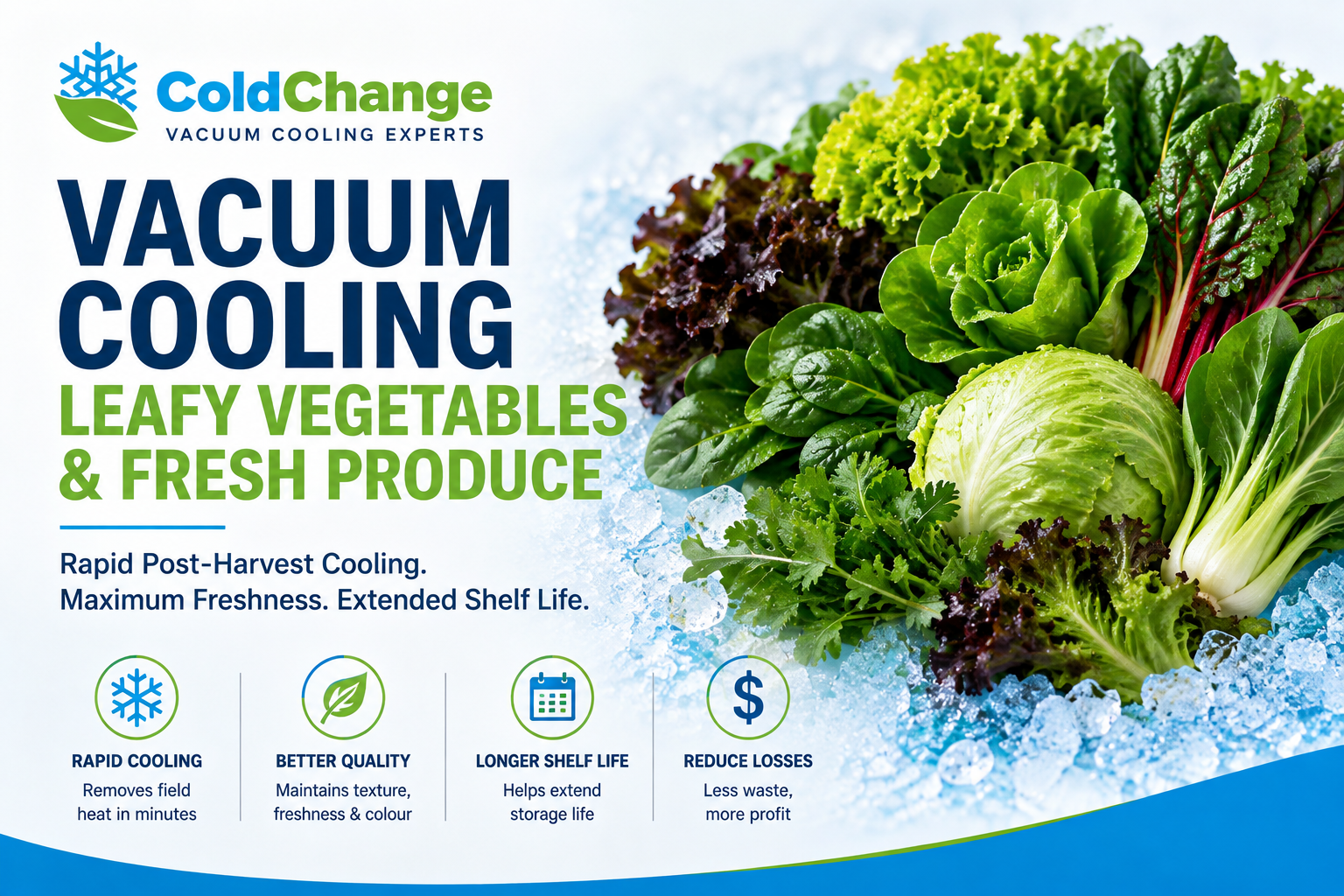
Vacuum cooling leafy vegetables and fresh produce is one of the fastest and most effective ways to remove field heat immediately after harvest.
For commercial growers, farms, packhouses and fresh produce processors, removing field heat as quickly as possible after harvest is one of the most important stages of maintaining an effective cold chain.
Vacuum cooling — also known around the world as vacuum pre-cooling, vacuum precooling, vacuum chilling, vacuum refrigeration, vacuum pre chilling and rapid vacuum cooling — is one of the fastest methods available for reducing the temperature of suitable fresh produce.
The technology is particularly effective for lettuce, leafy vegetables, leafy greens, spinach, herbs, cabbage, broccoli, cauliflower and other porous fresh produce.
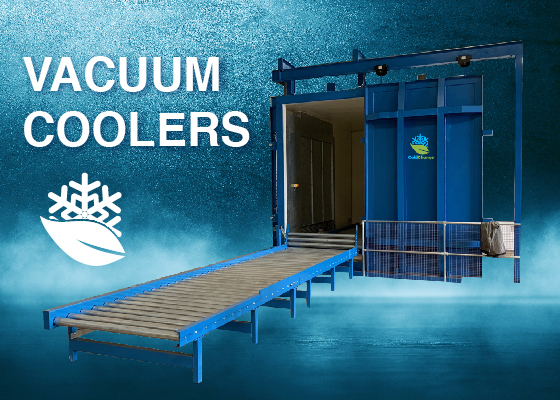
At Cold Change Group, we supply commercial and industrial vacuum cooling systems for fresh produce growers and processors around the world, ranging from compact single-pallet machines to large 20-pallet vacuum cooling systems.
What Is a Vacuum Cooler?
A vacuum cooler is a rapid post-harvest cooling system that removes heat from fresh produce inside a sealed vacuum chamber.
Unlike conventional refrigeration, which relies primarily on cold air transferring heat from the outside of the product, vacuum cooling uses controlled evaporation under reduced atmospheric pressure.
As pressure inside the vacuum chamber decreases, the boiling point of water also decreases.
A small amount of moisture contained within or on the surface of the produce evaporates. This evaporation requires energy, and that energy is removed from the produce as heat.
The result is extremely rapid cooling throughout suitable products.
Explore the complete Cold Change vacuum cooler range.

What Is Vacuum Cooling Called Around the World?
Companies searching for this technology don’t always use the term vacuum cooler.
Depending on the country, industry and application, buyers may search for:
Vacuum cooling system
Vacuum cooling equipment
Vacuum cooling chamber
Vacuum cooling plant
Vacuum precooler
Vacuum pre-cooling system
Vacuum precooling machine
Vacuum chilling machine
Vacuum chilling system
Vacuum refrigeration system
Vegetable vacuum cooler
Lettuce vacuum cooler
Leafy vegetable vacuum cooler
Fresh produce vacuum cooler
Produce pre-cooler
Post-harvest cooler
Rapid cooling system
Rapid produce cooler
Evaporative vacuum cooler
Hydro-vac cooler
Hydro vacuum cooler
Wet vacuum cooler
Although terminology differs, these descriptions can refer to the same fundamental concept: rapidly removing heat using evaporation under reduced atmospheric pressure.
Cold Change specialises in commercial vacuum cooling equipment designed specifically for demanding industrial applications.
Why Is Vacuum Cooling So Effective for Leafy Vegetables?
Leafy vegetables are particularly well suited to vacuum cooling because of their structure and high surface-area-to-mass ratio.
Products such as:
Iceberg lettuce
Romaine lettuce
Cos lettuce
Leaf lettuce
Baby leaf
Spinach
Rocket
Arugula
Watercress
Cabbage
Pak choi
Bok choy
Kale
Swiss chard
Fresh herbs
Celery
Broccoli
Cauliflower
Spring onions
Green onions
Leeks
Asparagus
Brussels sprouts
Sweetcorn
can potentially benefit from rapid post-harvest cooling, depending on the product and processing requirements.
Rather than waiting for refrigerated air to gradually penetrate boxes, pallets and layers of produce, a correctly designed vegetable vacuum cooler can remove heat rapidly throughout the load.
This makes vacuum pre-cooling particularly attractive for high-throughput fresh produce packhouses.
Removing Field Heat Immediately After Harvest
Harvesting doesn’t stop biological activity within fresh produce.
Once crops are removed from the field, temperature becomes one of the most important factors affecting subsequent quality and storage.
Freshly harvested vegetables can arrive at the packhouse carrying significant field heat.
Rapid post-harvest pre-cooling is therefore used to reduce product temperature as quickly as practically possible before refrigerated storage and transportation.
This is one of the principal reasons growers invest in dedicated pre-cooling equipment rather than relying entirely on their cold rooms.
A cold room is excellent at maintaining temperature.
A pre-cooler is designed to remove heat rapidly.
These are two different jobs.
Vacuum Cooling vs Conventional Cold Rooms
Putting warm lettuce or leafy vegetables directly into a cold room does not necessarily mean the centre of the product will cool rapidly.
Heat removal can depend upon:
Air velocity
Packaging
Ventilation
Pallet arrangement
Product density
Starting temperature
Refrigeration capacity
Air distribution
Vacuum cooling works differently.
Inside a vacuum cooling chamber, reduced atmospheric pressure allows evaporative cooling to occur throughout suitable produce.
For large palletised loads, this can provide much faster and more uniform temperature reduction than simply placing warm produce into refrigerated storage.
Vacuum Cooling vs Blast Chilling
Another common method of rapidly reducing product temperature is blast chilling or forced-air cooling.
Cold Change also supplies a complete range of commercial blast chillers for applications where forced-air cooling is more appropriate.
Blast chilling uses high-velocity refrigerated air to remove heat.
Vacuum cooling uses evaporation under reduced pressure.
Neither technology is universally better for every product.
The correct cooling method depends on the crop, packaging, throughput, starting temperature, final temperature, moisture characteristics and processing operation.
For highly suitable leafy products, however, vacuum cooling can achieve exceptionally rapid cooling.
Vacuum Cooling vs Hydro Cooling
Hydro cooling uses chilled water to remove heat from produce.
Cold Change supplies a dedicated range of hydro cooling systems for products where direct chilled-water cooling is appropriate.
Hydro cooling can be particularly effective for certain robust fruits and vegetables.
Vacuum cooling, however, can be advantageous for leafy vegetables because the cooling mechanism occurs throughout suitable produce without requiring the complete product load to be submerged in chilled water.
The best technology should always be selected according to the specific crop and operation.
What Is Hydro-Vacuum Cooling?
You may also encounter the terms hydro-vac, hydro vacuum cooling, wet vacuum cooling or wet vacuum pre-cooling.
A hydro-vacuum system combines vacuum cooling with controlled water addition.
During conventional vacuum cooling, a small quantity of moisture evaporates from the product as part of the cooling process.
For certain products, introducing controlled moisture can help compensate for some of this moisture loss.
This allows growers to combine the speed of vacuum cooling with additional moisture management.
Vacuum Cooling Lettuce
Lettuce is one of the products most closely associated with commercial vacuum cooling.
Iceberg lettuce, cos lettuce, romaine lettuce and other leafy varieties can contain considerable field heat when harvested during warm conditions.
Rapid cooling before storage and transportation can therefore form an important part of maintaining product quality.
For growers producing large quantities of lettuce, a dedicated lettuce vacuum cooler can process entire pallet loads rather than relying on gradual cooling inside a cold room.
Cold Change supplies systems ranging from a single pallet vacuum cooler for smaller operations through to large multi-pallet systems for industrial packhouses.
Vacuum Cooling Spinach, Baby Leaf and Salad Crops
Spinach, baby leaf, rocket, watercress and mixed salad crops are highly temperature-sensitive products.
Once harvested, establishing the cold chain quickly can be extremely important.
A correctly selected leafy greens vacuum cooler can rapidly reduce temperature before the produce moves into cold storage, packing, distribution or refrigerated transportation.
This makes vacuum cooling particularly relevant to growers supplying:
Supermarkets, salad processors, wholesalers, foodservice companies, fresh-cut processors and export markets.
Vacuum Cooling Broccoli and Cauliflower
Vacuum cooling isn’t limited to lettuce.
Broccoli and cauliflower are also important fresh produce applications where rapid post-harvest temperature reduction can be beneficial.
Cold Change vacuum cooling equipment is designed for a wide range of vegetable applications and can be customised around product weight, pallet arrangement and required throughput.
Growers handling multiple crops can therefore potentially use the same industrial vacuum cooling system across several suitable product lines.
Vacuum Cooling Mushrooms
Mushrooms are another major commercial application for vacuum cooling.
Because mushrooms can deteriorate quickly after harvesting, rapid temperature reduction can be particularly valuable.
If mushrooms form part of your operation, see our dedicated guide to vacuum cooling mushrooms in the Cold Change News & Insights section.
Our vacuum cooler range can be configured for mushrooms as well as leafy vegetables and other suitable products.
What Size Vacuum Cooler Do I Need?
This is one of the most important questions when selecting a commercial vacuum cooler.
Cold Change offers equipment ranging from small systems for individual pallet loads through to large industrial machines.
Single Pallet Vacuum Cooler
For smaller growers, research facilities, specialist producers and lower-volume operations, our Single Pallet Vacuum Cooler provides a compact entry into commercial vacuum cooling.
2 Pallet Vacuum Cooler
A 2 pallet vacuum cooler can provide additional throughput while retaining a relatively compact footprint.
Explore our complete vacuum cooling equipment range for available configurations.
4 Pallet Vacuum Cooler
Our 4 Pallet Vacuum Cooler is designed for commercial growers requiring increased batch capacity.
6 Pallet Vacuum Cooler
A 6 pallet vacuum cooler provides a further step in production capacity for expanding packhouses.
8 Pallet Vacuum Cooler
The Cold Change 8 Pallet Vacuum Cooler is designed for larger commercial applications and high-volume fresh produce operations.
10 Pallet Vacuum Cooler
For substantial commercial packhouses, our 10 Pallet Vacuum Cooler provides increased batch capacity for vegetables, flowers and other suitable products.
12–18 Pallet Vacuum Cooling Systems
Cold Change also manufactures larger 12 pallet, 14 pallet, 16 pallet and 18 pallet vacuum cooling systems.
These machines are intended for high-throughput operations where cooling capacity must match large harvesting and packing volumes.
View all available sizes in our industrial vacuum cooler range.
20 Pallet Vacuum Cooler
At the larger end of the range, the 20 Pallet Vacuum Cooler provides substantial batch capacity for large commercial growers and processors.
Cold Change also offers a 20 Pallet Eco Vacuum Cooler for customers particularly focused on energy-efficient large-scale cooling.
Choosing Vacuum Cooler Capacity by Tonnes per Hour
The number of pallets that fit inside the chamber is only part of the calculation.
A commercial vacuum cooling machine should ideally be selected around your actual production requirements.
Important factors include:
Product type
Kilograms per pallet
Number of pallets per batch
Incoming product temperature
Required final temperature
Required cooling time
Loading time
Unloading time
Cycles per hour
Tonnes per hour
Daily operating hours
Harvest peaks
Future production growth
For example, two 10-pallet operations can have completely different cooling requirements if one loads 250 kg per pallet and another loads 700 kg per pallet.
This is why Cold Change can provide customised vacuum cooling solutions rather than simply supplying equipment according to chamber capacity.
How Long Does Vacuum Cooling Take?
There isn’t one universal vacuum cooling time.
Cycle duration depends on:
Product
Starting temperature
Target temperature
Product weight
Pallet density
Packaging
Moisture content
Vacuum pump capacity
Refrigeration capacity
System design
Cold Change’s current commercial vacuum cooler range quotes typical cooling times of approximately 8–25 minutes depending on product weight and temperature.
The machine should therefore be engineered around the required process rather than selecting a vacuum chamber based purely on physical dimensions.
Vacuum Cooling and Shelf Life
Temperature management is fundamental to the fresh produce cold chain.
Rapid removal of field heat can help slow deterioration and support the maintenance of product quality during subsequent storage and transportation.
For growers supplying distant customers, every additional day of usable product life can have commercial value.
Effective vacuum pre-cooling can form the first stage of a properly managed cold chain involving:
Rapid pre-cooling → refrigerated storage → refrigerated transportation → controlled retail/storage conditions.
Learn more about Cold Change’s complete range of cold-chain and pre-cooling equipment.
Vacuum Cooling for Export Produce
Export growers face an additional challenge: time and distance.
Fresh produce may travel hundreds or thousands of kilometres before reaching the consumer.
This makes rapid temperature reduction immediately after harvesting particularly important.
Cold Change supplies vacuum cooling machines internationally for growers, packhouses and food processors.
Our systems can be designed for applications throughout:
United Kingdom
Ireland
Europe
Australia
New Zealand
United States
Canada
South America
Africa
Middle East
Asia
For growers searching for a vacuum cooler Australia, vacuum cooler New Zealand, vacuum cooler UK, vacuum cooler Europe, vacuum cooler USA or an international vacuum cooling supplier, Cold Change can provide systems for worldwide projects.
Vacuum Cooler for Sale – What Should You Look For?
Searching online for a vacuum cooler for sale can produce equipment with very different specifications.
Price alone doesn’t tell you whether a machine is suitable for your operation.
A commercial system should be assessed according to:
Vacuum pump performance
Refrigeration capacity
Vacuum chamber construction
Cooling performance
Cycle time
Energy consumption
Automation
Door system
Conveyor system
PLC controls
Temperature monitoring
Remote access
Serviceability
Spare parts availability
Technical support
Explore Cold Change vacuum coolers for sale to see our available equipment.
How Much Does a Vacuum Cooler Cost?
There isn’t one standard vacuum cooler price.
A single-pallet machine and a 20-pallet industrial vacuum cooling plant are fundamentally different pieces of equipment.
Cost can be affected by:
Chamber dimensions
Pallet capacity
Vacuum pump configuration
Refrigeration capacity
Condenser specification
Door configuration
Conveyors
Automation
Electrical specification
Refrigerant
Remote monitoring
Shipping requirements
Installation requirements
Instead of considering purchase price alone, commercial growers should also consider cost per pallet, cost per tonne, energy consumption, throughput, maintenance and expected machine life.
View our vacuum cooling systems or contact Cold Change for a system selected around your application.
Vacuum Cooler Manufacturer & Supplier
Choosing a vacuum cooler manufacturer or vacuum cooling equipment supplier is an important long-term decision.
For many growers, the vacuum cooler becomes one of the most important machines in the packhouse during harvesting.
Reliability matters.
Cold Change focuses on complete cold-chain solutions including:
and other Cold Chain Products.
This allows the cooling method to be selected according to the product rather than attempting to use one technology for every application.
Frequently Asked Questions About Vacuum Cooling
What is the best way to cool leafy vegetables after harvest?
The most appropriate method depends on the crop and operation. For many suitable leafy vegetables, vacuum cooling can provide extremely rapid post-harvest temperature reduction.
Is vacuum cooling suitable for lettuce?
Yes. Lettuce is one of the best-known commercial applications for vacuum cooling.
Is vacuum cooling the same as vacuum pre-cooling?
The terms vacuum cooling, vacuum pre-cooling, vacuum precooling and vacuum pre cooling are commonly used to describe the same fundamental cooling process when used after harvesting.
Is a vacuum cooler the same as a vacuum chiller?
The terms vacuum cooler and vacuum chiller are often used interchangeably in international searches for this technology.
What products can be vacuum cooled?
Potential applications include lettuce, leafy greens, spinach, watercress, herbs, broccoli, cauliflower, cabbage, celery, leeks, green onions, asparagus, sweetcorn, mushrooms, flowers, turf and bakery products, depending on the characteristics of the product and process.
Can palletised vegetables be vacuum cooled?
Yes. Commercial pallet vacuum coolers are specifically designed to process palletised loads.
Cold Change supplies systems ranging from a single pallet vacuum cooler through to a 20 pallet vacuum cooling system.
What size vacuum cooler should I buy?
Machine capacity should be selected according to product type, kilograms per pallet, pallets per batch, incoming temperature, final temperature, desired cycle time and required tonnes per hour.
Where can I buy a commercial vacuum cooler?
Cold Change supplies industrial vacuum coolers for sale for growers, packhouses and food processors internationally.
Find the Right Vacuum Cooling System for Your Produce
Whether you grow lettuce, leafy vegetables, spinach, herbs, broccoli, cauliflower, cabbage, mushrooms or other suitable fresh produce, the correct pre-cooling system should be selected around your individual operation.
Cold Change supplies systems from compact single pallet vacuum coolers through 4 pallet, 8 pallet and 10 palletsystems to large 20 pallet vacuum coolers.
You can also explore our complete Vacuum Cooling Range, our wider Pre-Cooling Equipment or visit Cold Change Group.
Looking for a vacuum cooler for your operation?
Click the link Get a Quote Tell us:
What product you are cooling
Your starting temperature
Your required final temperature
Kilograms per pallet
Number of pallets per hour
Daily production volume
and Cold Change can help determine the most appropriate vacuum cooler, vacuum chiller or vacuum pre-cooling system for your application.
Check out our youtube channel Cold Change


