
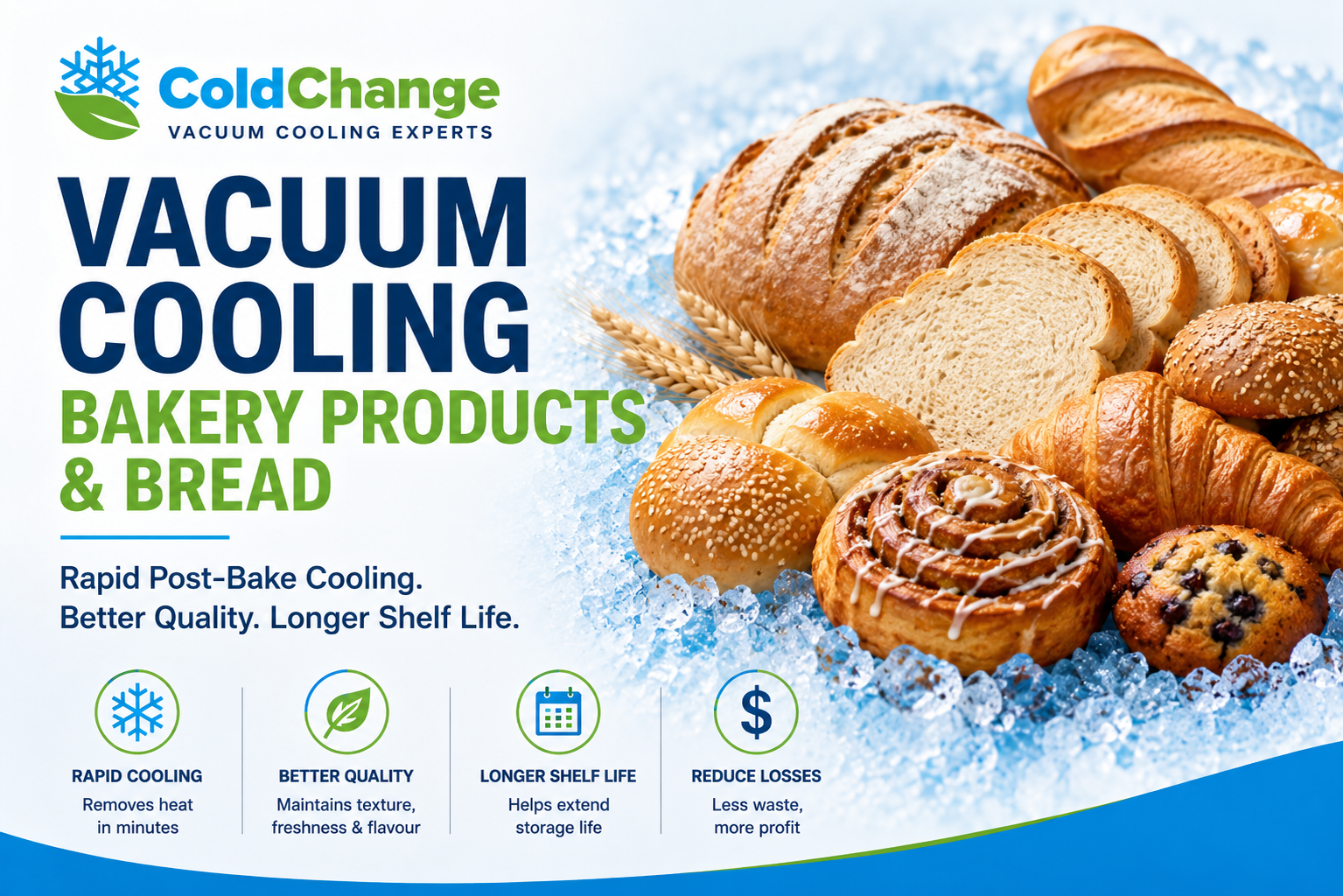
Bakery Vacuum Cooling – The Complete Guide to Rapid Cooling Bread & Bakery Products
Bakery vacuum cooling is transforming the way commercial and industrial bakeries cool bread, rolls, buns, cakes, pastries and other baked products after they leave the oven.
Traditional bakery cooling can take considerable time and require large cooling conveyors, racks or spiral cooling systems. A bakery vacuum cooler provides a completely different approach. By reducing pressure inside a sealed vacuum chamber, moisture within the hot bakery product can evaporate at a lower temperature, rapidly removing heat from the product.
For high-output bakeries, vacuum cooling bakery products can significantly reduce cooling times, increase production throughput and reduce the amount of factory floor space required for conventional cooling.
Cold Change Group supplies industrial bakery vacuum cooling systems ranging from compact single-trolley machines to larger multi-trolley vacuum coolers for high-volume bakery production.
What Is Bakery Vacuum Cooling?
Bakery vacuum cooling is a rapid evaporative cooling process specifically suited to many hot, moisture-containing bakery products.
Freshly baked products are loaded into a stainless steel vacuum cooling chamber, normally while still positioned on bakery trays or trolleys.
The chamber door closes and powerful vacuum pumps begin reducing the pressure inside the chamber.
Reducing pressure lowers the boiling point of water. A controlled quantity of moisture within the hot bakery product begins to evaporate at a much lower temperature than it would under normal atmospheric conditions.
Evaporation requires energy. That energy is removed from the bakery product in the form of heat, causing its temperature to fall rapidly.
This is the principle behind vacuum cooling bread and bakery products.
Rather than waiting for cold air to gradually remove heat from the outside of the product, vacuum cooling uses controlled evaporation to achieve rapid cooling throughout the product.
Why Are Bakeries Using Vacuum Cooling?
Cooling can become one of the largest bottlenecks in an industrial bakery.
Bread and other baked products normally need to reach an appropriate temperature before they can proceed to processes such as:
-
Slicing
-
Filling
-
Decorating
-
Handling
-
Wrapping
-
Packaging
-
Storage
-
Distribution
Traditional bread cooling systems can therefore occupy significant production time and factory floor space.
The American Society of Baking describes vacuum cooling as a rapid alternative to conventional atmospheric cooling and notes that high-speed bakeries can benefit from shorter cycle times and more efficient use of production-floor space.
For bakeries trying to increase production without substantially increasing the size of their facility, an industrial bakery vacuum cooler can therefore provide an interesting alternative to conventional cooling.
How Fast Can Vacuum Cooling Cool Bread?
One of the biggest reasons manufacturers investigate vacuum cooling for bread is speed.
The American Society of Baking gives an illustrative comparison in which cooling from approximately 100°C to 30°C can be achieved in around 3–6 minutes using vacuum cooling, while conventional cooling of a one-pound loaf can require around 60 minutes.
Actual cooling times will vary according to bread type, product dimensions, recipe, moisture content, load, starting temperature, target temperature and vacuum-cooling programme.
The important point is that rapid bread cooling can potentially turn a lengthy production stage into a process measured in minutes rather than tens of minutes or hours.
Vacuum Cooling Bread
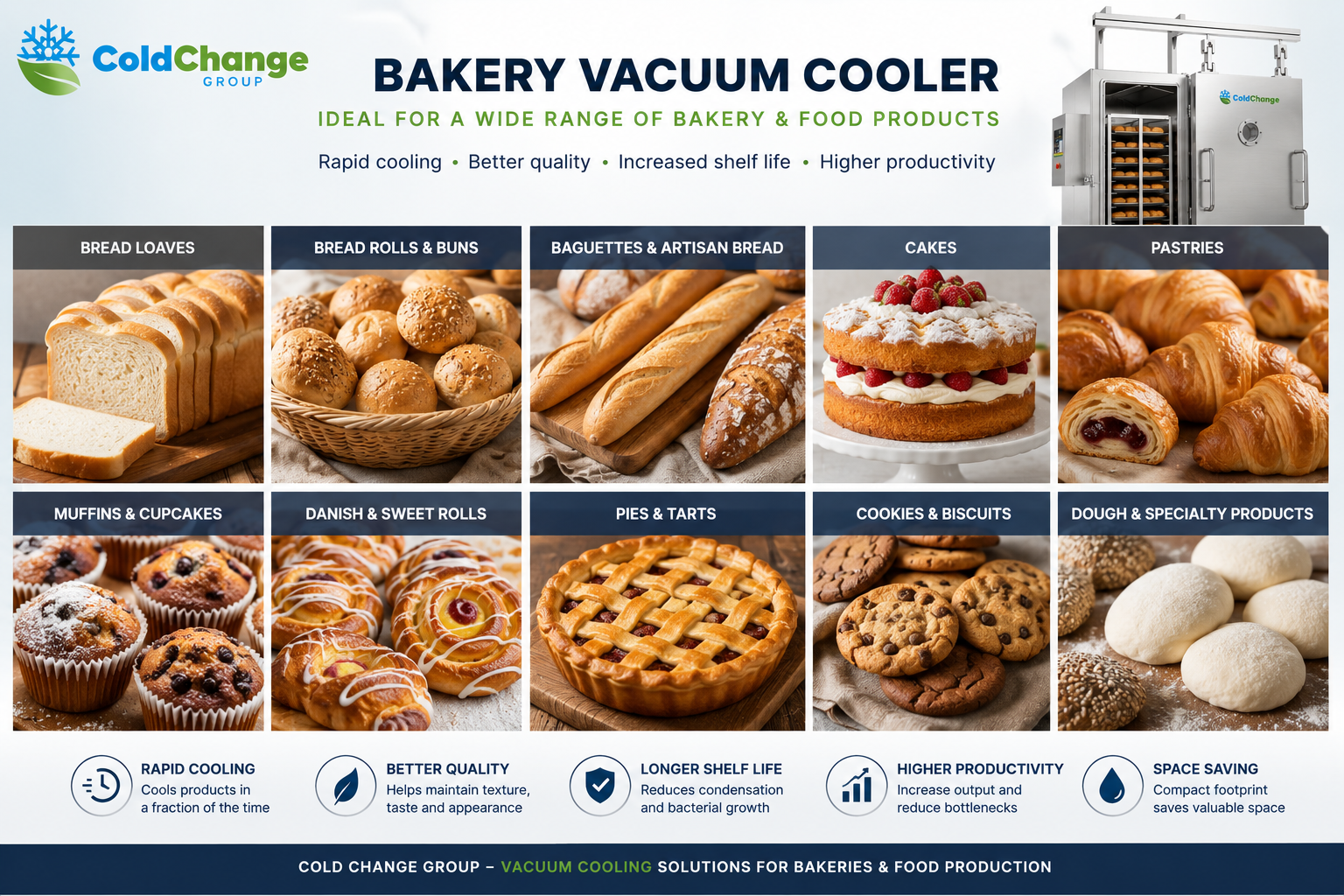
Vacuum cooling bread is one of the most established bakery applications for this technology.
Fresh bread contains significant heat and moisture when it leaves the oven. Before many breads can be sliced and packaged, that heat needs to be removed.
A bread vacuum cooler can rapidly reduce the temperature of the product while it remains on its bakery trays or trolley.
Applications can include:
-
White bread
-
Brown bread
-
Wholemeal bread
-
Toast bread
-
Sandwich bread
-
Artisan bread
-
Sourdough
-
Baguettes
-
Bread rolls
-
Hamburger buns
-
Hot dog rolls
-
Brioche
-
Ciabatta
-
Other commercial bread products
Academic research into toast bread has found that vacuum cooling can dramatically shorten cooling time when the baking and vacuum-cooling process is properly optimised.
Vacuum Cooling Bread Rolls and Buns
Vacuum cooling bread rolls and buns can be particularly attractive for high-output industrial production.
Large commercial bakeries may manufacture thousands of rolls or buns every hour. A conventional cooling stage can therefore require extensive conveyors or spiral cooling equipment.
A commercial bakery vacuum cooler allows multiple trays of products to be placed on bakery trolleys and cooled as a batch.
Products such as burger buns, sandwich rolls, dinner rolls, brioche buns and similar baked goods can therefore potentially move through the cooling stage considerably faster.
Vacuum Cooling Cakes and Muffins
Bread isn’t the only potential application for bakery vacuum cooling technology.
Vacuum cooling has also been investigated and used with products including cakes and muffins.
The exact vacuum programme needs to be matched to the characteristics of the product because different bakery products contain different levels of moisture and have different structures.
This is why selecting a vacuum cooler for bakery production should involve understanding the actual product rather than simply selecting a machine based on trolley capacity.
Vacuum Cooling Pastries and Croissants
Laminated bakery products are another important application.
Research into vacuum cooling bakery products has specifically considered laminated pastries alongside sandwich bread and cake.
Potential products include:
-
Croissants
-
Danish pastries
-
Puff pastry
-
Pastry products
-
Filled pastries
-
Pies
-
Other laminated bakery products
The vacuum pressure profile and cooling programme should be configured around the individual product to achieve the required cooling performance.
Vacuum Cooler vs Traditional Bread Cooling
Conventional bakery cooling generally relies on transferring heat from the product into the surrounding air.
This can involve cooling racks, conveyors, cooling tunnels or large spiral cooling systems.
Vacuum cooling works differently because a significant proportion of the cooling effect is produced through evaporation under reduced pressure.
For an industrial bakery, the potential difference can be substantial.
Conventional Bakery Cooling
Traditional cooling can require:
-
Long cooling periods
-
Large conveyor systems
-
Extensive floor space
-
Spiral cooling equipment
-
Significant product residence time
-
Large cooling areas
Vacuum Cooling
A bakery vacuum cooling system can potentially provide:
-
Rapid cooling cycles
-
Compact equipment footprint
-
Batch trolley loading
-
Programmable cooling recipes
-
Repeatable process control
-
Faster transfer to subsequent production stages
-
Increased production throughput
For businesses where cooling is restricting output, replacing or supplementing a conventional bread cooling system with vacuum technology can potentially release additional production capacity.
Vacuum Cooler vs Spiral Cooler
The comparison between a bakery vacuum cooler and spiral cooler is particularly interesting for industrial bakeries.
Spiral cooling systems allow continuous production but can require a substantial amount of factory space.
A vacuum cooler concentrates the cooling operation inside a comparatively compact chamber.
The American Society of Baking gives an example comparing approximately 20 m² of vacuum cooling equipment with around 300 m² for a traditional spiral tower, although actual equipment footprints depend on the required capacity and installation.
This means floor-space savings can become an important consideration when evaluating vacuum cooling vs spiral cooling.
For bakeries operating from expensive or restricted production facilities, freeing up factory space can be almost as valuable as reducing cooling time.
Can Vacuum Cooling Increase Bakery Production?
Potentially, yes.
If cooling is currently the bottleneck within a production line, reducing the cooling cycle can allow products to move more quickly from the oven to slicing, packaging or another production stage.
This can potentially increase overall bakery throughput without requiring an equivalent expansion of conventional cooling equipment.
The benefit depends on the entire production line.
For example, increasing cooling capacity will have limited value if packaging subsequently becomes the new bottleneck.
Cold Change Group therefore recommends considering bakery vacuum cooling equipment as part of the complete production process rather than simply looking at cooling time in isolation.
Does Vacuum Cooling Affect Bread Quality?
Vacuum cooling parameters need to be correctly matched to the bakery product.
Academic research has shown considerable potential for vacuum cooling to reduce cooling times and influence characteristics such as bread volume. However, researchers also emphasise the importance of adjusting the baking process to compensate for moisture loss during vacuum cooling.
This is important.
A professional industrial bread vacuum cooler shouldn’t simply pull the deepest possible vacuum as quickly as possible.
The process needs controlled vacuum pressure, temperature monitoring and an appropriate cooling recipe for the particular bread or bakery product.
Different products may require different programmes.
Commercial Bakery Vacuum Cooler
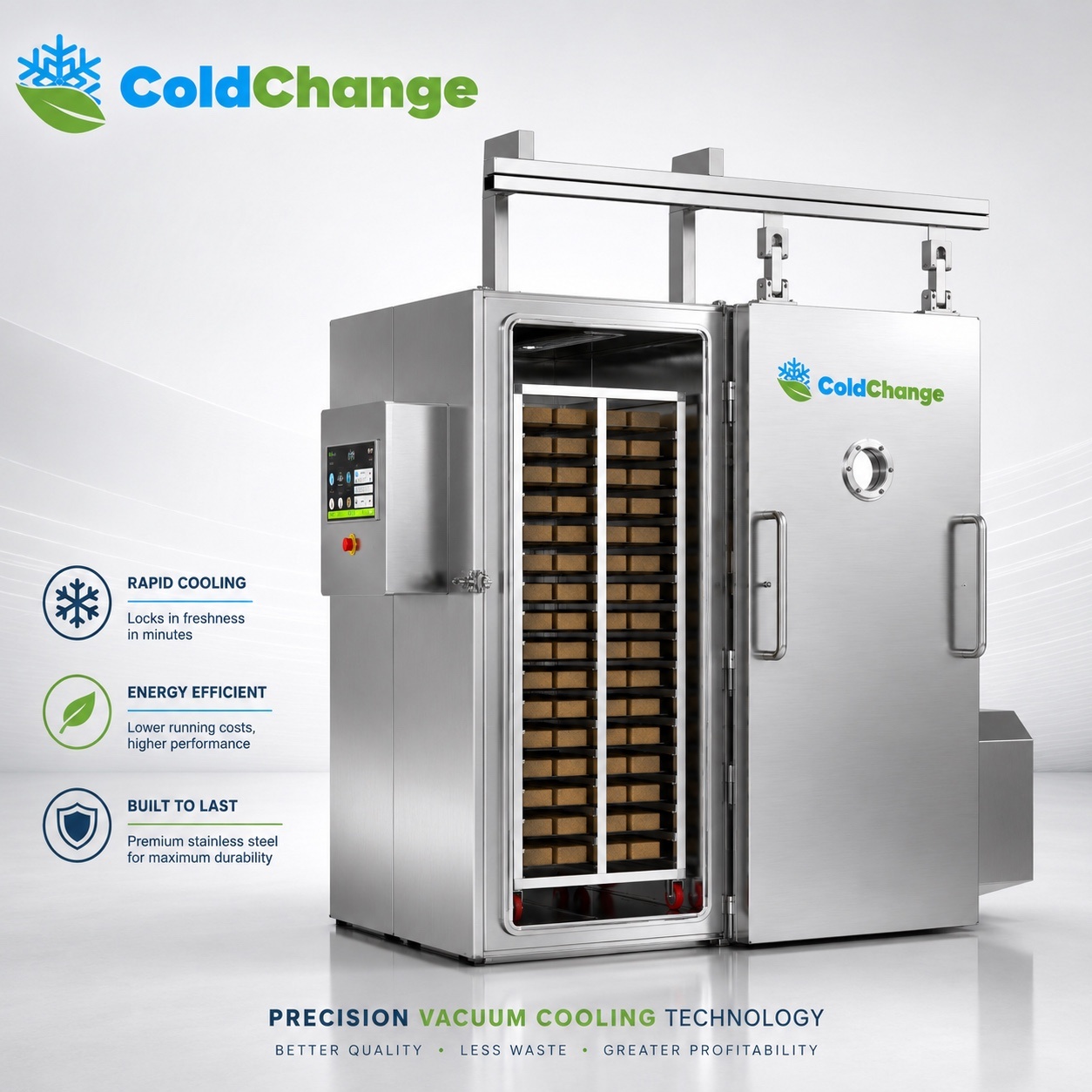
A commercial bakery vacuum cooler typically consists of:
-
Stainless steel vacuum chamber
-
Heavy-duty vacuum pumps
-
Vapour-management or condensing system
-
Refrigeration system where required
-
Temperature sensors
-
Vacuum pressure measurement
-
PLC control system
-
Touchscreen operator interface
-
Programmable cooling cycles
-
Safety systems
-
Bakery trolley or rack loading area
Industrial machines can then be configured according to the number and dimensions of bakery trolleys required per cycle.
Single Trolley Bakery Vacuum Cooler
For smaller and medium production requirements, Cold Change Group offers the Single Trolley Bakery Vacuum Cooler.
One complete bakery trolley can be loaded directly into the stainless steel vacuum chamber.
This configuration is particularly useful for bakeries wanting to introduce vacuum cooling without requiring the capacity of a larger two-trolley system.
View the Bakery Vacuum Cooler – Single Trolley
2 Trolley Bakery Vacuum Cooler
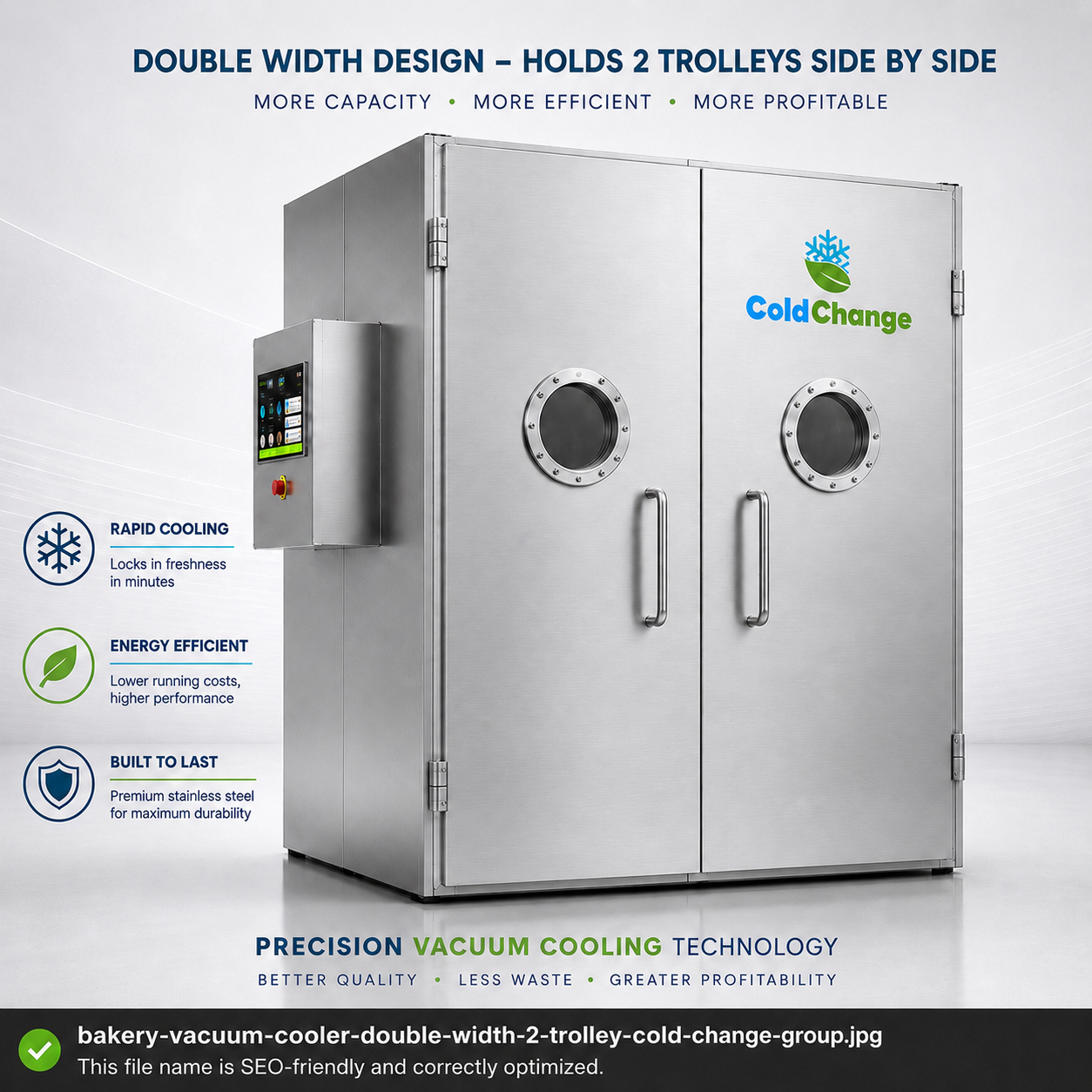
For larger production requirements, Cold Change Group offers the Bakery Vacuum Cooler – 2 Trolley.
The double-width chamber accommodates two bakery trolleys positioned side by side, increasing the quantity of bakery products that can be processed during each vacuum cooling cycle.
This makes the machine particularly suitable for industrial bakeries requiring higher batch capacity and increased production throughput.
View the Bakery Vacuum Cooler – 2 Trolley
Which Vacuum Cooler Do I Need?
The correct bakery vacuum cooler depends on the production process.
Before selecting a machine, consider:
-
Bakery product type
-
Product dimensions
-
Product weight
-
Bakery trolley dimensions
-
Number of trays per trolley
-
Product weight per trolley
-
Oven output
-
Starting product temperature
-
Required final temperature
-
Desired cooling time
-
Number of trolleys produced per hour
-
Daily operating hours
-
Future production growth
Cold Change Group can use this information to determine whether a single trolley bakery vacuum cooler, 2 trolley bakery vacuum cooler or a larger customised industrial system is appropriate.
Benefits Vacuum Cooling
The potential advantages of a correctly specified bakery vacuum cooling system include:
Faster Cooling
Rapidly reduce bakery product temperatures compared with many conventional ambient cooling methods.
Increased Production Throughput
Shorter cooling cycles can allow products to reach subsequent manufacturing stages sooner.
Reduced Factory Floor Space
Compact vacuum chambers may reduce the requirement for lengthy cooling conveyors or large spiral cooling systems.
Controlled Cooling
PLC-controlled vacuum and temperature programmes provide repeatable cooling cycles.
Trolley Loading
Industrial bakery racks and trolleys can be loaded directly into appropriately designed vacuum chambers.
Flexible Applications
Vacuum cooling can be considered for bread, rolls, buns, pastries, cakes, muffins and numerous other bakery products.
Scalable Capacity
Machines can be configured around one trolley, two trolleys or larger production requirements.
Is Vacuum Cooling Energy Efficient?
Energy consumption needs to be assessed against the complete production process.
A vacuum cooling system requires electrical energy to operate vacuum pumps, controls and associated cooling equipment.
However, bakeries should compare this with the energy requirements of their existing cooling system, required cooling time, production footprint and potential improvements in throughput.
For this reason, bakery vacuum cooler energy efficiency should be evaluated on an application-specific basis rather than using a single universal figure.
Bakery Vacuum Cooling for Industrial Bakeries
Industrial bakeries typically have very different requirements from small craft bakeries.
High-volume manufacturers may operate continuously and require cooling equipment capable of keeping pace with oven output.
A suitable industrial bakery cooling system therefore needs to consider:
-
Hourly production capacity
-
Trolley movement
-
Batch timing
-
Vacuum cycle duration
-
Door opening and loading time
-
Production scheduling
-
Cleaning requirements
-
Maintenance access
-
Equipment redundancy
-
Future expansion
Cold Change Group can configure vacuum cooling equipment around these production requirements.
Bakery Vacuum Cooler Price
The price of a bakery vacuum cooler depends on the required chamber size, number of trolleys, vacuum system, refrigeration configuration, controls and customer-specific requirements.
For this reason, the best way to obtain an accurate bakery vacuum cooler price is to provide information about your existing bakery production process.
If you’re searching for a bakery vacuum cooler for sale, send Cold Change Group your trolley dimensions, product type, batch weight, starting temperature, target temperature and required production capacity.
Click Here to Get a Bakery Vacuum Cooler Quote
Bakery Vacuum Cooling FAQs
What is a bakery vacuum cooler?
A bakery vacuum cooler is a machine that cools hot bakery products by reducing pressure inside a sealed chamber, encouraging controlled moisture evaporation and rapid heat removal.
Can you vacuum cool bread?
Yes. Vacuum cooling bread is an established industrial application and can significantly reduce cooling time when the baking and vacuum-cooling process is properly configured.
What bakery products can be vacuum cooled?
Potential applications include bread, rolls, buns, baguettes, croissants, pastries, cakes, muffins and other baked products. Suitability and operating parameters depend on the individual product.
How long does vacuum cooling bread take?
Cooling time varies according to the product and process. Industry guidance from the American Society of Baking gives an example of cooling from approximately 100°C to 30°C in around 3–6 minutes using vacuum cooling.
Can vacuum cooling replace a spiral cooler?
For some bakery processes it may provide an alternative to conventional spiral cooling. The correct solution depends on production capacity, product type, factory layout and whether batch or continuous processing is required.
What size bakery vacuum cooler do I need?
Cold Change Group offers single trolley and 2 trolley bakery vacuum coolers, with larger systems available according to production requirements.
Vacuum Coolers from Cold Change Group
Cold Change Group supplies bakery vacuum coolers, bread vacuum cooling systems, industrial vacuum coolers and commercial bakery cooling equipment for customers worldwide.
Whether you are investigating vacuum cooling bread, replacing an existing bread cooling system, reducing reliance on a spiral cooler or increasing the production capacity of an industrial bakery, we can help identify an appropriate vacuum cooling solution.
Explore our:
Bakery Vacuum Cooler – Single Trolley
Bakery Vacuum Cooler – 2 Trolley
Or tell us about your bakery production requirements:
Cold Change Group – industrial vacuum cooling technology for modern bakery production The American Society of Baking provides further technical information about the use of vacuum cooling in commercial bakery production, including its potential to reduce cooling cycle times and the amount of production floor space required for cooling.


