From a Small Italian Island to Australia
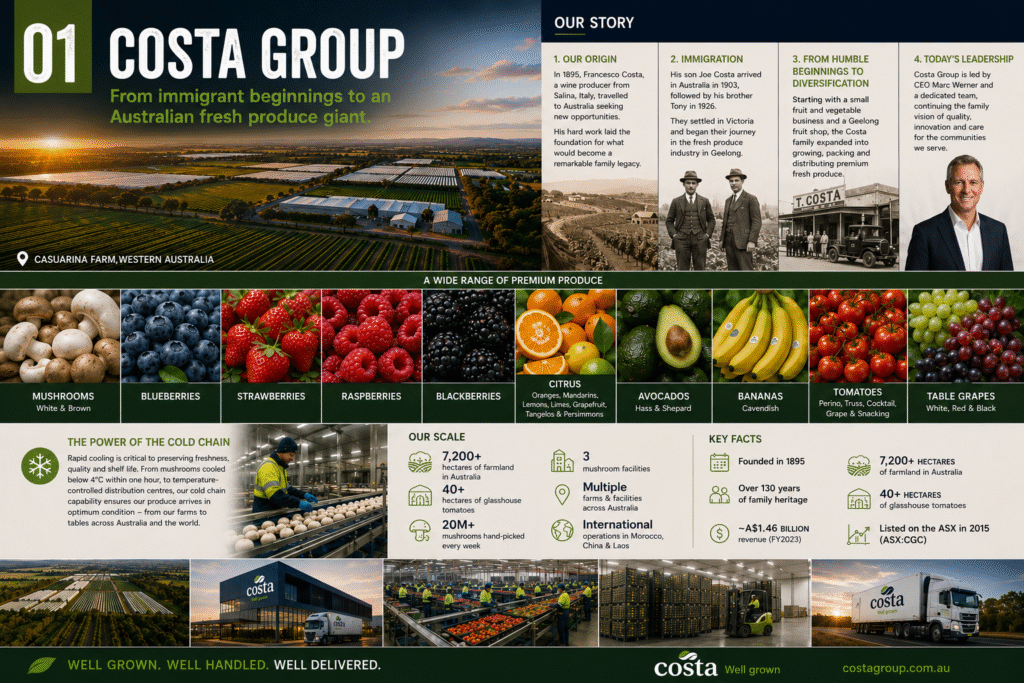
The story of Costa Group stretches back more than 130 years and begins thousands of kilometres from the Australian farms that carry the Costa name today. In 1895, Francesco Costa, a wine producer from the Italian island of Salina, travelled to Australia with the intention of earning money to invest back into his vineyard. He worked in Melbourne, Colac and Geelong before eventually returning to Italy, but the connection he established with Australia would change the future of the Costa family.
Francesco’s son Joe Costa arrived in Australia in 1903, followed by his brother Tony Costa in 1926. The family established itself in Victoria and became involved in the fruit and vegetable trade in Geelong. Tony and his wife Mary eventually became owners of a fruit shop, and their sons Frank and Adrian Costa would go on to play important roles in expanding the family enterprise. What began as a relatively modest fresh-produce business gradually developed through successive generations into something considerably larger.
The Costa family expanded beyond retail and wholesaling and moved increasingly into growing, packing, marketing and distributing fresh produce. Over the decades, the company built farming operations across some of Australia’s most important horticultural regions while developing the infrastructure required to supply major retailers consistently throughout the year.
From a Fruit Shop to Farms Across Australia
Today, the Costa name is associated with an extraordinary variety of fresh produce. Its portfolio includes mushrooms, blueberries, strawberries, raspberries, blackberries, oranges, mandarins, lemons, limes, grapefruit, tangelos, persimmons, avocados, bananas, tomatoes and table grapes. Its operations have also extended internationally, particularly through berry growing and genetics in markets including Morocco and China.
The scale of that transformation is remarkable. Immediately before Costa returned to private ownership in 2024, company reporting showed approximately 7,200 planted hectares of farmland in Australia, together with around 40 hectares of advanced glasshouse production and three major mushroom-growing facilities. Its citrus and grape operations alone represented thousands of hectares of production, while avocado, banana, berry and tomato farms added further scale.
The company’s tomato operation at Guyra in New South Wales demonstrates how technologically advanced the business became. Around 40 hectares of glasshouses provide the capacity to produce approximately 20 million kilograms of tomatoes annually, allowing growing conditions to be carefully controlled rather than relying entirely on the external environment.
Costa’s mushroom business is similarly impressive. The company describes itself as the largest mushroom grower in the Southern Hemisphere, with more than 20 million mushrooms hand-picked every week. At that level of production, growing the crop is only one part of the challenge; harvesting, cooling, packing and transporting it efficiently become equally important.
Protecting Freshness Through the Cold Chain
One of the important lessons from Costa’s success is that investment didn’t stop at the farm gate. As production expanded and products travelled greater distances, post-harvest cooling, refrigerated storage and temperature-controlled distribution became essential parts of protecting product quality and shelf life.
Mushrooms provide an excellent example. They are highly perishable and continue to respire rapidly after harvesting, meaning temperature management needs to begin almost immediately. Costa states that its mushrooms are hand-picked at peak freshness and rapidly cooled to below 4°C within approximately one hour, before being dispatched from the farm within 24 hours.
This demonstrates an important principle for the wider fresh-produce industry: the cold chain begins at harvest, not when the product reaches the supermarket distribution centre. Months of work and investment can go into producing a premium crop, but that value can quickly be reduced if field heat isn’t removed and the correct temperature maintained afterwards.
Different crops require different cooling solutions. Depending on the product, growers can use refrigerated rooms, forced-air cooling, hydrocooling and technologies such as vacuum cooling, which can be particularly effective for rapidly and uniformly removing heat from suitable fresh produce. The objective is always similar: bring the product to its optimum post-harvest temperature as quickly as practical and then maintain the appropriate conditions through packing, transport and retail.
Costa’s investment in growing technology, packing facilities and temperature-controlled distribution shows how modern horticulture has become a combination of agriculture, engineering, refrigeration and logistics. At the scale Costa operates, those systems need to work together.
From Family Business to Billion-Dollar Company
Costa’s growth eventually took the family business onto the Australian stock market. Costa Group Holdings Limited listed on the Australian Securities Exchange in July 2015, providing a platform for further investment and expansion. Between its listing and 2023, Costa reported that it had approximately doubled its planted hectares of Australian farmland and glasshouse facilities while expanding major operations including citrus and international berries.
By its final full financial year before returning to private ownership, Costa had reached a scale that Francesco Costa could scarcely have imagined. For the year ending December 2023, the company reported approximately A$1.46 billion in total revenue, demonstrating how a family fresh-produce enterprise had evolved into a billion-dollar international horticultural business.
Another major change came in February 2024, when Costa was acquired by a consortium led by Paine Schwartz Partners, alongside Driscoll’s and British Columbia Investment Management Corporation. The transaction valued Costa at around A$1.5–1.6 billion, and the company was subsequently removed from the ASX and returned to private ownership.
Today, Costa is led by Chief Executive Officer Marc Werner, who took over as CEO in March 2024 after previously serving as the company’s Group Chief Operating Officer and Deputy CEO. Although ownership and leadership have changed considerably since the early Costa family years, the business remains one of the most significant names in Australian horticulture.
More Than 130 Years of Growth
Perhaps the most impressive part of the Costa story is the distance between where it began and what it eventually became. In 1895, Francesco Costa travelled from the small Italian island of Salina to Australia looking for opportunity. His sons followed, the family established itself in Victoria’s fruit and vegetable trade, and successive generations progressively expanded into farming, packing, distribution and international horticulture.
More than a century later, that journey has resulted in thousands of hectares of Australian farmland, enormous glasshouses, major mushroom-growing facilities, international berry operations and annual revenues that surpassed A$1.4 billion before the company returned to private ownership.
Costa’s success also demonstrates how the definition of a successful grower has changed. Modern horticulture isn’t simply about producing more fruit and vegetables. The leading businesses increasingly control and optimise the entire journey: growing, harvesting, rapid cooling, packing, refrigeration, logistics and distribution.
For highly perishable fresh produce, that final point is particularly important. Growing an exceptional crop creates value; protecting its freshness after harvest preserves that value until it reaches the consumer.
From an Italian family’s first connection with Australia in the nineteenth century to one of the country’s largest fresh-produce businesses, Costa Group is an extraordinary Australian agricultural success story.
Visit Costa Group →
Costa Group official website
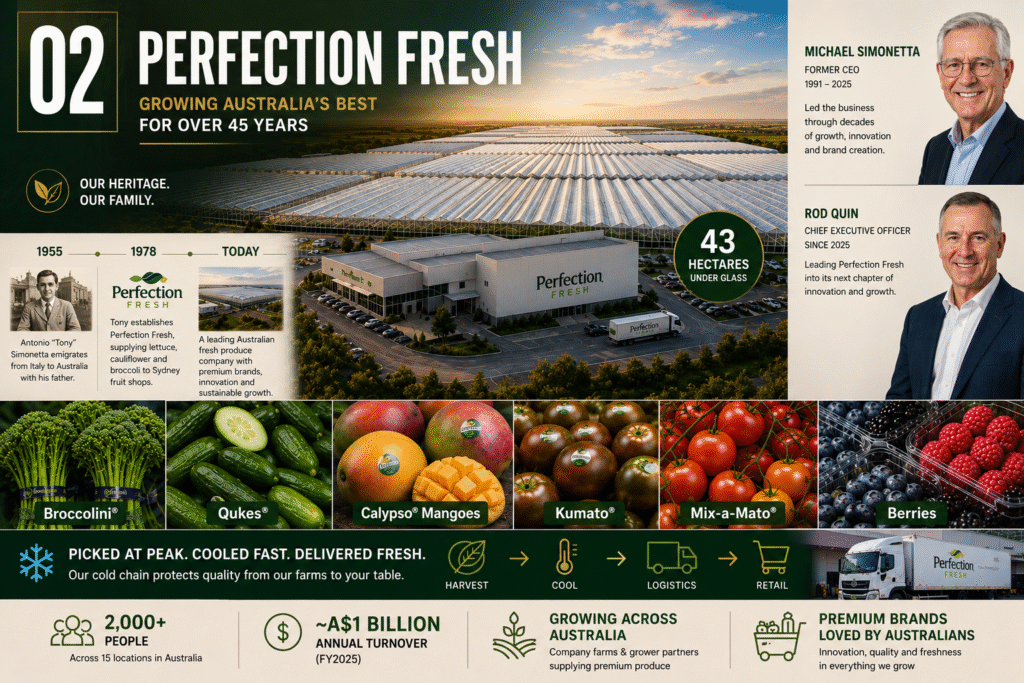
The story of Perfection Fresh Australia begins in 1955, when Antonio “Tony” Simonetta emigrated from Italy to Australia with his father. Like many European migrants arriving during the post-war period, the Simonetta family came to Australia looking for opportunity and a chance to build a new life. Tony had limited formal education, but he found his future in an industry that would eventually become synonymous with the family name: fresh fruit and vegetables.
Tony entered the produce trade in Sydney and established a fruit and vegetable shop in Moorebank in south-western Sydney. He married Mary Simonetta, and together they raised their children Michael, Rosemary, Vincent and John. Fresh produce became part of family life, and by around 1971 Tony and a business partner had expanded their retail interests considerably, acquiring another seven or eight fruit shops around Sydney.
Growth, however, created a problem. Tony was finding it increasingly difficult to source a reliable year-round supply of consistently high-quality vegetables for the stores. Instead of simply accepting the limitations of the existing supply chain, he saw an opportunity to improve it. That decision would ultimately provide the foundations for one of Australia’s largest privately owned fresh-produce businesses.
From Lettuce, Cauliflower and Broccoli to National Produce Brands
In 1978, Tony established the business that would become Perfection Fresh. Its early product range was remarkably simple compared with the company today, concentrating predominantly on lettuce, cauliflower and broccoli. Tony developed relationships with growers in regions including Werribee South in Victoria and Queensland’s Lockyer Valley, using different climates and growing seasons to provide the consistent year-round supply his customers needed.
The next generation of the Simonetta family subsequently became involved, with sons Michael, Vince and John Simonetta helping to expand the company. Michael eventually became CEO in 1991, and the business began evolving far beyond conventional fruit and vegetable wholesaling. Perfection Fresh increasingly invested in exclusive varieties, plant genetics, growing technology, branding and consumer-focused fresh produce, transforming products that had traditionally been treated as commodities into recognisable supermarket brands.
Perhaps the best-known example is Broccolini®, but Perfection Fresh’s portfolio grew to include names such as Qukes® baby cucumbers, Calypso® mangoes, Kumato® tomatoes and Mix-a-Mato® tomatoes, alongside berries, grapes and numerous premium and speciality produce lines. This ability to combine agriculture with product development and marketing became an important part of the company’s success. Consumers weren’t simply buying broccoli, cucumbers, mangoes or tomatoes anymore; increasingly, they were looking for specific varieties and brands they recognised.
Taking Growing Technology to Another Level
One of the clearest demonstrations of Perfection Fresh’s transformation can be found at Two Wells in South Australia, where the company operates an extraordinary 43-hectare glasshouse complex. That’s approximately 106 acres under glass, forming part of a wider agricultural property of around 166 hectares.
The facility produces tomatoes and Qukes® baby cucumbers throughout the year using sophisticated controlled-environment agriculture. Temperature, irrigation, plant nutrition and other growing conditions can be managed far more precisely than would be possible in conventional open-field production, but the technology extends well beyond the plants themselves.
Rain falling onto the enormous glasshouse roofs is captured and stored for irrigation, with Perfection Fresh reporting that just 10mm of rainfall can provide approximately four million litres of collected water. The facility also generates electricity, while heat produced during the generation process can be reused within the glasshouses. Even CO₂ generated by the system can be captured and utilised to support plant growth.
The scale and sophistication of Two Wells demonstrates how dramatically Australian horticulture has evolved. What began with an Italian migrant family operating Sydney fruit shops now includes one of the Southern Hemisphere’s most impressive protected-cropping operations.
Protecting Quality from Harvest to Supermarket
Perfection Fresh’s approach to post-harvest handling provides another important part of its success story. Producing premium fruit and vegetables is only valuable if that quality can be maintained during the journey from the farm to the consumer, making rapid cooling, refrigeration and careful cold-chain management increasingly important as an agricultural business grows.
Broccolini® provides a particularly good example. Perfection Fresh has previously highlighted growers targeting getting freshly harvested Broccolini® into refrigeration within approximately 20 minutes of picking. From there, maintaining appropriate conditions through packing, transportation and retail helps preserve the colour, texture and freshness consumers expect.
The principle extends across many fresh-produce categories. Berries, leafy vegetables and other highly perishable crops can begin deteriorating rapidly after harvest, while tomatoes, cucumbers, mangoes and other products each have their own requirements for temperature, humidity and ripening.
Different crops therefore require different post-harvest technologies. These can include refrigerated storage, forced-air cooling, hydrocooling, controlled ripening and, for suitable products, vacuum cooling. The objective isn’t simply to make produce cold; it is to manage the product correctly from the moment it leaves the plant until it reaches the customer.
For a business built around premium produce, this is particularly important. Months can be spent creating value in the field or glasshouse, while poor post-harvest temperature management can begin destroying that value within hours.
From Family Business to a Billion-Dollar Operation
Perfection Fresh has continued expanding well beyond the business Tony Simonetta established in 1978. Today, the company operates farms and growing facilities while working with a network of specialist growers across Australia, enabling it to maintain supply across different regions and seasons.
The scale of the modern operation is substantial. A detailed 2025 industry profile reported that Perfection Fresh had grown to more than 2,000 people across approximately 15 locations, with annual turnover approaching A$1 billion. As a privately owned company, Perfection Fresh doesn’t publish the same level of financial information required of an ASX-listed business, so these figures are best understood as publicly reported industry estimates rather than statutory public-company results.
The value of its agricultural infrastructure provides another indication of the company’s scale. In 2025, the Two Wells property was acquired by Centuria for approximately A$168 million, with Perfection Fresh continuing to operate the facility under a long-term lease.
The Simonetta family legacy remains an important part of the company, but Perfection Fresh has also evolved into a professionally managed national agribusiness. Today, the company is led by Chief Executive Officer Rod Quin, who took up the position in 2025 after building extensive international experience across the food and agribusiness industries.
From Three Vegetables to One of Australia’s Fresh Produce Leaders
The contrast between Perfection Fresh in 1978 and the company today is extraordinary. Tony Simonetta began by solving a relatively straightforward problem: his fruit shops needed a more reliable supply of good-quality lettuce, cauliflower and broccoli. By developing relationships with growers in different Australian regions, he created the consistency his customers required.
Successive generations then took that principle much further. The business invested in new varieties, branding, farms, glasshouses, water management, energy systems, packing, refrigeration and national distribution. Products such as Broccolini®, Qukes® and Calypso® mangoes became recognised by consumers in their own right, while facilities such as Two Wells demonstrated how sophisticated large-scale Australian horticulture could become.
From an Italian father and son arriving in Australia in 1955 to a fresh-produce business employing thousands of people and generating turnover reported at close to A$1 billion, the Simonetta family’s journey is another remarkable Australian agricultural success story.
It also reinforces a theme that appears repeatedly among the country’s leading growers: success isn’t created in the field alone. Genetics, growing technology, harvesting, rapid cooling, packing, refrigeration and logistics all contribute to the quality of the product that eventually reaches the supermarket shelf.
Tony Simonetta began by trying to secure better vegetables for a handful of Sydney fruit shops. Nearly half a century later, Perfection Fresh has become one of Australia’s great fresh-produce success stories.
Visit Perfection Fresh →
Perfection Fresh official website
From Sicily to Western Australia
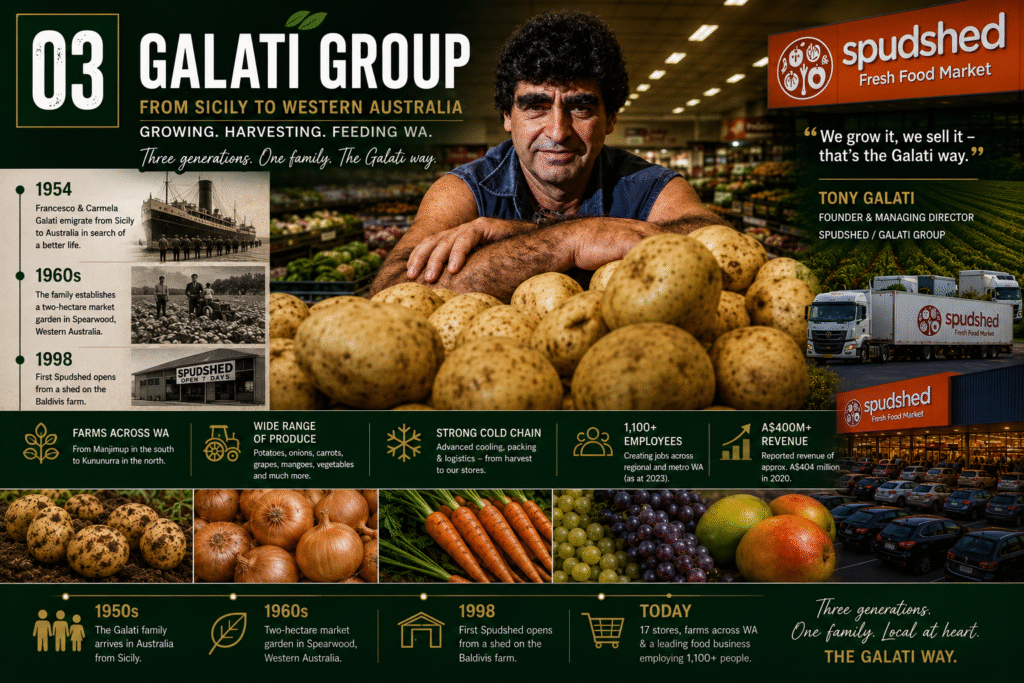
The story of Galati Group and Spudshed began in 1954, when Francesco and Carmela Galati emigrated from Sicily to Western Australia in search of a new life and greater opportunity. Francesco came from Tortorici in Sicily, while Carmela’s roots were in Agrigento. Like many Italian families who settled in Australia during the post-war years, they brought with them a strong connection to food, agriculture and the land.
By the 1960s, Francesco and Carmela were operating a modest two-hectare market garden in Spearwood, south of Perth. Their sons Tony, Vince and Sam Galati grew up working alongside their parents, often coming home from school to pick beans, harvest potatoes and help with the daily demands of the farm. As the eldest son, Tony took on considerable responsibility from an early age, including helping his father with parts of the business because Francesco’s English was limited.
Tony left school in Year 10 and began working full-time, but his education in fresh produce was only beginning. He drove his father’s truck before working for Coles, initially in fruit and vegetable management and later in purchasing. He also spent several years within Perth’s wholesale produce markets. Together, these experiences gave Tony an unusually complete understanding of the food industry — from growing and harvesting through to wholesale buying, logistics, pricing and supermarket retail.
Eventually, Tony returned to farming and, together with his family, began acquiring additional agricultural land around Wattleup and Baldivis. Potatoes became particularly important, but the Galatis continued expanding into other crops and growing regions. The family was gradually building the foundations of a business that would eventually control far more than farming alone.
From a Farm Shed to 20 Supermarkets
The decision that transformed the Galati family business came in November 1998, when Tony opened the first Spudshedfrom a relatively simple shed on the family’s Baldivis farm. The concept was straightforward: instead of growing vegetables and passing them through numerous layers of wholesalers and retailers, the family could grow the produce and sell it directly to the public.
Customers responded to the combination of fresh produce and competitive pricing. The original farm shop expanded, additional locations followed, and Spudshed gradually developed into a full supermarket business selling not only fruit and vegetables but also meat, dairy products, groceries and household goods.
The growth since then has been remarkable. In 2025, Spudshed opened its 18th store at Bunbury Forum, extending the company’s regional presence. In July 2026, the business reached another major milestone with the opening of its 20th Spudshed store at Waterford.
That means the Galati family has gone from one shed on a Baldivis farm in 1998 to 20 supermarkets across Western Australia today, and the expansion isn’t finished. Further regional development has been publicly discussed, including proposed Spudshed locations in Albany and Geraldton, potentially taking the network beyond its current 20 stores.
Yet the most interesting part of the Spudshed model isn’t simply the number of supermarkets. Unlike a conventional retailer that buys most of its produce from outside suppliers, the Galati family is also a major grower. This gives the business greater control over the journey from farm to supermarket shelf, helping reduce unnecessary stages between the grower and consumer.
Farming Across Western Australia
As Spudshed grew, the Galati family’s agricultural operations expanded with it. What began with Francesco and Carmela’s two-hectare market garden eventually developed into farming operations across an extraordinary geographic area, stretching from Manjimup in southern Western Australia to Kununurra in the tropical north.
Operating across such different climates allows the business to take advantage of varying seasons and growing conditions, helping maintain supply throughout the year. Although potatoes remain closely associated with the Galati name, the family’s production has expanded to include onions, carrots, grapes, mangoes and numerous other fruit and vegetable crops.
This geographic diversity has helped create a highly integrated business in which farming, packing, logistics and retail can increasingly operate as parts of the same supply chain:
Growing → Harvesting → Cooling & Packing → Transport → Spudshed → Consumer
For fresh produce, this model can provide a significant advantage. The fewer unnecessary delays between harvest and retail, the greater the opportunity to maintain freshness while controlling costs and reducing waste.
Protecting Freshness Across an Enormous State
Western Australia presents a unique challenge for fresh-produce businesses because of its sheer size. Fruit and vegetables grown hundreds or even thousands of kilometres from Perth may need to travel considerable distances before reaching consumers, making post-harvest handling, refrigeration and logistics increasingly important as production expands.
Once fresh produce is harvested, biological deterioration continues. Depending on the crop, high field temperatures can accelerate respiration, moisture loss and quality decline, meaning the period immediately after harvest can have a major influence on eventual shelf life.
Different crops require different approaches to post-harvest cooling. Commercial growers can use refrigerated storage, forced-air cooling, hydrocooling and, for suitable products, vacuum cooling, depending on the characteristics of the produce and the way it is packed and transported. The objective is to remove field heat where appropriate, establish the cold chain quickly and then maintain suitable conditions through transportation and retail.
The Galati model is particularly interesting because the family controls so much of that journey. Instead of handing the crop to another business at the farm gate, Galati Group can manage more of the process through harvesting, packing, transportation and ultimately its own Spudshed stores.
That doesn’t simply provide greater control over cost. It can provide greater control over freshness.
The Potato Battle That Made Tony Galati Famous
Tony Galati became one of Western Australia’s most recognisable agricultural figures through a battle that went far beyond his own farms. For decades, WA’s potato industry operated under a regulated system controlling how much individual growers could produce. Tony argued that the restrictions limited competition and prevented him from growing the volumes his customers required.
He repeatedly challenged the system, at times producing potatoes beyond his allocated quota and famously giving excess potatoes away to the public when restrictions prevented him from selling them conventionally.
The dispute was controversial and divided opinion within the farming industry, but it transformed Tony from a successful farmer and retailer into something of a Western Australian folk hero. The regulated potato system was ultimately dismantled in 2016, ending an extraordinary chapter in the state’s agricultural history.
Whatever people’s views on the dispute, it highlighted a characteristic that appears throughout Tony Galati’s business career: a willingness to challenge established ways of doing business when he believes there is a better alternative. The same thinking can be seen in Spudshed itself — rather than accepting the conventional route from farmer through wholesaler to retailer, the family increasingly built its own route to the consumer.
From Two Hectares to a Major Western Australian Business
Today, the contrast with Francesco and Carmela’s original market garden is extraordinary. Galati Group encompasses farming operations across Western Australia, fresh-produce packing and distribution, logistics and a supermarket network that has grown to 20 Spudshed stores, with further expansion planned.
The wider operation has previously been reported as employing more than 1,100 people, making it a significant employer across metropolitan and regional Western Australia. Because Galati Group remains privately owned, it doesn’t publish the same detailed annual financial results required of an ASX-listed company. However, publicly reported figures provide an indication of the scale the business had already reached, with Spudshed revenue reported at approximately A$404 million in 2020. The store network has expanded significantly since that figure was reported, so it should be viewed as a historical benchmark rather than an estimate of current turnover.
Perhaps the most impressive numbers in the Galati story, however, aren’t 20 supermarkets or more than A$400 million in previously reported revenue. They’re 1954 and two hectares.
Francesco and Carmela Galati arrived from Sicily and established a small market garden in Western Australia. Their sons grew up picking vegetables after school. Tony left school early, drove trucks, worked in supermarkets and wholesale produce markets, then returned to farming with an understanding of almost every stage of the fresh-food industry.
From those beginnings, the family progressively gained control over more of the journey its food takes — growing it, harvesting it, cooling and packing it, transporting it and ultimately selling it through its own supermarkets.
The original Spudshed opened from a farm shed in 1998. Today there are 20 stores, farming operations spanning Western Australia and further expansion on the horizon.
From a two-hectare market garden established by Sicilian migrants to one of Western Australia’s most recognisable vertically integrated food businesses, the Galati story is another remarkable example of what Australian agriculture, family enterprise and long-term ambition can create.
Visit Spudshed / Galati Group →
Spudshed official website
From Liverpool to Australia
The story of Barden Farms, formerly known as Barden Produce, begins not on an Australian farm but more than 10,000 miles away in Liverpool, England. Founder John Drummond grew up in Liverpool and began building his career in the British food and supermarket industry before making the move to Australia — a decision that would eventually lead him from retail and food procurement into fresh-produce trading and, ultimately, large-scale farming.
Drummond’s early career included experience with Tesco in the UK before he moved to Australia and entered the country’s rapidly developing food industry. He later worked as an interstate fresh-produce buyer for Woolworths, followed by a lengthy period in supply management with KFC Australia. Those roles gave him a valuable perspective on fresh produce from the customer’s side of the supply chain. He understood what major retailers and national food businesses needed from growers: reliable volumes, consistent specifications, competitive pricing, food safety, dependable logistics and, above all, quality that could be maintained throughout the year.
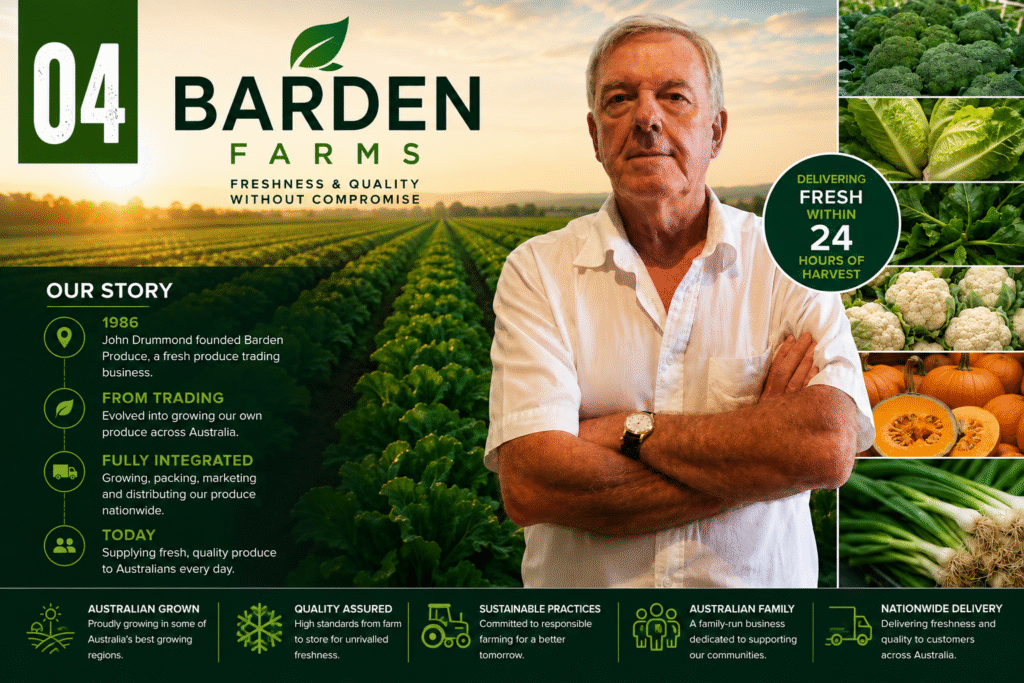
In 1986, Drummond used that experience to establish the business that would eventually become Barden Farms. Initially focused on the trading and supply of fresh produce, the company progressively moved closer to the source of the food itself. Instead of simply purchasing vegetables from growers and supplying them to customers, Barden began developing its own farming capabilities, allowing the business to gain much greater control over production, quality and availability.
That transition would eventually turn a produce-trading company founded by a Liverpudlian into a vertically integrated Australian farming operation.
From Produce Trading to Growing Its Own Crops
Today, Barden’s business is built around much more than buying and selling vegetables. The company has developed into an integrated operation involved in growing, packing, marketing and distributing fresh produce, supplying supermarkets, food processors and independent retailers across Australia.
Its product range demonstrates the scale of that transformation. Barden grows major vegetable lines including broccoli, cauliflower, green and red cabbage, iceberg lettuce, baby cos and gem lettuce, spring onions, radish, leek and silverbeet, together with Asian vegetables such as pak choy, buk choy, choy sum and gai lan. Its portfolio also extends into fresh herbs, Kent pumpkin and butternut pumpkin, giving the company a broad range of crops with very different growing and post-harvest requirements.
Barden has developed operations across different Australian growing regions to help maintain supply throughout the seasons. Its footprint has included production around Kemps Creek and Peats Ridge in New South Wales and Gatton in Queensland, alongside its presence within the Sydney fresh-produce market and continued expansion of its farming structure.
The business also combines traditional field production with hydroponic growing, particularly for crops where greater environmental control can help deliver the consistency demanded by large retail customers. This combination of locations, growing methods and crop varieties helps Barden achieve one of the most important requirements in modern supermarket supply: dependable fresh produce throughout the year.
From the Field to the Customer Within 24 Hours
One of the most interesting elements of the Barden story is the company’s emphasis on speed. Barden has publicly highlighted its ability to deliver fresh produce within approximately 24 hours of harvest, an ambitious target that demonstrates just how closely modern farming and logistics have become connected.
For many of Barden’s principal crops, the hours immediately following harvest are critical. Broccoli, cauliflower, lettuce, Asian greens and herbs are highly perishable products, and once they are harvested they continue to respire and lose moisture. When vegetables are picked during warm Australian conditions, retained field heat can accelerate that deterioration, making post-harvest handling and temperature management an essential part of protecting the crop’s quality.
This is where precooling and the cold chain become increasingly important. Different products require different approaches, with commercial growers able to use technologies such as refrigerated rooms, forced-air cooling, hydrocooling and, for suitable produce, vacuum cooling. Leafy vegetables such as lettuce are particularly interesting because rapid cooling can remove heat from throughout the product rather than simply cooling its outer surface.
The objective is not simply to make vegetables cold. It is to bring them to an appropriate post-harvest temperature as quickly as practical and then maintain suitable conditions through packing, storage, transportation and distribution. Barden’s own employment information refers to produce moving through cold rooms and production sheds, as well as transportation between farms, production facilities, distribution centres and markets, providing an indication of the infrastructure required behind a national fresh-produce operation.
For a company whose philosophy is centred on “Freshness and Quality without Compromise,” protecting the product after harvest is therefore just as important as producing it successfully in the field.
Building a Vertically Integrated Supply Chain
Barden’s development reflects a pattern we have already seen among several of Australia’s leading fresh-produce businesses. As the company grew, it gained greater control over more stages of the supply chain rather than relying entirely on outside businesses once the crop left the farm.
The modern operation increasingly connects:
Growing → Harvesting → Cooling → Packing → Distribution → Customer
This integration can provide major advantages. A grower can coordinate harvesting with packing requirements, manage product temperature sooner, respond more quickly to customer orders and reduce unnecessary delays between the field and supermarket shelf. For highly perishable vegetables, even relatively small improvements in time and temperature management can have a significant impact on the condition in which produce reaches the consumer.
Supplying Australia’s major retailers also requires far more than simply producing a good vegetable. Large growers must repeatedly deliver the correct product, volume, specification and quality at the correct time, while complying with increasingly demanding food-safety and traceability requirements. Barden’s operations have therefore incorporated recognised food-safety and quality programmes, including systems associated with Freshcare, HACCP and major retailer requirements.
At this level, agriculture becomes a combination of farming, engineering, food safety, refrigeration, packing and logistics, all working towards the same objective: delivering a consistent fresh product.
Barden Farms Today
Nearly four decades after John Drummond established the original business, Barden has evolved into a substantial Australian fresh-produce organisation. The company changed its corporate name from Barden Produce to Barden Farms in 2022, a change that appropriately reflects how far the business had travelled from its produce-trading origins.
Today, Barden operates across multiple Australian locations and is involved in field and hydroponic production, packing, marketing and distribution. Public company profiles place its workforce within the hundreds of employees, while the business supplies fresh vegetables into some of Australia’s most demanding retail and food-production supply chains.
Barden remains privately owned, which means detailed figures such as annual turnover and total hectares under cultivation are not published with the regularity required of a publicly listed company. Rather than estimate those figures, the scale of Barden is better demonstrated by the breadth of its crop portfolio, multiple growing regions, integrated packing and logistics operations and its ability to supply customers nationally throughout the year.
The Drummond family connection also continues. John Drummond remains associated with the company he founded, while the next generation, including Rohan Drummond, has become involved in the business, continuing the family story that began with John’s move from Liverpool to Australia.
From Liverpool to Australian Supermarket Shelves
What makes Barden particularly interesting is that John Drummond didn’t begin his career as the owner of a huge Australian farm. His route into agriculture came through the food supply chain itself.
His journey took him from Liverpool and the British supermarket industry to Australia, Woolworths, KFC, fresh-produce trading and eventually farming. Along the way, he gained an understanding of what customers expected from growers before ultimately creating an operation capable of supplying those requirements itself.
The business he established in 1986 progressively evolved from trading produce grown by others into growing, packing, marketing and distributing its own vegetables. In doing so, Barden gained greater control over the quality, availability and freshness of the food reaching its customers.
That evolution demonstrates another important lesson from Australia’s most successful fresh-produce businesses: the value of a crop doesn’t stop being at risk once it has been successfully grown. Harvesting, rapid cooling where appropriate, packing, refrigeration and efficient transportation all play a role in protecting the months of work already invested in the field.
Nearly 40 years after John Drummond established the business, Barden Farms has become part of Australia’s sophisticated fresh-produce supply chain — taking vegetables from farms across different growing regions and delivering them to customers around the country.
From Liverpool to Australian supermarket shelves, Barden is another remarkable example of how experience, opportunity and long-term investment can transform a relatively modest fresh-produce business into a major farming operation.
Visit Barden Farms →
Barden Farms official website
From England to Queensland
The story of Rugby Farm stretches back more than a century and begins with another family that found opportunity in Australia. In the late 1800s, the parents of Ernest Hood emigrated from an area near Rugby in England and settled in Queensland, eventually establishing themselves around Gatton in the fertile Lockyer Valley.
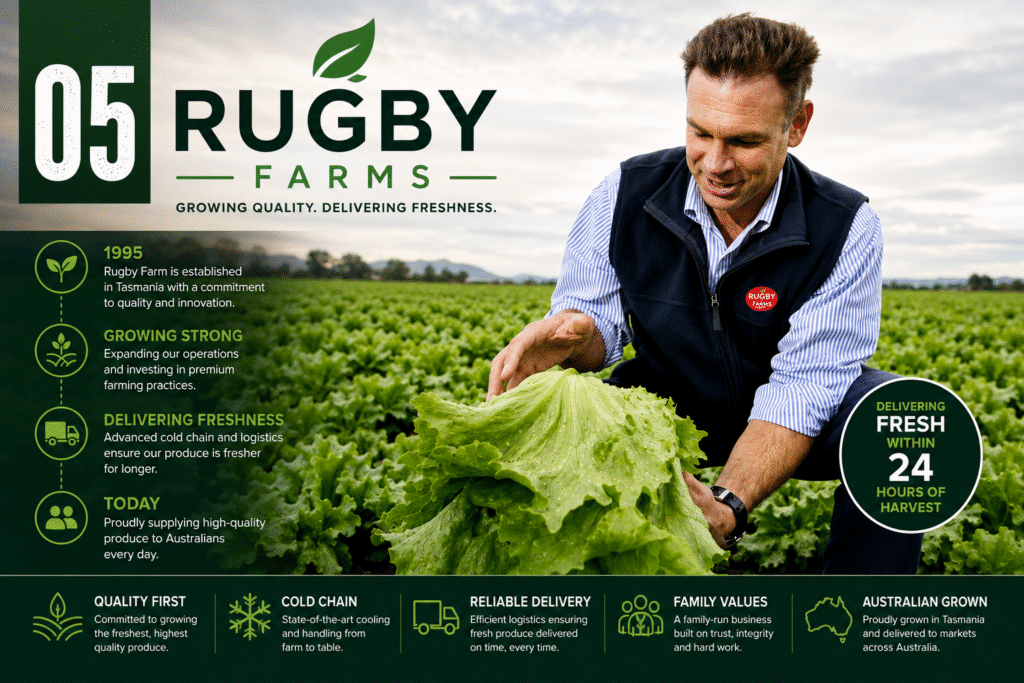
In 1912, at just 19 years old, Ernest Hood purchased the original property that would become Rugby Farm. The name reflected his family’s connection with the Rugby district in England, while also fitting Ernest’s own enthusiasm for rugby football. What began as a relatively modest Queensland farming operation would remain in the Hood family for more than 110 years and grow into one of Australia’s significant fresh-vegetable businesses.
Innovation became part of the farm surprisingly early. In 1924, Rugby Farm pioneered the use of spray irrigation in Queensland’s Lockyer Valley, demonstrating a willingness to adopt technology that would continue through successive generations. Rather than simply repeating the farming methods of the past, the Hood family continued investing in new growing techniques, infrastructure and regions as the business expanded.
Today, Rugby Farm remains family operated and is led by Matt and Dan Hood, grandsons of founder Ernest Hood. Their business, however, bears little resemblance to the farm their grandfather purchased as a teenager.
From One Farm to 14,000 Acres of Annual Production
One of Rugby Farm’s greatest strengths has been its expansion across different Queensland growing regions. Instead of relying on a single farm and one seasonal climate, the business developed production across the Lockyer Valley, Darling Downs, southern Queensland and North Queensland, allowing crops to be grown where conditions are most suitable at different times of the year.
Its farming locations include Gatton, Lowood and Fernvale in the Lockyer Valley; Clifton on the Darling Downs; Amiens and Kyoomba in southern Queensland; and Bowen and Ayr in North Queensland. This enormous geographic spread allows Rugby Farm to maintain fresh-vegetable production throughout all 12 months of the year — an increasingly important capability when supplying major supermarkets and food businesses that require consistent volumes regardless of season.
The scale of production is impressive. Rugby Farm says it now produces approximately 14,000 acres of vegetable crops every year, equivalent to roughly 5,666 hectares of annual production. Its major crops include baby broccoli, broccoli, cauliflower, green beans, iceberg lettuce, cabbage, sweet corn and wombok, giving the business a substantial portfolio of some of Australia’s most important fresh vegetables.
Rugby Farm has also expanded beyond simply growing and harvesting whole vegetables. Its operations now encompass growing, packing, processing and transporting fresh produce, while prepared vegetable lines have included products such as broccoli florets, broccoli and cauliflower combinations, diced butternut pumpkin, stir-fry vegetables and vegetable medleys.
The result is a modern agricultural business that controls considerably more of the journey between the field and the customer than a traditional grower.
Protecting 14,000 Acres of Production After Harvest
Producing approximately 14,000 acres of vegetables each year creates enormous value in the field, but the success of a crop isn’t determined solely by what happens before harvest. Many of Rugby Farm’s core products — particularly lettuce, broccoli, cauliflower, cabbage, wombok, beans and sweet corn — are highly perishable and require careful handling once they leave the plant.
Fresh vegetables remain biologically active after harvest. They continue to respire, lose moisture and deteriorate, while high field temperatures can accelerate these processes significantly. In warm Australian growing conditions, reducing the amount of time produce remains at elevated temperatures can therefore play an important role in maintaining quality and potential shelf life.
This is why precooling and cold-chain management have become fundamental parts of large-scale vegetable production. Different crops require different cooling methods. Broccoli, beans, cauliflower and sweet corn can respond well to technologies such as hydrocooling, while leafy vegetables such as iceberg lettuce are particularly well suited to rapid vacuum cooling. Forced-air systems and refrigerated rooms are also widely used depending on the crop, packaging and logistics requirements.
Rugby Farm doesn’t publicly disclose every cooling system installed across its facilities, so it would be wrong to claim that it uses a particular technology without confirmation. What the company does confirm is that its operations extend through packing, processing and transportation, meaning the responsibility for protecting product quality continues well beyond the moment the vegetable is harvested.
At this scale, the cold chain isn’t simply a logistics function added at the end of farming. It becomes an integral part of the production process itself. Months can be spent creating value in a crop, while poor temperature management after harvest can begin reducing that value within hours.
Technology, Water and Year-Round Supply
Rugby Farm’s history of adopting new technology didn’t end with spray irrigation in 1924. Modern vegetable farming across thousands of acres requires sophisticated management of water, soil, plant nutrition, machinery, harvesting, food safety, packing, refrigeration and logistics.
Geographic diversity is equally important. Queensland stretches from temperate agricultural regions in the south to tropical growing conditions in the north, and Rugby Farm has used those differences to its advantage. Production can shift between regions as seasons change, allowing the company to maintain supply rather than attempting to force the same crop to grow in one location throughout the entire year.
That strategy creates a complicated agricultural and logistical operation. Planting schedules need to correspond with anticipated customer demand months later, while harvesting, packing and transportation need to be coordinated so that vegetables reach customers at the correct specification and quality.
Supplying national customers also means consistency is essential. A supermarket doesn’t simply need an excellent crop when conditions happen to be favourable; it needs predictable volumes and specifications week after week. Rugby Farm’s expansion across multiple growing regions has helped the Hood family build the resilience required to provide that year-round supply.
More Than 110 Years of Family Farming
Today, Matt and Dan Hood continue the farming business their grandfather Ernest established in 1912. Rugby Farm describes its modern management structure as combining experience with a continuing willingness to expand, improve communication throughout the supply chain and invest in new infrastructure.
Running a farming operation of this scale now requires expertise extending far beyond traditional agriculture. Modern horticultural businesses need to understand finance, people, agronomy, soil science, irrigation, crop nutrition, engineering, food safety, post-harvest management, refrigeration, processing, transportation and marketing.
That ability to adapt is perhaps one of the most important reasons Rugby Farm has survived for more than a century. The crops may still grow from the soil, but virtually everything surrounding their production has changed since Ernest Hood purchased his first property.
From a 19-Year-Old Farmer to a Major Australian Grower
The contrast between Rugby Farm in 1912 and today is extraordinary. Ernest Hood was just 19 years old when he purchased the original Queensland property and named it after the English district connected to his family’s origins. Within little more than a decade, the family was already pioneering new irrigation technology in the Lockyer Valley.
Successive generations continued that expansion, establishing farms across dramatically different Queensland growing regions and moving beyond production into packing, processing and national distribution. Today, Rugby Farm produces approximately 14,000 acres of vegetable crops every year, supplies fresh produce throughout Australia and also services export markets.
Yet despite that transformation, the business remains in the Hood family more than 110 years after its foundation.
Rugby Farm’s journey demonstrates another recurring feature among Australia’s leading fresh-produce businesses: successful farming is no longer simply about growing the crop. The modern grower needs to understand and control as much of the journey as possible — from soil, water and growing conditions through to harvesting, cooling, packing, processing, logistics and ultimately the customer.
Ernest Hood began with one Queensland property. His descendants now manage thousands of acres of annual vegetable production across multiple growing regions.
From an English migrant family’s new beginning in Australia to approximately 14,000 acres of vegetable production every year, Rugby Farm is another remarkable Australian agricultural success story.
Visit Rugby Farm →
Rugby Farm official website
Bringing Queensland Growers Together
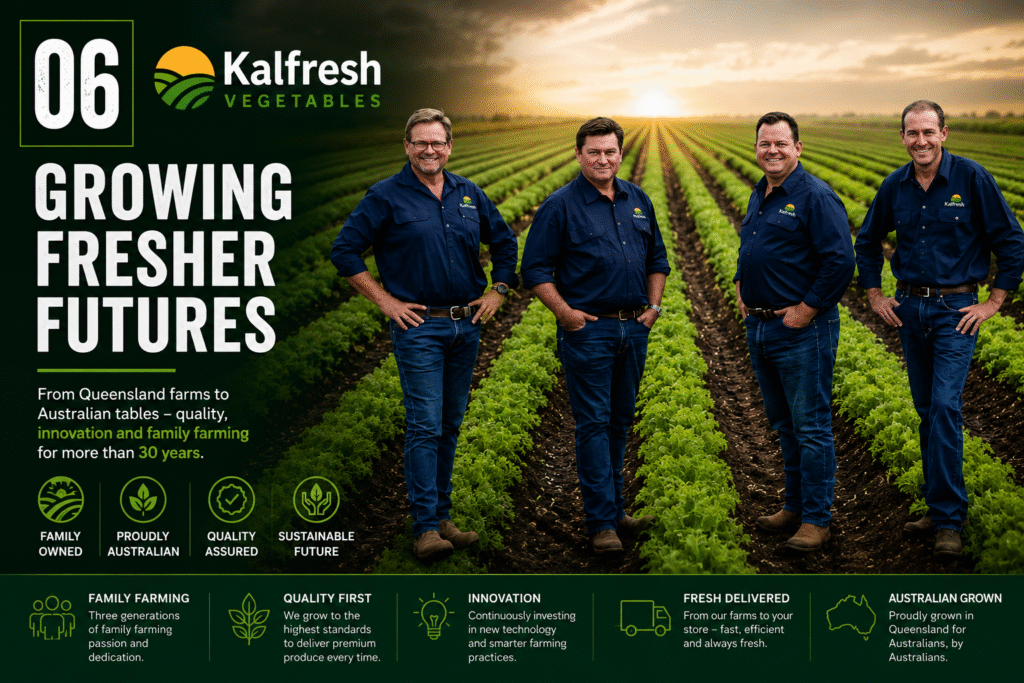
The story of Kalfresh began in Queensland’s Fassifern Valley in 1992, when Barry and Kay Hinrichsen and their son Robert Hinrichsen established the business with a simple but ambitious idea: bring local growers together under one brand, market the region’s vegetables collectively and give major customers a single, reliable source of fresh produce.
The Hinrichsens were not newcomers to agriculture. Robert is a third-generation farmer, and farming was already deeply embedded in family life. He has recalled growing up surrounded by small family-run packing sheds producing carrots, potatoes and other vegetables, while his father Barry moved into fresh sweet-corn production during Robert’s later school years. Those experiences gave the family an understanding of both the opportunities and limitations facing smaller growers: individually they could produce excellent crops, but by working together they could achieve the scale required to invest in better technology, packing facilities, logistics and marketing.
That cooperative thinking became the foundation of Kalfresh. Rather than trying to replace local farming families, the business created a structure that allowed growers to combine their strengths. More than three decades later, Kalfresh describes itself as one of Australia’s leading vertically integrated fresh-vegetable businesses, controlling much of the journey from paddock to packet. The company remains family owned, today by four farming families, while the values established by Barry, Kay and Robert continue to shape the business.
From Local Vegetables to Year-Round Production
Kalfresh has expanded considerably from its beginnings in the Fassifern Valley. Its crop portfolio now includes carrots, green beans, sweet corn, onions, baby capsicums, pumpkins, mini melons and brassicas, supplied as whole, pre-packed, prepared and ready-to-eat produce for retail and food-service customers. The company produces both conventional and Certified Organic vegetables and has progressively moved further into value-added processing.
Geographic expansion has also been central to its success. Kalfresh now farms across four major Queensland growing regions — the Scenic Rim, Southern Downs, Lockyer Valley and North Queensland around Bowen and Ayr. Its network combines company-owned farms at Kalbar, Tent Hill and Clintonvale with other family farms and a North Queensland joint venture with the Jurgens family. By growing crops in different climates at different times of year, Kalfresh can provide the reliable year-round supply demanded by Australia’s major fresh-food customers.
The company has also become increasingly vertically integrated. Farming, harvesting, washing, grading, packing, processing and transportation are connected rather than treated as separate businesses. In 2007, Kalfresh even acquired local trucking company Beutels Transport, bringing another important part of the fresh-produce journey directly into the operation.
The model can increasingly be viewed as one continuous process:
Growing → Harvesting → Rapid Cooling → Washing & Packing → Refrigerated Transport → Customer
For Cold Change’s readers, however, one particular part of the Kalfresh story stands out.
The Hydrocooler That “Changed the Game”
Kalfresh provides perhaps the clearest example in this series so far of how investment in post-harvest cooling technology can directly contribute to the growth of a fresh-produce business.
Robert Hinrichsen has explained that sweet corn was originally hand-picked and packed, but the family subsequently purchased the first hydrocooler in their district. Robert described that investment as something that “changed the game” for the local corn industry and helped convince him that technology would be a major driver of change in horticulture.
The significance of that investment is easy to understand. Sweet corn begins losing quality rapidly after harvest because its natural sugars start converting to starch. Removing field heat quickly can therefore be critical to protecting sweetness and freshness before the product enters refrigerated storage and transportation.
Kalfresh continued investing in this area. During the 1990s, it introduced new washing and packing systems for pre-packed carrots and hydrocooled beans, while improvements to chilled washing, packing and refrigerated transportation helped the company reach new export markets. By 1996, Kalfresh says these improvements enabled it to export carrots to new international customers.
This is an important example of why cooling should not simply be viewed as an operating cost. In the right application, better post-harvest technology can help a grower protect quality, extend the distance produce can travel and potentially open entirely new markets.
Different crops require different cooling methods. Kalfresh’s history demonstrates the value of hydrocooling for suitable products such as sweet corn and beans, while other fresh vegetables can benefit from forced-air refrigeration or, particularly for leafy products, vacuum cooling. The technology may change according to the crop, but the commercial objective remains the same: remove field heat rapidly, protect the value created on the farm and maintain the correct temperature through the remainder of the supply chain.
Innovation from the Paddock to the Packing Shed
The hydrocooler wasn’t a one-off investment. Kalfresh has continued using technology as a means of improving productivity and product quality. Its history includes robotic carton stacking, mechanised carrot and bean harvesting, automated packing and crate-filling systems, optical vision graders and trials of solar-powered farm robots capable of seeding and weeding crops.
In 2015, the company also constructed a high-care value-adding facility at Kalbar, allowing it to move further into prepared vegetables. More recently, Kalfresh has invested in expanded sweet-corn facilities, automated carrot packing and new temperature-controlled onion production infrastructure. The company says its production facilities are deliberately located close to farms so crops can move from harvesting to processing extremely quickly, helping lock in freshness before distribution.
That approach demonstrates how modern horticulture has evolved. The successful grower is no longer simply responsible for producing the crop. Increasingly, the same business needs expertise in agronomy, harvesting, engineering, automation, refrigeration, food safety, packing, processing and logistics.
For Kalfresh, those investments have helped transform a collection of local farming families into a sophisticated vertically integrated fresh-food business.
Building the Next Generation of Australian Agriculture
Kalfresh is now pursuing an even more ambitious project: the Scenic Rim Agricultural Industrial Precinct, which the company describes as Australia’s first Bioenergy and Food Precinct. The concept is designed to bring food manufacturing and bioenergy production into the farming region itself, creating opportunities to add value closer to where crops are grown.
A central part of the vision is turning agricultural and food waste into useful resources rather than simply disposing of it. Plans for the precinct include bioenergy production capable of converting organic waste into renewable electricity, gas and biofertiliser, creating a more circular agricultural system in which nutrients can ultimately be returned to farms.
The Queensland Government gave the precinct approval to proceed in 2024, following years of planning. The proposed development has been valued at approximately A$291 million and has been projected to create up to 1,000 jobs, demonstrating just how far the original Kalfresh concept has evolved.
More Than 30 Years of Family Farming and Innovation
Today, Kalfresh is led by CEO Richard Gorman, who became CEO in 2013 after working with the business since its early years. Founding director Robert Hinrichsen remains a shareholder and non-executive director while continuing to lead his own family farming operation, AEH Farming, a major supplier to Kalfresh. Founder Barry Hinrichsen remained an important figure in the company and local farming community until his death in 2025, with Kalfresh describing his vision, work ethic and determination as fundamental to the culture of the business.
The journey from 1992 to today demonstrates what can happen when farming families combine scale with a willingness to invest in technology. Barry, Kay and Robert Hinrichsen began by bringing Fassifern Valley growers together so they could market their vegetables collectively. The business subsequently expanded across Queensland, invested in farms, packing, automation, processing and transport, moved into export markets and is now pursuing an ambitious agricultural and renewable-energy precinct.
Yet one of the most revealing moments in that entire journey remains surprisingly simple: a farming family purchased a hydrocooler.
Robert Hinrichsen’s description of that investment as something that “changed the game” for the sweet-corn industry captures an important lesson for modern growers. Producing more isn’t always the only route to growth. Sometimes the breakthrough comes from protecting the crop better once it has been harvested.
Kalfresh’s story demonstrates how growing, rapid cooling, packing, automation, refrigerated transport and market access can work together as one system. From a group of Queensland farming families joining forces in 1992 to one of Australia’s leading vertically integrated vegetable businesses, Kalfresh is another remarkable example of innovation driving Australian agriculture forward.
Visit Kalfresh →
Kalfresh official website
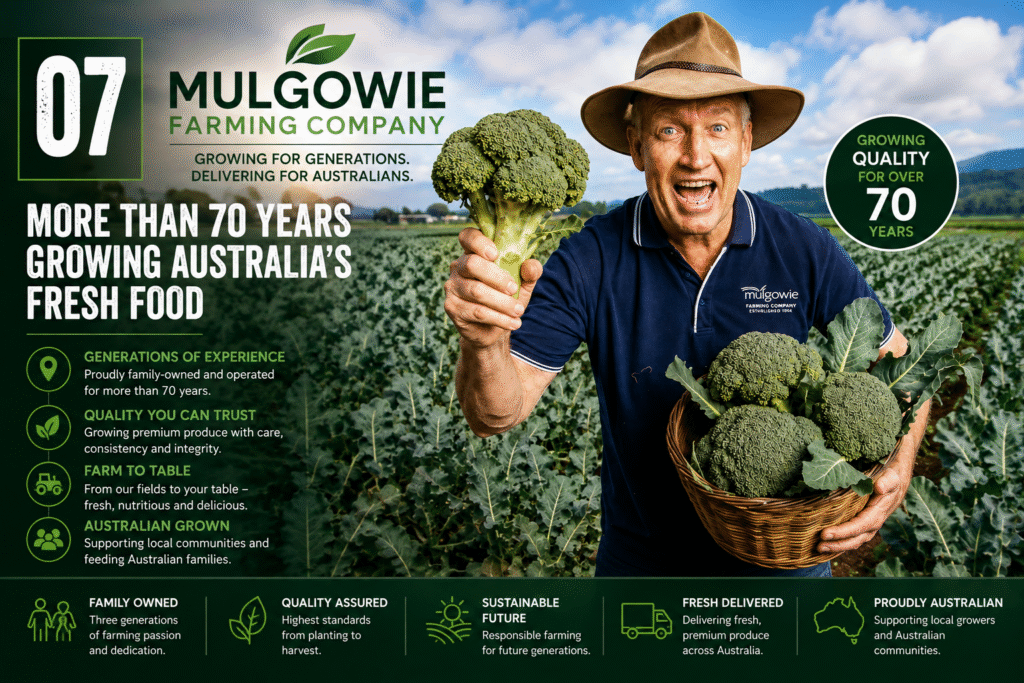
A Queensland Farming Story More Than 70 Years in the Making
The story of Mulgowie Farming Company begins in Queensland’s fertile Lockyer Valley, where the Emerick family established roots in Australian agriculture more than 70 years ago. In 1949, John Emerick began farming in the region, laying the foundations for a family business that would eventually grow far beyond its original Queensland property.
The Lockyer Valley is one of Australia’s most productive horticultural regions, but building a business capable of supplying fresh vegetables throughout the year requires more than simply having good soil. Seasonal changes, weather, water availability and customer demand all influence production, and the Emerick family gradually expanded beyond the valley to overcome those limitations.
Successive generations developed Mulgowie into a multi-region farming operation, combining traditional agricultural knowledge with increasingly sophisticated growing, harvesting, packing and distribution systems. What started as a family farming enterprise ultimately became one of Australia’s significant fresh-vegetable producers, with operations stretching across several states.
At its peak scale, Mulgowie Farming Company was farming approximately 10,000 acres, employing and working with around 400 staff and contract partners, while supplying some of Australia’s largest supermarket and food-service customers.
Building a Year-Round Australian Growing Network
One of the keys to Mulgowie’s growth was recognising that major customers don’t simply need excellent vegetables during one local growing season — they require consistent quality and supply throughout the year.
To achieve this, Mulgowie expanded production beyond its original Lockyer Valley base and developed farming operations across different climatic regions in Queensland, New South Wales and Victoria. By moving production between locations as seasons changed, the company could maintain supply for far longer than would have been possible from a single farm.
Mulgowie became particularly well known for sweet corn and green beans, developing into one of Australia’s largest growers and suppliers of these crops. Its wider production has also included broccoli, pumpkin and other fresh vegetables, with substantial volumes grown for major retail and food-service customers.
At one stage, the company’s broader farming portfolio was reported as covering approximately 5,100 hectares and producing around 90,000 tonnes of fresh produce annually. That scale required far more than farming expertise alone. Harvesting schedules, packing capacity, refrigeration, transport and supermarket orders all had to work together, often across farms separated by hundreds or thousands of kilometres.
This transformed Mulgowie from a traditional family farm into a sophisticated national fresh-produce supply business.
When Cooling Becomes Part of Growing
Mulgowie’s focus on crops such as sweet corn, green beans and broccoli makes post-harvest temperature management particularly important.
Sweet corn provides one of the clearest examples of why the cold chain matters. Once corn is harvested, the sugars responsible for its sweetness begin converting to starch. Higher temperatures accelerate that process, meaning freshly harvested sweet corn can begin losing the eating quality consumers value surprisingly quickly.
For large commercial growers, harvesting therefore cannot be considered the end of production. The crop needs to move efficiently from the field into precooling, packing, refrigerated storage and temperature-controlled transportation.
Green beans and broccoli present similar challenges. Both can deteriorate quickly when exposed to inappropriate temperatures, making rapid removal of field heat and careful cold-chain management important for maintaining colour, texture and overall quality.
Different crops require different cooling technologies. Hydrocooling is particularly effective for suitable vegetables such as sweet corn and beans, while forced-air cooling and refrigerated storage can be used across numerous other fresh-produce categories. Other products, particularly leafy vegetables, may be better suited to technologies such as vacuum cooling.
The exact equipment used can vary between farms and packing facilities, but the principle remains consistent: the faster suitable produce enters its correct post-harvest environment, the greater the opportunity to protect the value created in the field.
For a business producing tens of thousands of tonnes of vegetables and supplying customers across multiple states, cold-chain management isn’t simply an additional service. It becomes part of the agricultural production system itself.
From the Farm to the Supermarket Shelf
As Mulgowie expanded, the business increasingly integrated activities beyond growing. Fresh produce needed to be harvested, cooled, graded, packed and transported to customers according to precise supermarket specifications and delivery schedules.
That integration can be represented as one continuous process:
Growing → Harvesting → Precooling → Packing → Refrigerated Distribution → Customer
Controlling more of this process gives a large grower significant advantages. Harvesting can be coordinated with customer orders, packing facilities can operate around crop availability, and temperature management can begin much closer to the point of harvest.
It also helps reduce one of the biggest enemies of fresh produce: time.
Every unnecessary hour between harvesting and correct temperature management potentially reduces the remaining commercial life of a highly perishable product. When produce is travelling significant distances through Australia’s supply chain, preserving as much of that life as possible becomes commercially important to the grower, retailer and consumer.
Mulgowie’s growth therefore reflects the same evolution we have seen across many of Australia’s most successful horticultural businesses. Agriculture has become increasingly connected with engineering, refrigeration, automation, food safety, packing and logistics.
More Than Seven Decades of Expansion
From John Emerick’s beginnings in the Lockyer Valley in 1949, Mulgowie developed over successive generations into a major Australian horticultural operation. The company became particularly recognised for its sweet corn and beans, while expanding production across multiple growing regions to provide customers with consistent year-round supply.
At its larger scale, Mulgowie reported approximately 10,000 acres under production, while other publicly reported figures placed its broader farming portfolio at around 5,100 hectares, producing approximately 90,000 tonnes of fresh produce annually.
The company also developed a workforce and grower network involving approximately 400 employees and contract partners, illustrating just how far the operation had travelled from its family-farming beginnings.
More recently, Mulgowie entered another important chapter in its history. In 2023, Ontario Teachers’ Pension Plan acquired a majority stake in Mulgowie Farming Company, with the Emerick family retaining a minority interest. The investment formed part of a broader Australian agricultural platform, demonstrating the substantial institutional value now attached to sophisticated fresh-produce farming businesses.
The transaction did not erase Mulgowie’s family history; instead, it demonstrated what that family had managed to build. A farming operation established in the Lockyer Valley had grown into an agricultural business large enough to attract major international investment.
From a Family Farm to a National Fresh-Produce Business
The contrast between 1949 and today tells the Mulgowie story particularly well. John Emerick began farming in one of Queensland’s great agricultural regions, and successive generations progressively expanded the operation into new crops, new farms and new states.
As the business became larger, the infrastructure surrounding the crop became increasingly important. Growing had to work alongside harvesting, cooling, packing, refrigeration and transportation, while production across different climatic regions allowed Mulgowie to meet the year-round requirements of major Australian customers.
This is perhaps the most important lesson from the Mulgowie story. Scaling a fresh-produce business isn’t simply a matter of planting more hectares. A grower also needs the infrastructure capable of protecting, processing and moving everything those additional hectares produce.
At its larger scale, Mulgowie was producing around 90,000 tonnes of fresh produce annually. Every tonne represented months of work in the field, but its commercial value still had to be protected after harvest.
That is why the most successful modern growers increasingly think about the entire journey as one operation: grow it efficiently, harvest it at the right time, remove field heat quickly where required, pack it correctly and maintain the cold chain until it reaches the customer.
From a Queensland family farm established more than 70 years ago to one of Australia’s major fresh-vegetable operations, Mulgowie Farming Company is another remarkable Australian agricultural success story.
Visit Mulgowie →
Mulgowie official website
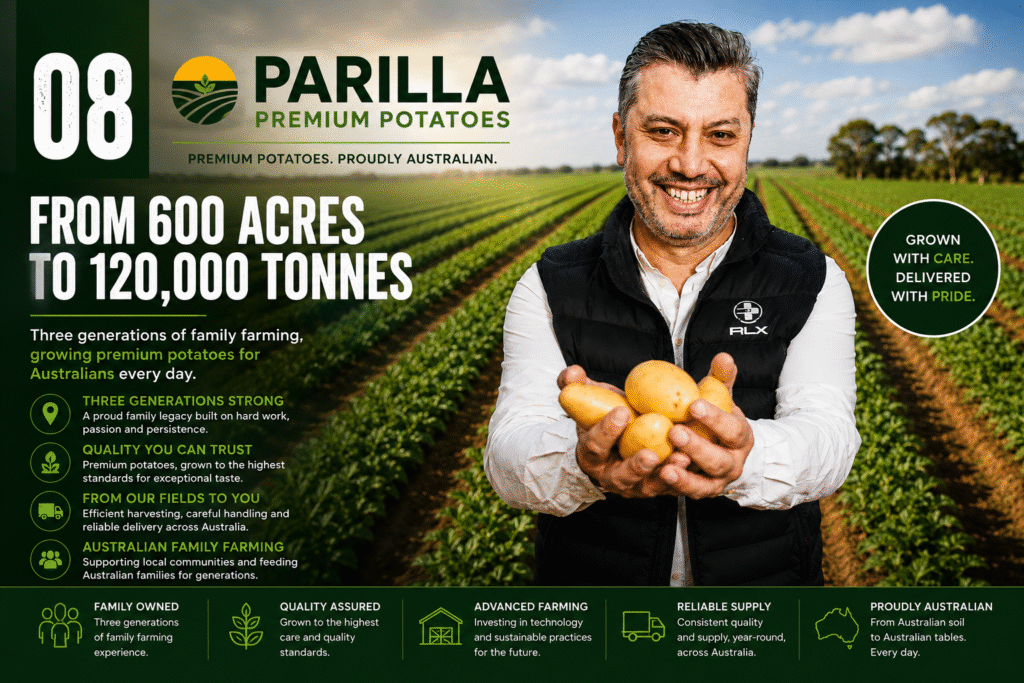
A Farming Journey from New Zealand to South Australia
The story of Parilla Premium Potatoes is another example of how migration, opportunity and agriculture have combined to create a major Australian fresh-produce business. This time, however, the journey didn’t begin in Europe. It began across the Tasman Sea in New Zealand, where the Pye family had already established generations of farming experience before an opportunity emerged that would change the direction of the family business.
In 1990, Allan Pye, his son Mark and daughter-in-law Fiona moved into potato production in South Australia, initially leasing approximately 600 acres of land near the small Mallee town of Parilla. The move followed an opportunity associated with McCain, which was looking for experienced growers capable of producing potatoes for its Australian processing operations.
The environment around Parilla presented both opportunity and challenge. Its sandy soils and relatively flat landscape offered excellent potential for large-scale irrigated agriculture, but establishing a successful operation required significant investment in water, irrigation, machinery and farming infrastructure. The Pye family brought their existing agricultural knowledge to the region and began developing a production system capable of operating on a much larger scale.
What started with those first 600 leased acres would eventually become Parilla Premium Potatoes, a vertically integrated farming business producing potatoes, carrots and onions on an extraordinary scale across South Australia.
From Potatoes to a Diversified Fresh-Produce Business
Potatoes were the foundation of the operation and remain central to the Parilla name, but the business progressively diversified as it expanded. Today, Parilla Premium Potatoes produces potatoes, carrots and both red and brown onions, allowing the company to supply several of Australia’s most important staple vegetable categories.
The scale is remarkable. Parilla says its farming operations now produce more than 120,000 tonnes of fresh produce every year, a considerable transformation from the business that began by leasing 600 acres in 1990.
Expansion has taken the company well beyond the original Parilla property. Its farming operations have extended across South Australia, including production around Parilla, Virginia and the Adelaide Plains, allowing different soil types, water resources and growing conditions to be used for different crops.
The Pye family’s approach has been characterised by large-scale investment and a willingness to develop the infrastructure surrounding the farm as production increased. Irrigation, harvesting equipment, washing, grading, packing, storage and logistics all needed to grow alongside the number of hectares planted.
This has created a business in which the crop’s journey can increasingly be managed as one connected process:
Growing → Harvesting → Cooling & Storage → Washing & Grading → Packing → Transport → Customer
That integration becomes particularly important when dealing with more than 120,000 tonnes of produce annually.
Growing More Is Only Half the Challenge
One of the recurring themes throughout Australia’s largest fresh-produce businesses is that expansion in the field must be matched by expansion after the field.
A farm can increase its acreage, improve yields and harvest enormous volumes of vegetables, but those gains become much less valuable if the business doesn’t have the capacity to handle, cool, store, pack and transport the additional crop efficiently.
Parilla’s product range demonstrates why post-harvest management can’t follow a single approach. Potatoes, carrots and onions are very different products, each requiring its own temperature, humidity, curing, storage and handling strategy.
Potatoes, for example, can potentially be stored for extended periods under carefully controlled conditions, but inappropriate temperatures can affect quality, sugar levels, sprouting and processing performance. Onions require effective curing and carefully managed storage conditions, while carrots can lose moisture and quality rapidly if they aren’t handled and refrigerated correctly.
For carrots in particular, rapid removal of field heat followed by refrigerated storage can play an important role in maintaining firmness and freshness. Depending on the product and operation, commercial vegetable businesses may use technologies including hydrocooling, forced-air systems and refrigerated storage, while other crop categories can benefit from technologies such as vacuum cooling.
The important point is that cold-chain technology must match the crop. There is no universal cooling system for every vegetable, and the largest growers increasingly build post-harvest infrastructure around the specific physiological requirements of what they produce.
For an operation the size of Parilla, getting those decisions right can affect thousands of tonnes of product.
Technology, Irrigation and Farming at Scale
The growth of Parilla Premium Potatoes also demonstrates how modern large-scale vegetable production increasingly depends on engineering and technology.
Producing consistent crops in South Australia’s relatively dry environment requires sophisticated irrigation and water management. The Pye family’s expansion has involved extensive use of centre-pivot irrigation, allowing large areas of crops to receive controlled quantities of water across otherwise challenging agricultural landscapes.
Large-scale production also requires specialised machinery capable of planting, harvesting and handling enormous quantities of vegetables efficiently. As production grows, relatively small improvements in yield, water efficiency, energy consumption or post-harvest losses can create substantial differences across thousands of acres.
This is one reason Australia’s largest farming businesses increasingly look very different from the traditional image of a family farm. They may still be family founded and connected to the land, but behind the crops sit sophisticated systems involving agronomy, irrigation engineering, automation, refrigeration, storage, packing, transport and data.
Parilla Premium Potatoes is an excellent example of that transformation.
From 600 Acres to More Than 120,000 Tonnes
Perhaps the simplest way to understand the Pye family’s achievement is to compare where the Australian operation started with what it subsequently became.
In 1990, Allan Pye, Mark Pye and Fiona Pye began by leasing around 600 acres near Parilla. Their initial focus was potato production, using the family’s previous farming experience to take advantage of an opportunity in the Australian market.
Over the following decades, the operation expanded dramatically. More land was developed, production diversified into carrots and onions, new properties were added and the infrastructure required to handle increasingly large volumes of vegetables grew alongside the farms.
Today, Parilla Premium Potatoes says it produces more than 120,000 tonnes of fresh produce annually.
To put that figure into perspective, an average of 120,000 tonnes across a year is equivalent to more than 2,300 tonnes of produce every week. At that level, farming becomes as much a logistical and engineering operation as an agricultural one.
Every harvest needs somewhere to go. Every tonne needs to be handled correctly. Washing and packing capacity needs to correspond with production, while cooling and storage infrastructure must be capable of protecting the crop until it can be dispatched to customers.
That is why vertical integration becomes increasingly valuable as growers become larger.
The Pye Family’s Wider Agricultural Story
The Parilla business also forms part of a much wider agricultural story associated with the Pye family, whose farming interests have expanded considerably across Australia.
The family has become associated with substantial investments in agricultural land, water and large-scale crop production, particularly across South Australia. The scale of those wider interests demonstrates how the opportunity that brought the family into Australian potato production ultimately developed into something far larger.
Yet the beginnings of Parilla Premium Potatoes remain relatively straightforward: an experienced farming family crossed from New Zealand to Australia, recognised an opportunity and began growing potatoes on leased South Australian land.
The business expanded because the family didn’t simply plant more potatoes. It invested in the systems required to make larger-scale production possible.
From New Zealand to an Australian Fresh-Produce Powerhouse
The journey from 600 leased acres in 1990 to more than 120,000 tonnes of annual fresh-produce production makes Parilla Premium Potatoes another remarkable Australian agricultural success story.
The Pye family brought farming knowledge from New Zealand but found the opportunity to dramatically expand that knowledge in Australia. Potatoes provided the beginning, while carrots, onions, additional farms and increasingly sophisticated agricultural infrastructure followed.
Like the other businesses in this series, Parilla demonstrates that modern horticultural success is built both before and after harvest. Producing a high-quality crop requires land, water, agronomy and experience, but protecting that crop requires equally serious investment in harvesting, cooling, storage, grading, packing and transportation.
When production reaches more than 120,000 tonnes per year, those systems aren’t secondary to farming. They are part of farming.
From a New Zealand farming family taking an opportunity in South Australia to one of the country’s major producers of potatoes, carrots and onions, Parilla Premium Potatoes demonstrates just how far a family agricultural business can grow when experience is combined with investment, technology and Australian opportunity.
Visit Parilla Premium Potatoes →
Parilla Premium Potatoes official website
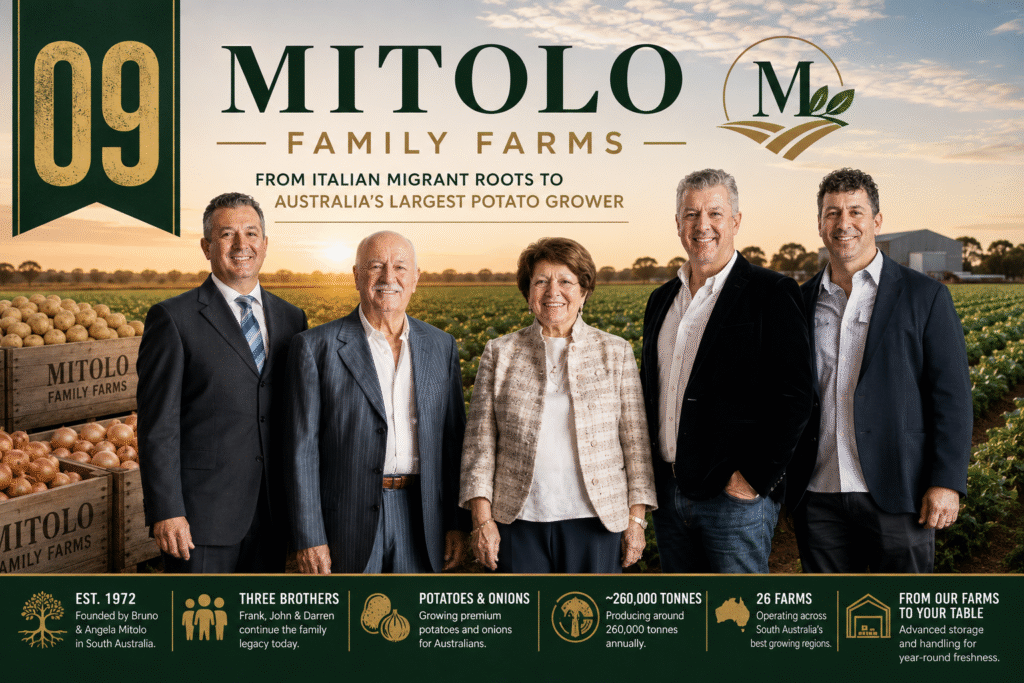
An Italian Migrant’s Australian Farming Dream
The story of Mitolo Family Farms began in South Australia in 1972, when Italian migrant Bruno Mitolo, together with his wife Angela, established a small fresh-produce business in Virginia on the Adelaide Plains. Bruno had arrived in Australia carrying the agricultural traditions and work ethic of his Italian background, and what began relatively modestly would eventually become one of the country’s largest and most sophisticated vegetable-growing operations.
Interestingly, Mitolo didn’t begin as the enormous farming business it is today. The original operation was primarily involved in aggregating and packing produce from other growers, particularly onions and potatoes grown around the Virginia region. This allowed Bruno to develop an understanding not only of growing but also of what happened to vegetables once they left the field — grading, packing, quality control, customer requirements and distribution.
As the business expanded, Bruno and Angela’s three sons — Frank, John and Darren Mitolo — became increasingly involved. The second generation brought new ambition to the company while maintaining the family’s connection with farming and fresh produce. Rather than remaining simply a packer and marketer of vegetables grown by other farmers, the Mitolos decided they wanted greater control over the product themselves.
In 1989, the family began acquiring agricultural land and developing its own farming operations. That decision fundamentally changed the business. The Mitolos were moving from packing other people’s crops towards controlling the complete supply chain themselves, and over the following decades that strategy would take the company to an extraordinary scale.
From a Packing Shed to 26 Farms
Today, Mitolo Family Farms is described as Australia’s largest potato-growing business, operating approximately 26 farms across South Australia and New South Wales. Its growing regions extend through the Adelaide Plains, Mallee, Riverland and Riverina, allowing production to be spread across different soils, climates and seasonal conditions.
The company’s overall agricultural footprint has been reported at around 40,000 hectares, although not all of that land is necessarily planted at the same time. This enormous geographic spread allows Mitolo to coordinate planting and harvesting across different regions while maintaining the consistent supply required by Australia’s major supermarkets and wholesalers.
Potatoes remain the product most closely associated with the Mitolo name, but onions are also a major part of the operation. The company works with an extraordinary range of varieties, with industry reporting identifying more than 120 potato varieties and around 30 varieties of red and brown onions within its broader production and research activities.
This variety isn’t simply about offering consumers more choice. Different potatoes have different characteristics for roasting, boiling, mashing, frying and other uses, while particular varieties can perform differently depending on soil, climate, disease pressure and storage conditions. Matching the correct variety with the correct growing environment and eventual customer requirement has therefore become another part of Mitolo’s increasingly sophisticated agricultural model.
Around 260,000 Tonnes of Potatoes and Onions Every Year
The volumes now associated with Mitolo demonstrate just how far the family business has travelled.
Managing Director Frank Mitolo said in 2024 that the company’s operations produced approximately 200,000 tonnes of potatoes and 60,000 tonnes of onions every year. That’s around 260,000 tonnes of vegetables annually.
Put another way, that represents an average of roughly 5,000 tonnes of potatoes and onions every week across the year.
At that scale, the business can no longer be thought of simply as a collection of farms. Every crop needs to be planted, irrigated and harvested, but once it leaves the soil an entirely different operation begins. Vegetables need to be transported, stored where necessary, washed, graded, inspected, packed and dispatched to customers throughout Australia and into international export markets.
Mitolo’s supply chain therefore increasingly resembles one continuous agricultural production system:
Growing → Harvesting → Transport → Temperature-Controlled Storage → Washing & Grading → Packing → Distribution → Customer
The company’s own reporting confirms that its trading operation transports, washes, grades and packs potatoes and onions before dispatching them to retail and wholesale customers throughout Australia and export markets overseas.
Protecting Hundreds of Thousands of Tonnes After Harvest
Mitolo is particularly interesting from a post-harvest perspective because potatoes and onions present very different challenges from highly perishable products such as lettuce, mushrooms or broccoli.
They may not require the same immediate rapid cooling regime as leafy vegetables, but temperature, humidity, ventilation and storage management remain critical.
Potatoes are living products after harvest. Under inappropriate conditions they can lose moisture, sprout, develop disease or undergo chemical changes that affect their cooking and processing characteristics. Long-term potato storage therefore requires carefully controlled temperature and humidity conditions appropriate to the particular variety and its intended market.
Onions present another challenge. They generally need to be properly cured after harvest, reducing moisture around the neck and outer layers before entering appropriate storage. Ventilation, temperature and humidity then need to be managed to minimise sprouting, disease and deterioration.
This is why Mitolo’s scale is so significant from a cold-chain and post-harvest engineering perspective. When a company produces around 260,000 tonnes annually, even a small improvement in storage efficiency or reduction in post-harvest losses can represent thousands of tonnes of additional saleable produce.
The cooling strategy may be different from the hydrocooling used for Kalfresh’s sweet corn or the rapid cooling required for Costa’s mushrooms, but the underlying principle is exactly the same:
Growing creates the value. Correct post-harvest management protects it.
Technology from the Farm to the Packing Line
Technology has become one of the defining features of the modern Mitolo operation. The company describes its approach as combining traditional farming techniques with the latest technology, with harvested produce passing through state-of-the-art sorting, cleaning, checking and packing machinery before reaching consumers.
At this level of production, automation isn’t simply about reducing labour. Sophisticated grading and packing systems can help deliver the consistency demanded by major supermarket customers while identifying products that don’t meet specification and directing them towards other suitable markets or uses.
Technology also extends back into the field. Variety research, soil management, irrigation, harvesting machinery and crop monitoring all contribute to improving yield and consistency before the potatoes and onions ever reach the packing facility.
This combination of agriculture, engineering, automation, storage and logistics is one of the recurring characteristics we’ve seen throughout Australia’s largest fresh-produce businesses.
The bigger the farm becomes, the more important everything surrounding the farm becomes.
Three Sons Continuing Bruno and Angela’s Legacy
Today, the second generation of the Mitolo family plays a central role in the company. Frank, John and Darren Mitolo, the three sons of founders Bruno and Angela, have helped transform their parents’ original business into the enormous operation it is today. Frank serves as Managing Director, and the family’s contribution to Australian horticulture has received international recognition.
In 2024, Mitolo Family Farms received the prestigious Industry Award at the World Potato Congress in Adelaide, becoming the first Australian grower to receive the honour. The award recognised the company’s contribution to the development and growth of the global potato industry and represented a remarkable milestone for a business founded by an Italian migrant family more than half a century earlier.
The company has also grown into a significant Australian employer. Mitolo’s own current website describes a workforce of more than 800 people working across its farms, factory and offices.
Another major development came in 2023, when Canada’s Ontario Teachers’ Pension Plan acquired a majority interest in Mitolo Family Farms. Importantly, the Mitolo family retained a significant ownership stake and continued its involvement in the business. The investment demonstrated just how valuable the farming operation created by Bruno, Angela and their sons had become.
From Italian Migrants to an Australian Agricultural Giant
The contrast between 1972 and today is extraordinary.
Bruno and Angela Mitolo began with a relatively small fresh-produce operation in Virginia, South Australia, packing and marketing vegetables from local growers. Their three sons joined the family business, and in 1989 the Mitolos took the crucial step of investing directly in their own farmland.
From there, the company expanded into new regions, acquired more farms, developed sophisticated packing and storage infrastructure and progressively gained greater control over the journey its vegetables took from the soil to the supermarket.
Today, Mitolo Family Farms operates around 26 farms, has an agricultural footprint reported at approximately 40,000 hectares, employs more than 800 people and produces around 200,000 tonnes of potatoes plus 60,000 tonnes of onions every year.
It is also now recognised as Australia’s largest potato-growing business.
Yet perhaps the most interesting part of the Mitolo story is how closely its growth mirrors the evolution of modern Australian horticulture itself. The company didn’t become successful simply by planting more land. It progressively invested in varieties, irrigation, harvesting, storage, grading, automation, packing and national distribution, creating a system capable of handling the enormous volumes produced by its farms.
More than 50 years after Bruno and Angela established the original business, their sons are continuing the family legacy on a scale their parents could scarcely have imagined.
From an Italian migrant family’s small South Australian packing operation to Australia’s largest potato grower producing around 260,000 tonnes of vegetables every year, Mitolo Family Farms is another extraordinary Australian agricultural success story.
Visit Mitolo Family Farms →
Mitolo Family Farms official website
From Aircraft Engineering to Fresh Produce
The story of Fresh Select is different from many of the multigenerational farming families in this series. Founder John Said didn’t begin his working life expecting to become one of Australia’s leading vegetable growers. In fact, his original career was in aircraft maintenance engineering, a world seemingly far removed from lettuce fields and supermarket produce aisles.
That direction changed after John met his wife Sandra, whose family was involved in the fruit business. Trips to Melbourne’s fresh-produce markets with his brother-in-law exposed him to an industry that was fast-moving, competitive and completely different from engineering. John has recalled being immediately attracted to the atmosphere, and he eventually left aircraft engineering behind to establish himself as a fruiterer in the Melbourne suburb of Altona. (Rijk Zwaan Australia)
The experience gave John an education in fresh produce from the retail end of the supply chain. He learned what customers wanted, how quickly quality could change, how important consistency was and how the relationship between grower, wholesaler and retailer ultimately determined what reached the consumer.
John subsequently moved deeper into the industry, and in 1993 he co-founded Fresh Select. Over the following three decades, the business would evolve from relatively modest beginnings into one of Australia’s largest growers of lettuce and brassica vegetables.
From 200 Hectares to Around 1,600 Hectares
Fresh Select’s growth has been substantial. Recent industry reporting describes the Said family’s operation as expanding from around 200 hectares to approximately 1,600 hectares across multiple states, while the company itself describes Fresh Select as one of Australia’s largest lettuce and brassica farmers. (Herald Sun)
Headquartered at Werribee South in Victoria, an area often described as Melbourne’s “salad bowl”, Fresh Select has expanded production beyond its home region to create a geographically diverse growing network. This allows the business to use different climates and seasons to maintain the consistent supply required by major Australian retailers.
Its crop portfolio includes broccoli, baby broccoli, cauliflower, cabbage, Brussels sprouts, iceberg lettuce, cos lettuce and hydroponically grown lettuce, with production taking place through both traditional open-field agriculture and protected cropping systems. (freshselect.com.au)
This mix is important. Fresh Select isn’t simply growing large quantities of one vegetable; it is managing numerous crops with different growing cycles, harvesting requirements and post-harvest characteristics while supplying customers who expect quality and availability every week of the year.
That requires the entire operation to function as one connected supply chain:
Growing → Harvesting → Rapid Vacuum Cooling → Packing → Cold Storage → Transport → Customer
And it is the vacuum-cooling stage that makes Fresh Select particularly relevant to our story.
Vacuum Cooled in Just 20 Minutes
Fresh Select is unusually open about the role cooling plays in protecting its vegetables after harvest.
The company states that crops are harvested according to sales requirements, quality checked and then vacuum cooled in just 20 minutes, explaining its philosophy very simply: faster cooling means fresher produce. After cooling, vegetables are packed, stored at their optimum temperature and transported to customers. (freshselect.com.au)
For products such as iceberg and cos lettuce, this is particularly important.
A lettuce may look simple, but from a refrigeration perspective it presents an interesting challenge. Conventional refrigerated air has to cool the product from the outside towards the centre, and tightly packed leafy vegetables can therefore take considerable time to cool uniformly.
Vacuum cooling approaches the problem differently. By reducing pressure inside a sealed vessel, a small amount of moisture within the product evaporates at a much lower temperature. That evaporation removes heat from throughout the lettuce extremely rapidly, allowing large quantities of produce to be cooled uniformly in a fraction of the time required by many conventional methods.
Fresh Select’s published 20-minute cooling time demonstrates exactly why this technology has become so important in large-scale leafy-vegetable production. (freshselect.com.au)
The objective isn’t simply speed for speed’s sake. Rapidly removing field heat slows respiration and deterioration, helping protect freshness, appearance, texture and potential shelf life before the vegetables begin their journey through Australia’s distribution network.
Fresh Select explicitly says it uses cold supply-chain management to guarantee freshness and consistent premium-quality produce. (freshselect.com.au)
For Cold Change, there could hardly be a better real-world demonstration of the principle behind the technology.
Protecting the Value Created in the Field
The Fresh Select model illustrates something that has appeared repeatedly throughout our Top 10: producing an excellent crop is only the first part of the challenge.
Months of work can go into selecting varieties, preparing soil, planting, irrigation, crop nutrition, pest management and harvesting. But once a lettuce or broccoli head is removed from the field, the clock starts ticking.
Fresh Select has designed its supply chain around reducing those delays. Its crops are harvested in response to sales requirements rather than simply being picked and left waiting for an eventual order. Produce then moves rapidly through quality control and cooling before packing and refrigerated storage. (freshselect.com.au)
This creates an important relationship between the farm and the cold chain. The cooling system isn’t simply equipment sitting inside a packing facility; it becomes part of the harvesting strategy itself.
Harvesting and cooling need to work together.
If the farm can harvest thousands of lettuces per hour but the cooling facility cannot process them quickly enough, a bottleneck develops and field heat remains within the product. Equally, investing in enormous cooling capacity is of little value if harvesting and packing systems can’t supply produce efficiently.
The most sophisticated fresh-produce operations therefore design these processes as parts of one system.
Technology Beyond Refrigeration
Fresh Select’s willingness to invest in technology extends well beyond vacuum cooling. The company says it has been an early adopter of new farming technologies and sustainable agricultural practices, combining crop production with initiatives focused on soil health, biological pest control, protected cropping and more environmentally responsible packaging. (freshselect.com.au)
Recent industry recognition has also highlighted the Said family’s use of renewable energy, soil-health programmes and extremely rapid distribution, with some lettuce reportedly reaching customers within around three hours of harvest. (Herald Sun)
Quality control is similarly integrated throughout the operation. Fresh Select says its assurance programme begins when crops enter the soil and continues until produce reaches the customer, with traceability systems following product movement from planting and pre-harvest through to loading and delivery. The company operates to recognised food-safety systems including SQF and HACCP. (freshselect.com.au)
At this scale, modern vegetable farming has become a combination of agriculture, engineering, refrigeration, automation, food safety, sustainability, data and logistics.
Turning Vegetable Waste into Another Opportunity
John Said’s approach to innovation has also extended beyond Fresh Select itself.
He founded Nutri V, a separate business created to find higher-value uses for vegetables that might otherwise become farm waste. The company develops vegetable powders and ingredients that can be incorporated into food, beverages and nutraceutical products.
The concept addresses a significant challenge facing large-scale horticulture. Not every perfectly edible vegetable meets supermarket specifications for size, shape or appearance, meaning large quantities of food can potentially lose commercial value before reaching consumers.
Finding alternative uses for that produce creates another opportunity to improve the efficiency of the overall agricultural system — extracting greater value from what has already been grown while reducing waste.
It’s another example of the thinking that appears throughout the Fresh Select story: identify a problem in the supply chain and use technology or innovation to solve it.
From Aircraft Engineer to Australian Agricultural Leader
Today, John Said remains Managing Director of Fresh Select and has become an influential figure within the wider Australian fresh-produce industry. He has served in senior industry positions, including being elected Chair of the Australian Fresh Produce Alliance, an organisation representing many of Australia’s largest fruit and vegetable growers and suppliers.
The contrast with the beginning of his career is remarkable.
John started out maintaining aircraft. A connection through his wife’s family introduced him to Melbourne’s produce markets, where he discovered an industry he wanted to be part of. He became a fruiterer, moved deeper into fresh produce and ultimately co-founded Fresh Select in 1993. (Rijk Zwaan Australia)
Over the following three decades, the Said family helped transform that business into one of Australia’s largest growers of lettuce and brassicas, with production reported at around 1,600 hectares across multiple states. (Herald Sun)
Yet perhaps the most interesting part of the Fresh Select story isn’t the number of hectares.
It’s what happens during those crucial minutes after the crop is harvested.
Fresh Select’s vegetables can move from the field into a vacuum cooler and be cooled in approximately 20 minutes, before being packed, stored at optimum temperature and transported to customers. (freshselect.com.au)
That provides a fitting conclusion to our Top 10 because it brings together virtually everything these Australian agricultural success stories have demonstrated.
Grow the right product. Harvest it efficiently. Remove field heat rapidly. Protect it through the cold chain. Pack it correctly. Reduce waste. And get it to the customer while it is still genuinely fresh.
From an aircraft engineer discovering Melbourne’s produce markets to a family business becoming one of Australia’s largest lettuce and brassica growers, Fresh Select is an outstanding example of how farming, technology and cold-chain innovation can work together to build a modern Australian fresh-produce success story.
Visit Fresh Select →
Fresh Select official website