
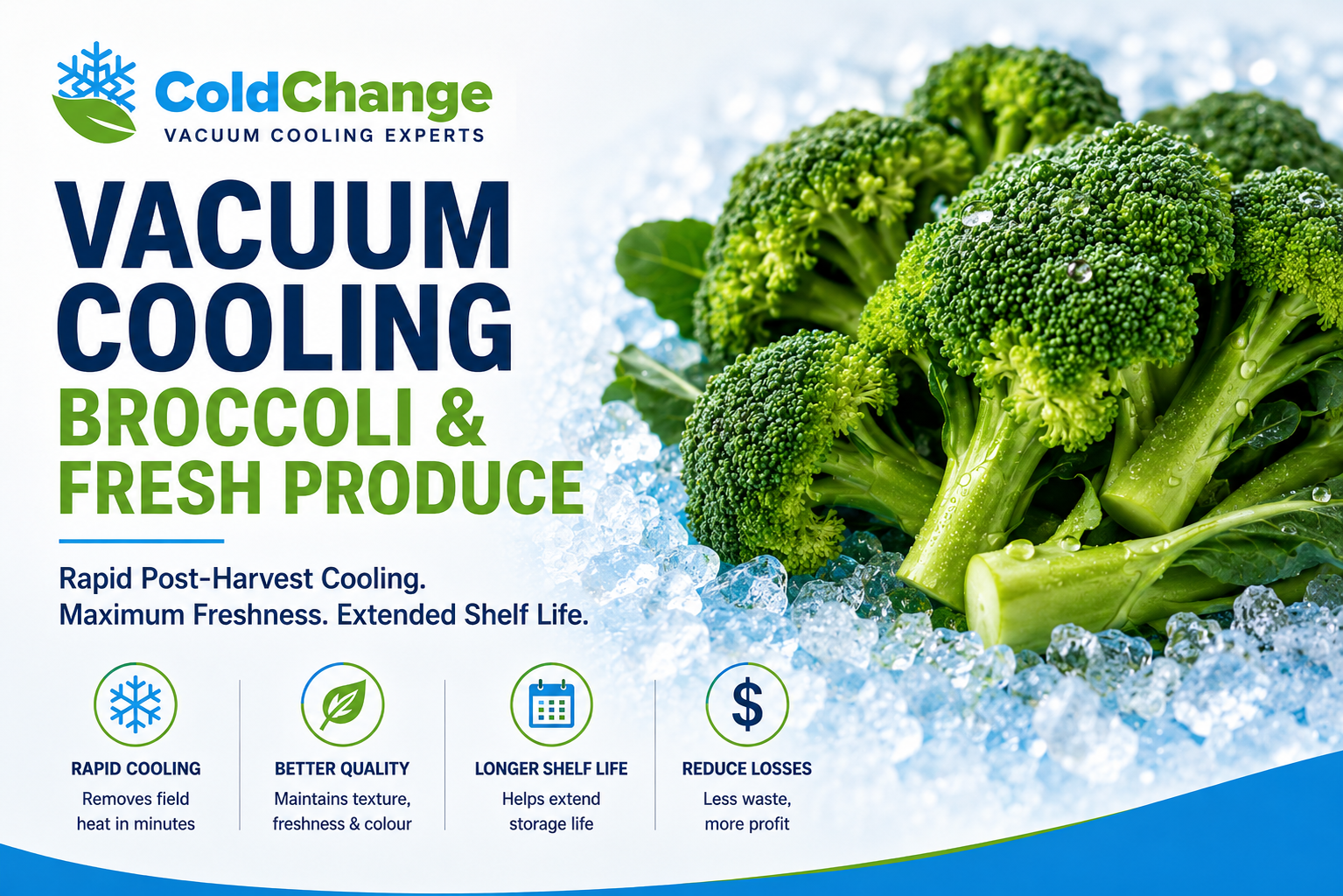
 Best Ways to Cool Broccoli After Harvest
Broccoli is one of the fresh produce crops that can benefit significantly from rapid cooling after harvest.
Once broccoli is harvested, it continues to respire. Heat retained from the field can contribute to deterioration if the temperature is not reduced quickly.
For commercial broccoli growers and packhouses, the challenge is therefore not simply keeping broccoli cold. It is removing field heat as quickly and efficiently as possible after harvest and then maintaining the required temperature throughout the cold chain.
There are several methods available for cooling broccoli, including vacuum cooling, hydro cooling, forced-air cooling and conventional cold-room cooling.
But which is the best way to cool broccoli?
In this guide, Cold Change compares the main commercial broccoli cooling methods and explains where each technology may be suitable.
We will also look at why vacuum cooling can provide extremely rapid pre-cooling for suitable fresh produce.
For businesses already considering vacuum cooling equipment, you can also view the complete Cold Change Vacuum Cooler Range.
Why Does Broccoli Need to Be Cooled Quickly?
Broccoli remains biologically active after harvesting.
Respiration continues after harvest, and temperature has an important influence on the rate at which fresh produce changes during storage.
Freshly harvested broccoli can enter a packhouse carrying significant field heat, particularly during warmer harvesting conditions.
Simply placing warm pallets inside a cold room does not necessarily remove this heat quickly.
Produce around the outside of the pallet may cool first. Produce deeper within the load can take considerably longer to reach the required temperature.
This is why dedicated pre-cooling equipment can be important for commercial growers.
Cold Change supplies a range of fresh produce pre-cooling systems designed for different products and production requirements.
Benefits of rapid broccoli cooling can include:
Faster removal of field heat
Faster establishment of the cold chain
Improved temperature consistency
Reduced cooling time
Reduced cooling demand on cold storage
Better control of post-harvest conditions
Support for maintaining product quality
Support for maximising commercial storage life
Faster preparation for refrigerated transportation
The best cooling method depends on the product, packaging, production volume and required cooling time.
What Is Pre-Cooling Broccoli?
Pre-cooling broccoli means rapidly removing field heat from freshly harvested produce before long-term refrigerated storage or transportation.
This is different from simply storing broccoli inside a cold room.
A cold room is primarily designed to maintain a low temperature.
A commercial pre-cooling system is designed to remove heat rapidly.
This distinction becomes increasingly important for larger commercial farms.
If several tonnes of warm broccoli arrive at a packhouse at the same time, the refrigeration system must remove a significant amount of heat.
Dedicated pre-cooling equipment can remove much of this heat before the product enters the main cold store.
Depending on the product and application, this could involve a vacuum cooler, hydro cooler or another rapid cooling technology.
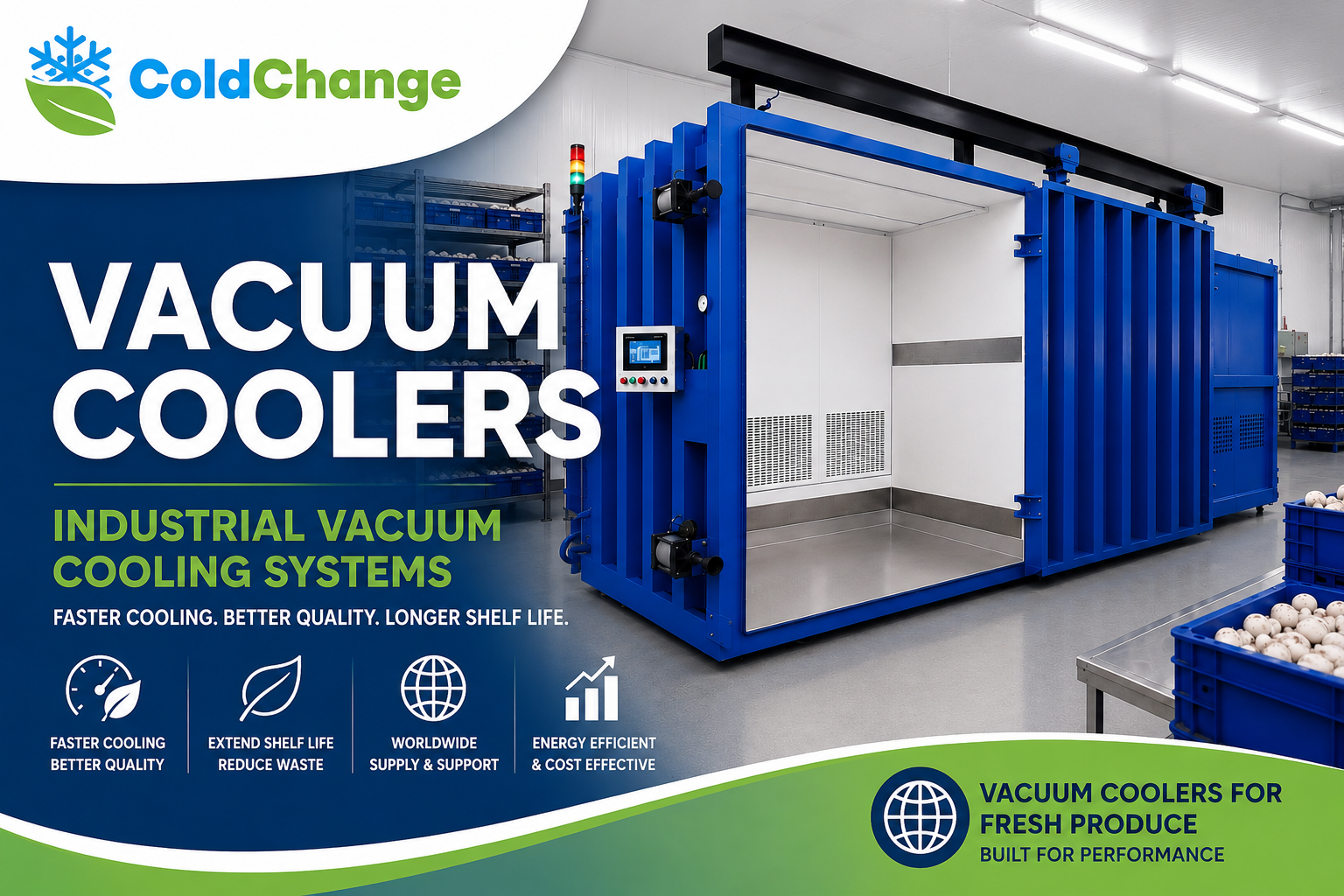
1. Vacuum Cooling Broccoli
Vacuum cooling can provide extremely rapid cooling for suitable fresh produce.
Instead of relying on cold air or chilled water to remove heat, a vacuum cooler reduces the pressure surrounding the product.
Freshly harvested broccoli is loaded into a sealed vacuum chamber.
Powerful vacuum pumps then reduce the pressure inside the chamber.
As pressure falls, the boiling point of water also falls.
A small quantity of moisture can therefore evaporate from suitable produce at a low temperature.
Evaporation requires energy. This energy is taken from the product in the form of heat.
As heat is removed, the temperature of the broccoli falls.
This allows suitable products to be cooled rapidly throughout the load.
Businesses considering this technology can compare our complete industrial vacuum cooling systems or browse the Vacuum Cooler Range.
Why Vacuum Cooling Can Be Effective for Broccoli
One of the major advantages of vacuum cooling is speed.
Cold Change vacuum cooling systems can typically be designed around cooling cycles of approximately 8–25 minutes, depending on product, weight, starting temperature, target temperature and operating conditions.
The process can also cool suitable produce throughout the pallet rather than relying solely on cold air gradually penetrating from the outside.
For commercial broccoli growers, potential advantages can include:
Rapid removal of field heat
Short cooling cycles
Cooling of complete pallet loads
High production throughput
Uniform cooling of suitable loads
Automatic and repeatable cooling cycles
Faster movement into refrigerated storage
Reduced load on downstream cold rooms
Integration into commercial packhouse operations
Cold Change supplies vacuum coolers ranging from the compact Single Pallet Vacuum Cooler and 2 Pallet Vacuum Cooler through to large high-capacity commercial systems.
2. Hydro Cooling Broccoli
Hydro cooling is another method of rapidly removing field heat from suitable fresh produce.
Instead of using reduced pressure, a hydro cooler uses chilled water.
The produce is exposed to cold water, allowing heat to transfer from the warmer product into the colder water.
Because water can transfer heat effectively, hydro cooling can provide rapid cooling for suitable products.
Cold Change supplies Hydro Cooling Systems alongside our vacuum cooling equipment.
This means the cooling method can be selected according to the actual product and production process.
Advantages of Hydro Cooling
Depending on the application, advantages can include:
Rapid heat removal
Continuous processing options
Effective heat transfer
Suitability for certain vegetables
Integration with harvesting and packing lines
However, hydro cooling requires direct contact with water.
Water quality, filtration, sanitation, drainage and product suitability therefore need to be considered.
Packaging must also be suitable for exposure to water.
For some broccoli operations, a Hydro Cooler may be an excellent solution.
For others, an industrial Vacuum Cooler may integrate more effectively into the existing process.
3. Forced-Air Cooling Broccoli
Forced-air cooling uses fans to pull or push refrigerated air through boxes and pallets of produce.
This is more active than simply placing produce inside a conventional cold room.
Correct packaging is important because cold air needs a clear route through the boxes and around the product.
Forced-air cooling performance depends on factors including:
Air temperature
Air velocity
Box ventilation
Pallet arrangement
Product density
Starting temperature
Required final temperature
Forced-air cooling can be useful where vacuum or water-based cooling is not appropriate.
However, cooling complete dense pallet loads can generally take longer than rapid vacuum cooling for suitable products.
4. Conventional Cold-Room Cooling
The simplest approach is to place freshly harvested broccoli directly into a refrigerated cold room.
This requires less specialised pre-cooling equipment.
However, it can also be one of the slower methods of removing substantial field heat from complete pallet loads.
Cold air first comes into contact with the outside of the boxes and pallets.
Heat from produce deeper inside the pallet then needs to transfer gradually towards the colder surrounding air.
As a result, the outside and centre of a pallet may not cool at the same rate.
This is one reason commercial growers may use a dedicated pre-cooling system before cold storage.
The cold room can then focus on maintaining the required storage temperature rather than removing the majority of the initial field heat.
Vacuum Cooling vs Hydro Cooling Broccoli
There is no single cooling technology that is automatically best for every broccoli operation.
Vacuum cooling uses reduced pressure and controlled evaporation.
Hydro cooling uses chilled water.
Vacuum cooling can be particularly attractive where growers require very fast batch cooling of complete pallet loads without using chilled water as the primary heat-transfer method.
Hydro cooling can be attractive where the product and packaging are suitable for water contact and where the system can be integrated into the production process.
Cold Change supplies both Vacuum Coolers and Hydro Coolers.
You can also explore the wider Cold Change Pre-Cooler Range to compare different technologies.
Vacuum Cooling vs Forced-Air Cooling Broccoli
Vacuum cooling and forced-air cooling remove heat in different ways.
Forced-air cooling relies on refrigerated air passing through the product and packaging.
Vacuum cooling removes heat through evaporation under reduced pressure.
For suitable produce, vacuum cooling systems can achieve rapid temperature reduction throughout the load.
This can make vacuum cooling particularly attractive where cooling speed, palletised loads and high throughput are priorities.
The correct choice should always be based on the individual product and production process.
What Is the Fastest Way to Cool Broccoli?
For suitable commercial applications, vacuum cooling can be one of the fastest methods of pre-cooling broccoli.
Cold Change vacuum cooling systems can typically achieve cooling cycles of approximately 8–25 minutes, depending on the application.
However, cooling time should never be selected from a generic figure alone.
The actual requirement depends on:
Weight of broccoli per pallet
Number of pallets
Starting temperature
Required final temperature
Packaging
Product condition
Vacuum pump capacity
Refrigeration capacity
Chamber design
A correctly sized vacuum cooling machine should therefore be designed around the grower’s actual production data.
Choosing the Correct Broccoli Vacuum Cooler
Cold Change manufactures vacuum cooling systems in a wide range of capacities.
For small growers, trials, specialist production and lower throughput, consider the Single Pallet Vacuum Cooler or 2 Pallet Vacuum Cooler.
For increasing production requirements, consider the 4 Pallet Vacuum Cooler, 6 Pallet Vacuum Cooler or 8 Pallet Vacuum Cooler.
Larger commercial operations can consider the 10 Pallet Vacuum Cooler or 12 Pallet Vacuum Cooler.
For very high-volume packhouses, Cold Change also offers the 14 Pallet Vacuum Cooler, 16 Pallet Vacuum Cooler, 18 Pallet Vacuum Cooler and 20 Pallet Vacuum Cooler.
The correct machine should be selected according to required throughput rather than simply choosing the largest chamber.
Compare the complete Cold Change Vacuum Cooler Range.
How Many Pallets of Broccoli Can Be Cooled Per Hour?
This depends on chamber capacity and total cycle time.
For example, a multi-pallet vacuum cooler can process several pallets simultaneously.
However, total cycle time includes more than the cooling stage.
Loading, vacuum pull-down, cooling, pressure equalisation and unloading all need to be considered.
Cold Change can calculate the required machine capacity using:
Pallets per hour
Kilograms per pallet
Tonnes per day
Operating hours per day
Starting temperature
Required final temperature
For lower throughput, a 4 Pallet Vacuum Cooler or 6 Pallet Vacuum Cooler may be appropriate.
For substantially higher production, systems such as the 12 Pallet Vacuum Cooler, 16 Pallet Vacuum Cooler or 20 Pallet Vacuum Cooler can be considered.
The final selection should be based on actual production data.
Energy-Efficient Broccoli Cooling
Cooling several tonnes of warm produce requires energy regardless of the cooling technology used.
The objective should therefore be to remove the required heat as efficiently as practical.
Cold Change can optimise the vacuum pumps, refrigeration system and PLC control program around the customer’s production requirements.
Factors such as production throughput, required cooling time, starting temperature and target temperature all influence equipment selection.
For facilities processing multiple products, the same industrial vacuum cooling system may also be configured with different cooling programs.
Intelligent Control for Multiple Products
Many vegetable packhouses do not process broccoli alone.
The same facility may handle lettuce, cauliflower, leafy greens, herbs and other vegetables.
Cold Change vacuum coolers can be supplied with a PLC and touchscreen HMI containing different cooling programs.
Operators can select the appropriate program for the product being cooled.
For businesses handling multiple crops, read our Vacuum Cooling Lettuce Guide and Vacuum Cooling Leafy Vegetables Guide.
This helps explain how the same vacuum cooling technology can be applied to different suitable fresh produce.
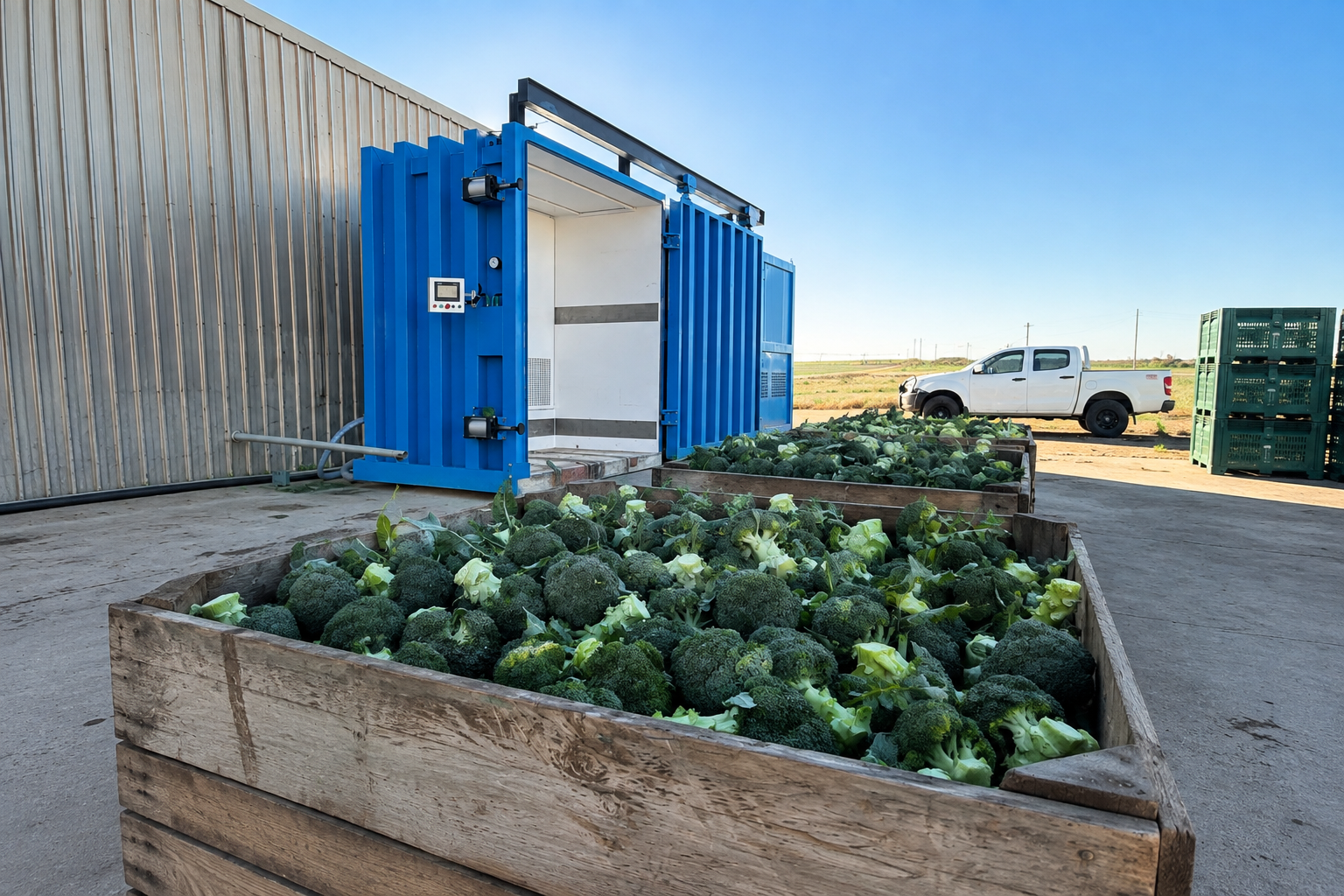
Cooling Mushrooms, Lettuce & Other Fresh Produce
Broccoli is only one application for commercial vacuum cooling.
Cold Change also supplies equipment for other suitable products.
For mushroom growers, read our Vacuum Cooling Mushrooms Guide.
For lettuce growers, read our Vacuum Cooling Lettuce Guide.
For spinach and other leafy crops, read our Vacuum Cooling Leafy Vegetables & Fresh Produce Guide.
These application pages connect to our complete Vacuum Cooler Range, allowing growers to compare machine capacities for their production requirements.
Other Commercial Pre-Cooling Equipment
Vacuum cooling is not the best cooling technology for every product.
Cold Change also supplies other pre-cooling equipment.
This includes Hydro Coolers, Blast Chillers and Blast Freezers.
This allows the cooling method to be selected according to the product, production process and required temperature.
Which Is the Best Way to Cool Broccoli?
The answer depends on the operation.
For some businesses, hydro cooling may provide the most appropriate solution.
For others, forced-air cooling may provide the required performance.
Smaller operations may rely primarily on refrigerated cold rooms.
However, where very rapid cooling, complete pallet cooling and high commercial throughput are priorities, vacuum cooling can be an excellent option for suitable broccoli applications.
The key is to select the cooling technology according to product, packaging, required temperature reduction and production throughput.
Businesses considering vacuum cooling can view all Cold Change Vacuum Coolers or learn more about how our vacuum cooling systems work.
Why Cold Change?
Cold Change specialises in vacuum cooling, vacuum chilling and rapid cold-chain technology for fresh produce.
We supply cooling systems for growers and packhouses across the UK, Europe, Australia, New Zealand, North America, the Middle East, Asia and other international markets.
Our equipment range includes Vacuum Coolers, Hydro Coolers, Blast Chillers and Blast Freezers.
Vacuum cooler capacities range from the Single Pallet Vacuum Cooler through to the 20 Pallet Vacuum Cooler.
This allows Cold Change to match the cooling system to the customer’s product and production requirements.
Looking for a Broccoli Cooling System?
If you are looking for the best way to cool broccoli after harvest, Cold Change can help assess the most suitable cooling system for your operation.
For a quotation, provide:
Weight of broccoli per pallet
Number of pallets per hour
Starting product temperature
Required final temperature
Pallet dimensions
Daily production volume
Installation country
We can then assess the required cooling duty and recommend the appropriate equipment.
Request a Broccoli Cooling System Quote
You can also view our complete Vacuum Cooler Range or explore all Cold Change Pre-Cooling Equipment.


