
Vacuum Cooling Celery – Rapid Post-Harvest Cooling for Fresh Celery
Vacuum cooling celery is a rapid and effective way to remove field heat from freshly harvested celery before refrigerated storage, packing and distribution.
For commercial celery growers, vegetable packhouses and fresh produce processors, rapidly reducing product temperature after harvest is an important part of maintaining an effective cold chain and protecting fresh produce quality.
Celery is commonly rapidly cooled after harvest before being stored at low temperatures. The University of California, Davis Postharvest Research and Extension Center recommends an optimum storage temperature of around 0°C (32°F)and relative humidity of 98–100% for celery.
Cold Change Group supplies industrial vacuum coolers and vacuum cooling systems for growers, farms, packhouses and food processors worldwide.
Why Is Rapid Cooling Important for Celery?
Freshly harvested celery can retain significant field heat, particularly when harvested during warmer weather.
Removing this heat quickly helps bring celery under temperature control sooner after harvesting, allowing it to enter refrigerated storage and distribution as part of a controlled cold chain.
Temperature management is particularly important for celery because the crop contains a high proportion of water and needs high humidity to help maintain freshness.
According to UC Davis Postharvest Research and Extension Center, celery is commonly rapidly cooled after harvest and can retain good quality for approximately 5–7 weeks under optimum storage conditions.
This makes effective celery pre-cooling an important consideration for commercial growers and fresh produce packhouses.
What Is the Best Way to Cool Celery After Harvest?
There are several methods available for cooling celery after harvest, including:
Refrigerated cold-room cooling
Forced-air cooling
Hydro cooling
Vacuum pre-cooling
The most suitable method depends on the product, packaging, pallet configuration, starting temperature, required final temperature and production throughput.
For suitable commercial applications, a vacuum cooler can provide rapid removal of field heat before celery enters refrigerated storage.
Cold Change Group designs industrial vacuum cooling equipment around the requirements of growers, packhouses and food processors.
How Does Vacuum Cooling Work?
A vacuum cooling system places the product inside a sealed chamber and reduces the atmospheric pressure around the load.
As atmospheric pressure falls, the boiling point of water decreases. A small amount of moisture contained within or on the surface of suitable fresh produce can therefore evaporate at a much lower temperature.
Evaporation requires energy.
That energy is taken from the product in the form of heat, causing the temperature of the celery to fall rapidly.
This process is known as vacuum cooling or vacuum pre-cooling.
Unlike conventional cold-room cooling, where refrigerated air must gradually remove heat from the product, a commercial vacuum cooler is specifically designed to rapidly reduce the temperature of suitable fresh produce.
Benefits of Pre-Cooling Celery
Rapid pre-cooling can provide several potential benefits for commercial celery operations.

Rapid Removal of Field Heat
A correctly specified industrial vacuum cooler can rapidly reduce the temperature of suitable celery following harvest.
This allows the crop to reach its required storage temperature sooner.
Improved Cold Chain Management
Rapid vacuum pre-cooling can help establish temperature control earlier in the post-harvest process.
This is particularly important when celery needs to be transported significant distances between the farm, packhouse, cold store and customer.
Consistent Batch Cooling
A correctly designed vacuum cooling system can provide repeatable cooling cycles across commercial loads.
The system can be specified around product weight, pallet configuration, starting temperature and required final temperature.
Reduced Cooling Duty on Cold Storage
Pre-cooling celery before it enters refrigerated storage can reduce the amount of field heat that the cold room needs to remove.
The vacuum cooler performs the rapid initial cooling stage, while the cold room maintains the required storage temperature.
High-Volume Commercial Cooling
Large celery growers and packhouses can use industrial vacuum coolers designed around their required production throughput.
Machine selection should be based on kilograms or tonnes of celery cooled per hour rather than simply the physical chamber capacity.
Celery Vacuum Cooling for Commercial Growers
A celery vacuum cooler should be selected according to the actual cooling requirement rather than simply choosing a machine based on pallet capacity.
Important factors include:
Weight of celery per pallet
Number of pallets per cycle
Starting product temperature
Required final temperature
Required cooling time
Cycles per hour
Total hourly throughput
Packaging configuration
Available electrical supply
Site conditions
A grower processing several tonnes of celery per hour will have very different cooling requirements from a smaller producer processing a few hundred kilograms per hour.
Cold Change Group can engineer a commercial vacuum cooling system around the individual production requirements.
Choosing the Right Cooling System
The correct system starts with understanding the complete production process.
A typical commercial celery operation may follow a process such as:
Harvest → Packing → Vacuum Pre-Cooling → Cold Storage → Refrigerated Distribution
The vacuum cooler provides the rapid initial reduction in temperature, while refrigerated storage maintains the required temperature afterwards.
Pre-cooling and cold storage therefore perform different but complementary jobs within the cold chain.
Vacuum Cooler Sizes for Celery
Cold Change Group manufactures a complete range of vacuum cooling machines for small, medium and high-volume fresh produce operations.
Single Pallet Vacuum Cooler
Our Single Pallet Vacuum Cooler provides a compact solution for smaller commercial operations and specialist fresh produce applications.
2 Pallet Vacuum Cooler
The 2 Pallet Vacuum Cooler provides additional batch capacity for growers requiring more throughput from a compact system.
4 Pallet Vacuum Cooler
The 4 Pallet Vacuum Cooler is designed for commercial growers and packhouses requiring increased cooling capacity.
6 Pallet Vacuum Cooler
The 6 Pallet Vacuum Cooler provides increased batch capacity for growing fresh produce operations.
8 Pallet Vacuum Cooler
The 8 Pallet Vacuum Cooler provides substantial commercial cooling capacity for larger production requirements.
10 Pallet Vacuum Cooler
The 10 Pallet Vacuum Cooler is designed for operations requiring significant quantities of fresh produce to be rapidly pre-cooled.
12 Pallet Vacuum Cooler
The 12 Pallet Vacuum Cooler provides high-volume batch cooling for larger growers, processors and packhouses.
14 Pallet Vacuum Cooler
The 14 Pallet Vacuum Cooler provides substantial pallet capacity for large commercial fresh produce operations.
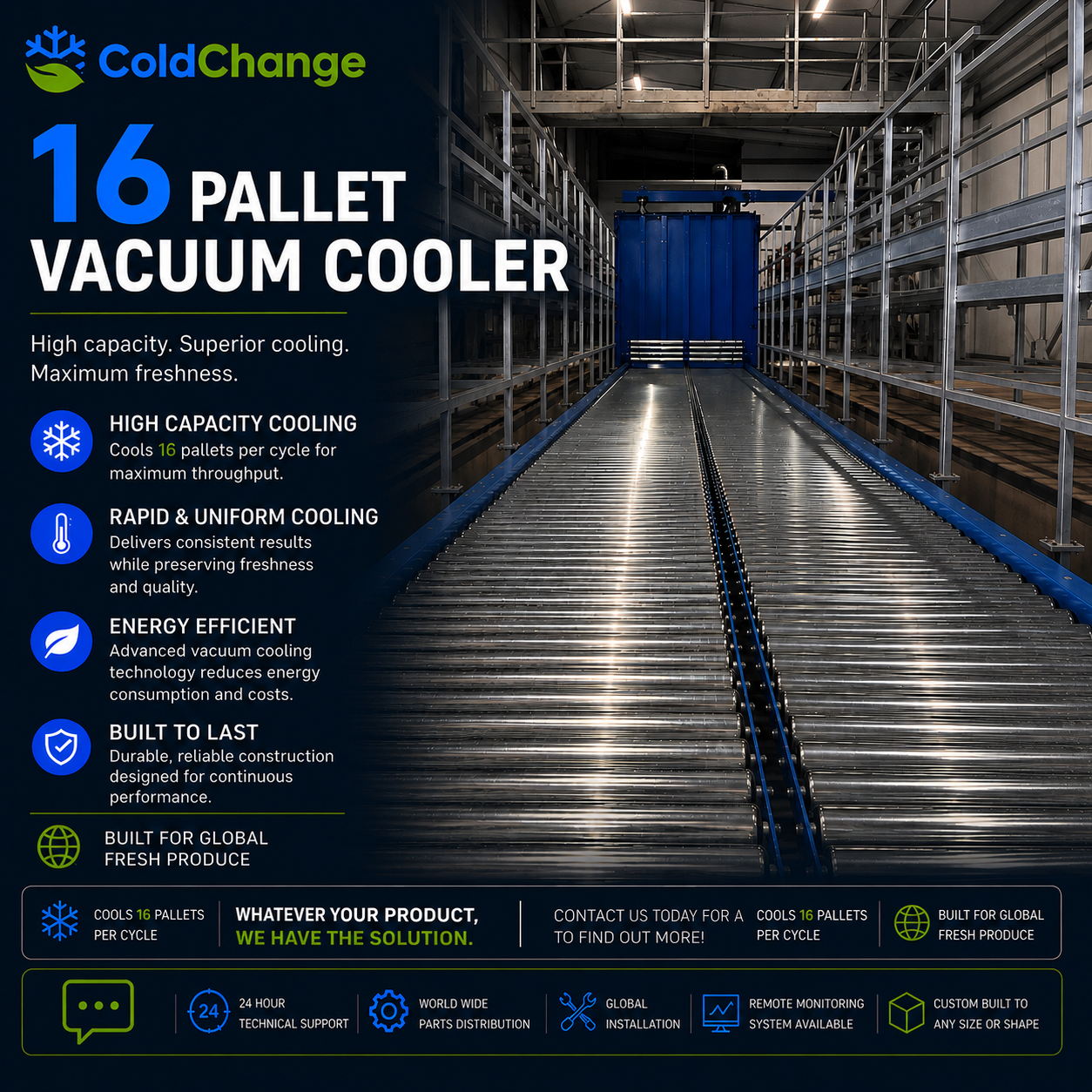
16 Pallet Vacuum Cooler
The 16 Pallet Vacuum Cooler is designed for major growers, packhouses and produce processors requiring high-capacity pre-cooling.
18 Pallet Vacuum Cooler
The 18 Pallet Vacuum Cooler provides very high batch capacity for large-scale fresh produce operations.
20 Pallet Vacuum Cooler
The 20 Pallet Vacuum Cooler provides high-capacity industrial cooling for major commercial growers and food processors.
20 Pallet Eco Vacuum Cooler
For operations looking at energy efficiency alongside high throughput, the 20 Pallet Eco Vacuum Cooler provides another industrial option.
The correct machine should always be selected according to the product weight, required temperature reduction, cooling time and hourly throughput.
How Quickly Can Celery Be Cooled?
The exact celery cooling time depends on the starting product temperature, required final temperature, product weight, pallet configuration, packaging and machine specification.
Vacuum cooling performance is also affected by the vacuum pump capacity and refrigeration system.
Cold Change Group’s vacuum cooling systems list typical cooling cycles of approximately 8–25 minutes, depending on product weight, starting temperature and required final temperature.
Each commercial celery application should be assessed individually to determine the appropriate equipment specification.
Celery Cooling and Shelf Life
Temperature management plays an important role in maintaining celery quality during storage and distribution.
UC Davis states that celery is commonly rapidly cooled after harvest and then stored at approximately 0–2°C (32–36°F). Under optimum conditions, good quality can be retained for around 5–7 weeks.
The same research also identifies 98–100% relative humidity as the optimum range for celery storage.
Rapid pre-cooling is therefore an important part of a wider post-harvest celery cooling strategy, alongside suitable refrigerated storage, humidity control, careful handling and refrigerated transportation.
Protecting Celery During Cooling and Handling
Cooling is only one part of maintaining celery quality.
Celery stalks can be susceptible to cracking, crushing and other physical damage during harvesting, packing and handling.
UC Davis notes that crushing or cracking can lead to rapid browning and decay, making careful harvesting, packing and handling particularly important.
For this reason, a commercial vacuum cooling system should be designed around the way the celery is harvested, packed and transported.
The objective is not simply to achieve a low temperature, but to develop a repeatable cooling process that works efficiently with the complete production operation.
What Other Products Can Be Vacuum Cooled?
Celery is just one of many fresh produce applications where rapid post-harvest cooling can be important.
Cold Change Group systems can be designed for a wide range of suitable fresh produce and horticultural products, including:
Asparagus
Leeks
Green onions
Turf
Cold Change Group’s vacuum cooling information also identifies mushrooms, lettuce, leafy vegetables, baby leaf, spinach, rocket, broccoli, cauliflower, celery, herbs, asparagus, watercress, cabbage, leeks, green onions, flowers and turf as suitable or potential applications depending on the product and cooling requirements.
This means a single industrial vacuum cooler can potentially be used across several crops during different harvesting seasons, helping diversified growers and packhouses maximise equipment utilisation.
Cooling Celery for Export and Long-Distance Distribution
Commercial celery may need to travel significant distances between the farm, packhouse, distribution centre and final customer.
Rapidly removing field heat before refrigerated transportation can help establish the cold chain earlier in the process.
For exporters and large vegetable growers, vacuum pre-cooling equipment should therefore be considered as part of the entire post-harvest logistics chain.
Cold Change Group supplies industrial vacuum cooling equipment internationally, with systems available for fresh produce operations across the UK, Europe, Australia, New Zealand, North America, Asia, Africa and the Middle East.
Vacuum Cooling vs Cold Room Cooling
Cold rooms are primarily designed to maintain the temperature of refrigerated produce.
When warm celery is placed directly into cold storage, the refrigeration system must first remove the field heat from the product.
A vacuum cooler is specifically designed to provide rapid pre-cooling before celery enters refrigerated storage.
For many commercial operations, the two systems therefore work together:
Vacuum cooler = rapid pre-cooling
Cold room = refrigerated storage
This approach allows the dedicated vacuum cooling system to perform the initial rapid cooling stage, while the cold store maintains the product temperature.
Vacuum Cooling vs Hydro Cooling
Hydro cooling uses chilled water to remove heat from suitable fresh produce.
It can be effective for products that can tolerate direct contact with water.
Vacuum cooling uses reduced atmospheric pressure and evaporation rather than direct chilled-water contact.
The correct cooling technology depends on the product, packaging, handling process, required cooling performance and overall cold-chain design.
Industrial Celery Cooling Systems
For large commercial growers and packhouses, the cooling system should be designed around production throughput.
Cold Change Group manufactures industrial vacuum coolers from single-pallet systems through to high-capacity multi-pallet installations.
Systems can be configured around:
Celery production volume
Pallet dimensions
Product weight
Cooling temperatures
Required cycle time
Refrigeration capacity
Vacuum pump configuration
Automation
Electrical requirements
Site conditions
This creates a commercial celery cooling system designed around the actual operation rather than a generic off-the-shelf specification.
Frequently Asked Questions About Cooling Celery
Can Celery Be Vacuum Cooled?
Yes. Celery is commonly rapidly cooled after harvest, and a correctly specified vacuum cooler can be used for suitable commercial celery applications.
What Temperature Should Celery Be Stored At?
UC Davis recommends an optimum storage temperature of approximately 0°C (32°F) for celery, with 98–100% relative humidity. Celery is commonly rapidly cooled and then stored at approximately 0–2°C.
How Do You Cool Celery Quickly After Harvest?
Commercial growers can use dedicated pre-cooling equipment to rapidly remove field heat. Vacuum cooling is one option for suitable celery loads and can provide rapid temperature reduction before refrigerated storage.
What Is a Celery Vacuum Cooler?
A celery vacuum cooler is an industrial pre-cooling machine that reduces atmospheric pressure around the product, allowing evaporation to remove heat rapidly from suitable fresh produce.
How Long Does Celery Take to Cool?
The cooling time depends on the starting temperature, required final temperature, product weight, pallet configuration, packaging and machine specification.
Cold Change Group systems can provide rapid cooling cycles, with exact performance determined for each individual application.
Can One Vacuum Cooler Be Used for Celery and Lettuce?
Potentially, yes. Vacuum cooling systems can be designed for multiple suitable fresh produce applications.
Cold Change Group systems can be used for products including celery, lettuce, broccoli, cauliflower, mushrooms, leafy vegetables, herbs and other suitable crops.
What Size Vacuum Cooler Do I Need for Celery?
The correct machine depends on product weight, pallets per cycle, starting temperature, required final temperature, target cooling time and total hourly throughput.
Cold Change Group supplies systems ranging from single-pallet machines through to large 20-pallet industrial vacuum coolers.
Looking for a Vacuum Cooler for Celery?
If you are a celery grower, vegetable producer, fresh produce packhouse or food processor looking for a faster and more controlled way to remove field heat after harvest, Cold Change Group can design a vacuum cooling system around your production requirements.
From compact single-pallet systems to high-capacity industrial machines, our vacuum coolers can be specified around your product, pallet configuration and production throughput.
Explore the Cold Change Group vacuum cooler range and find the right solution for your celery cooling requirements.
For independent information on celery post-harvest handling, storage temperatures and humidity requirements, see the UC Davis Postharvest Research and Extension Center celery guide.


