
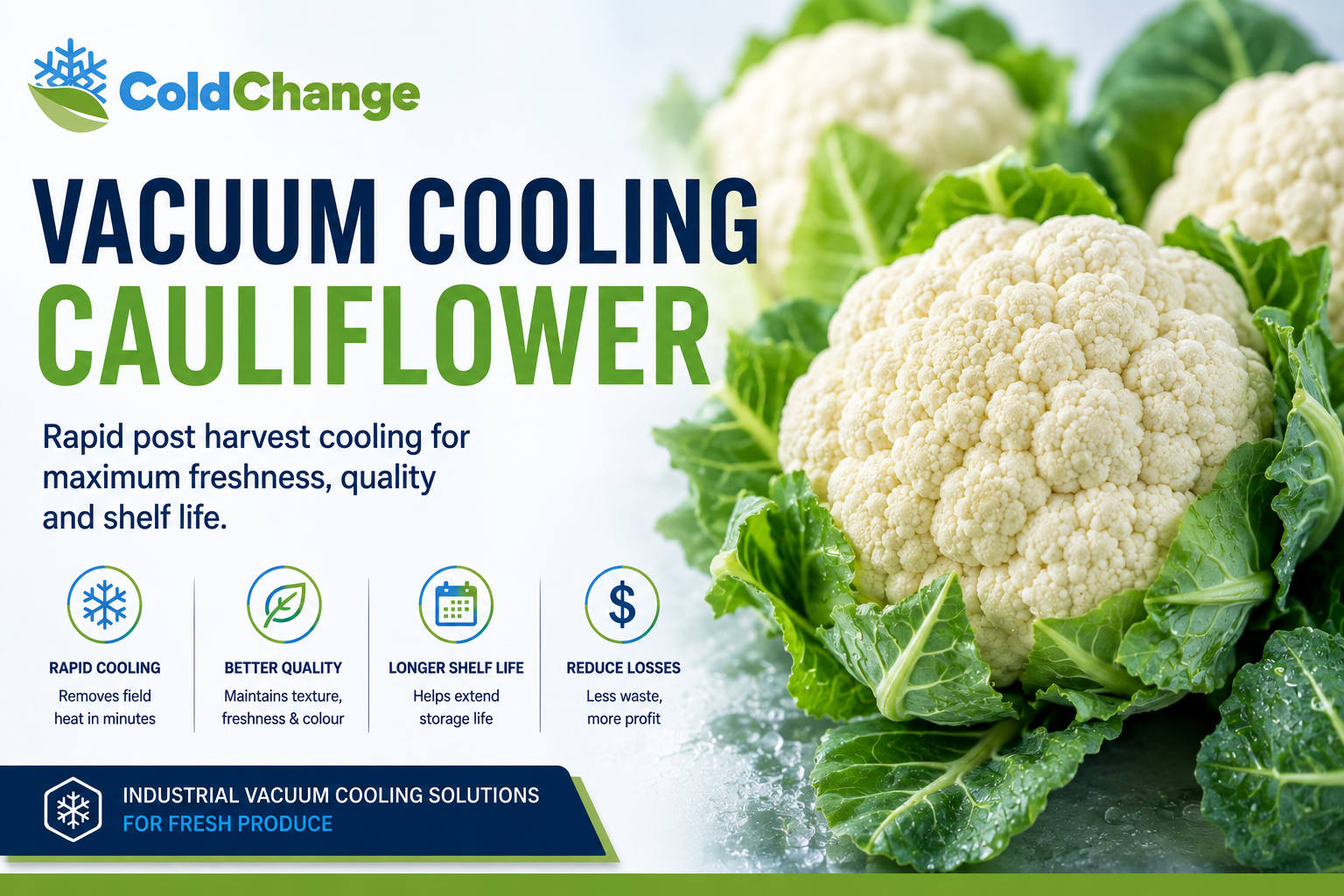
Vacuum Cooling Cauliflower – The Best Way to Rapidly Cool Cauliflower After Harvest
Vacuum cooling cauliflower is a fast and effective method of removing field heat from freshly harvested cauliflower before cold storage, packing and distribution.
For commercial cauliflower growers, fresh produce packhouses and vegetable processors, removing heat quickly after harvest is an important part of maintaining product quality and establishing an effective cold chain.
Traditional cold-room cooling relies on cold air gradually removing heat from the product. Vacuum cooling uses a completely different process, allowing suitable fresh produce such as cauliflower to be cooled rapidly and more uniformly.
Cold Change Group designs and supplies industrial vacuum coolers for fresh produce for growers, farms, packhouses and food processors worldwide.
Why Is Rapid Cooling Important for Cauliflower?
Cauliflower can retain considerable field heat after harvest, particularly when harvested during warmer conditions.
Once cauliflower has been harvested, rapidly reducing its temperature can help establish the cold chain sooner before the product enters refrigerated storage and distribution.
An effective cauliflower pre-cooling system can therefore form an important part of a commercial post-harvest operation.
Important considerations include:
Rapid removal of field heat
Fast post-harvest temperature reduction
Consistent cooling across commercial loads
Maintaining an effective cold chain
Reducing the cooling load placed on cold rooms
Preparing cauliflower for refrigerated storage
Preparing fresh produce for transport and export
For high-volume vegetable growers, cooling speed can also have a significant impact on packhouse throughput.
What Is the Best Way to Cool Cauliflower?
There are several methods available for cooling cauliflower after harvest, including cold-room cooling, forced-air cooling, hydro cooling and vacuum cooling.
The correct method depends on the product, packaging, starting temperature, required final temperature and processing operation.
For suitable commercial applications, vacuum pre-cooling cauliflower can provide extremely rapid temperature reduction.
Cold Change Group supplies a complete range of vacuum cooling systems designed for fresh produce applications.
How the Cooling Process Works?
A vacuum cooler operates by placing the harvested product inside a sealed vacuum chamber.
Powerful vacuum pumps then reduce the atmospheric pressure inside the chamber.
As the pressure decreases, the boiling point of water also decreases. A small amount of moisture within or around the product can therefore evaporate at a much lower temperature.
Evaporation requires energy.
That energy is taken from the cauliflower in the form of heat, causing the product temperature to fall rapidly.
This process is known as vacuum cooling or vacuum pre-cooling.
Unlike conventional air cooling, which relies on refrigerated air gradually penetrating boxes and pallets, vacuum cooling can remove heat throughout suitable palletised loads.
Vacuum Cooling vs Cold Room Cooling for Cauliflower
A refrigerated cold room is primarily designed to maintain product temperature.
When warm cauliflower is placed directly into a cold room, however, the refrigeration system must remove the field heat contained within the product.
Heat must gradually transfer from the cauliflower into the surrounding refrigerated air.
A cauliflower vacuum cooler is specifically designed to rapidly remove this field heat before the product enters refrigerated storage.
For many commercial operations, vacuum cooling and cold storage therefore work together:
Harvest → Vacuum Pre-Cooling → Cold Storage → Refrigerated Distribution
This allows the cold room to concentrate on maintaining temperature rather than performing the entire initial cooling process.
How Fast Can a Vacuum Cooler Cool Cauliflower?
The required cauliflower cooling time depends on several factors:
Starting product temperature
Required final temperature
Weight of cauliflower per pallet
Number of pallets per cycle
Packaging and airflow characteristics
Vacuum pump capacity
Refrigeration capacity
Vacuum chamber design
Required production throughput
Cold Change Group vacuum cooler systems typically list cooling cycles of approximately 8–25 minutes, depending on the product, load weight, starting temperature and required final temperature.
Every commercial cauliflower operation should therefore be assessed individually rather than assuming one cooling time or machine size will suit every grower.
Cooling Solutions for Commercial Growers
A commercial vacuum cooler for cauliflower should be selected according to production throughput rather than simply chamber dimensions.
For example, a grower should consider:
How many tonnes of cauliflower need to be cooled every hour?
The answer determines the required combination of:
Pallets per cycle
Product weight per pallet
Cooling time
Cycles per hour
Vacuum pump capacity
Refrigeration capacity
Cold Change Group supplies machines ranging from compact single pallet vacuum coolers through to large industrial systems.
Small and Medium Cauliflower Vacuum Coolers
Smaller growers and specialist vegetable producers may require lower-capacity batch systems.
Options include:
These systems can provide commercial vacuum pre-cooling while matching the throughput requirements of smaller and medium-sized fresh produce operations.
High-Capacity Systems for Large Packhouses
Large farms, vegetable processors and packhouses may need to cool significant quantities of cauliflower every hour.
Cold Change Group manufactures larger industrial systems including the:
and
Machine selection should always consider kilograms or tonnes per hour, rather than simply selecting the largest possible chamber.
Cooling Multiple Brassica Crops
Cauliflower and broccoli have similar commercial requirements when it comes to rapidly removing field heat after harvesting.
Both products can benefit from an effective post-harvest pre-cooling process before refrigerated storage and distribution.
This makes vacuum cooling particularly relevant to growers and packhouses processing several brassica crops through the same facility.
A correctly designed industrial vacuum cooler can potentially be configured for multiple suitable fresh produce products rather than being dedicated exclusively to cauliflower.
Vacuum Cooling Other Vegetables
One advantage for diversified growers is that vacuum cooling technology can be suitable for numerous fresh produce applications.
Cold Change Group vacuum cooling systems can be designed for products including:
Cauliflower
Broccoli
Lettuce
Leafy vegetables
Spinach
Rocket
Watercress
Cabbage
Celery
Asparagus
Herbs
Leeks
Green onions
Mushrooms
Cut flowers
Read more about vacuum cooling lettuce and vacuum cooling mushrooms.
You can also explore the complete industrial vacuum cooler range.
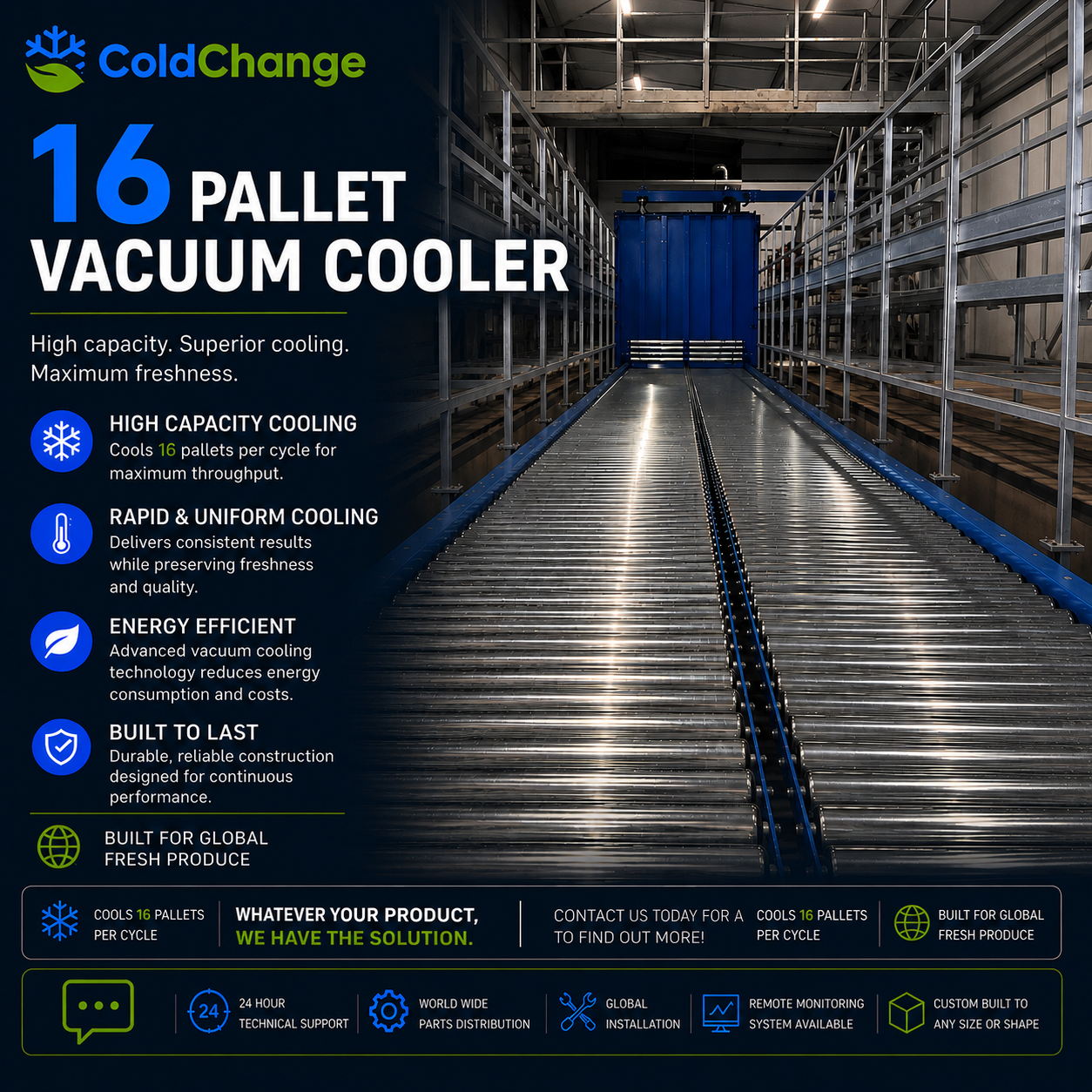
Choosing a Vacuum Cooler for Cauliflower
Before selecting a vacuum cooler for cauliflower, Cold Change Group recommends establishing the actual cooling duty.
Useful information includes:
Product: Cauliflower
Pallets per cycle: How many pallets need cooling simultaneously?
Weight per pallet: What is the average product weight?
Starting temperature: What temperature is the cauliflower when it enters the machine?
Required final temperature: What temperature should it reach?
Cooling time: How quickly must the temperature reduction be achieved?
Hourly throughput: How many kilograms or tonnes need cooling every hour?
Operating hours: How many hours per day will the vacuum cooler operate?
Using this information, the vacuum chamber, vacuum pumps and refrigeration system can be engineered around the actual production requirement.
Industrial Cauliflower Pre-Cooling Systems
Commercial vegetable cooling equipment should be designed around the complete process.
Cold Change Group supplies industrial vacuum cooling systems from single-pallet machines through to large automated multi-pallet installations.
Systems can be configured according to:
Production capacity
Pallet dimensions
Product weight
Cooling temperatures
Required cycle time
Refrigeration capacity
Vacuum pump configuration
Door configuration
Conveyor requirements
Electrical specification
Refrigerant requirements
Controls and automation
This makes it possible to develop a cauliflower cooling system specifically around the requirements of the grower or packhouse.
Worldwide Supply and Installation
Cold Change Group supplies commercial vacuum coolers and industrial pre-cooling equipment worldwide.
Systems can be supplied for cauliflower growers, vegetable farms, packhouses and fresh produce processors throughout:
United Kingdom
Europe
Australia
New Zealand
USA
Canada
South America
Middle East
Asia
Africa
Whether you require a compact machine for a smaller vegetable operation or a high-throughput industrial cauliflower vacuum cooling system, the equipment can be selected around the required production capacity.
Frequently Asked Questions About Cooling Cauliflower
Can cauliflower be vacuum cooled?
Yes. Cauliflower is one of the fresh produce applications suitable for vacuum cooling when the system and process are correctly designed for the product and cooling requirement.
What is vacuum cooling cauliflower?
Vacuum cooling cauliflower involves reducing atmospheric pressure around the product so that a small amount of moisture evaporates at a low temperature. The evaporation removes heat from the cauliflower, producing rapid cooling.
How do you cool cauliflower quickly after harvest?
Commercial growers can use dedicated pre-cooling equipment to rapidly remove field heat. Vacuum cooling is one method that can provide fast temperature reduction for suitable cauliflower loads.
Is vacuum cooling faster than a cold room?
A vacuum cooler is specifically designed for rapid pre-cooling, while a cold room is primarily used to maintain refrigerated temperatures. For suitable products and correctly specified equipment, vacuum cooling can remove field heat substantially faster than relying solely on conventional cold-room cooling.

Can the same vacuum cooler cool broccoli and cauliflower?
Potentially, yes. Industrial vacuum coolers can be engineered for multiple suitable fresh produce applications. Product weight, temperatures, packaging and required cooling time should be considered for each product.
What size vacuum cooler do I need for cauliflower?
The correct size depends on the weight per pallet, pallets per cycle, starting temperature, required final temperature, target cycle time and total hourly throughput.
Cold Change Group supplies industrial vacuum coolers from single-pallet machines through to high-capacity 20-pallet systems.
Looking for a Vacuum Cooler for Cauliflower?
If you are a cauliflower grower, vegetable producer, fresh produce packhouse or food processor looking to improve your post-harvest cooling process, Cold Change Group can design a vacuum cooling system around your production requirements.
Our systems are available for small, medium and high-volume operations, with machines ranging from single-pallet units to large automated industrial vacuum cooling installations.
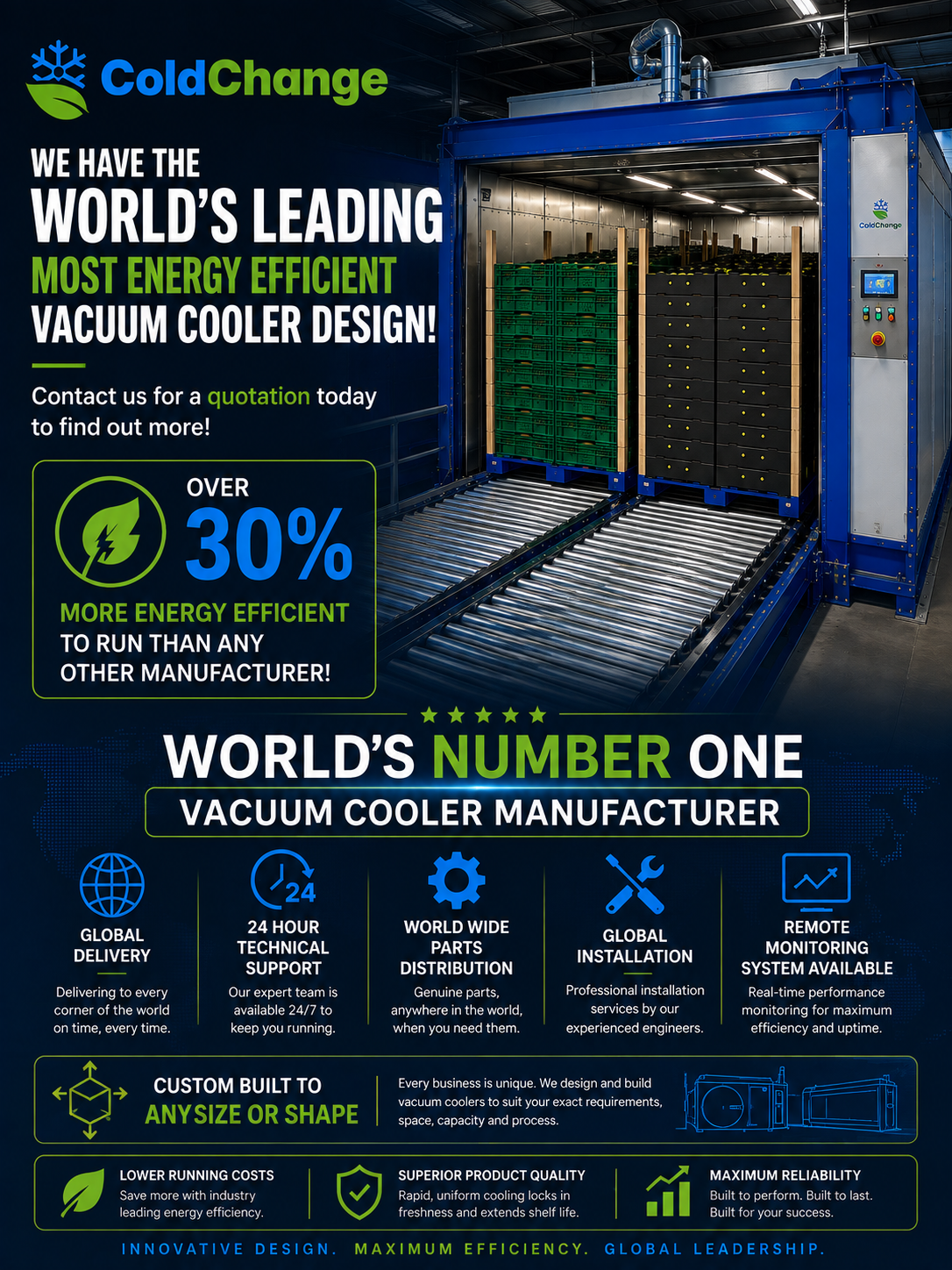
View the complete Cold Change Group vacuum cooler range and find the right vacuum cooling system for cauliflower and fresh vegetables.


