Vacuum Pre-Cooling for Fresh Produce
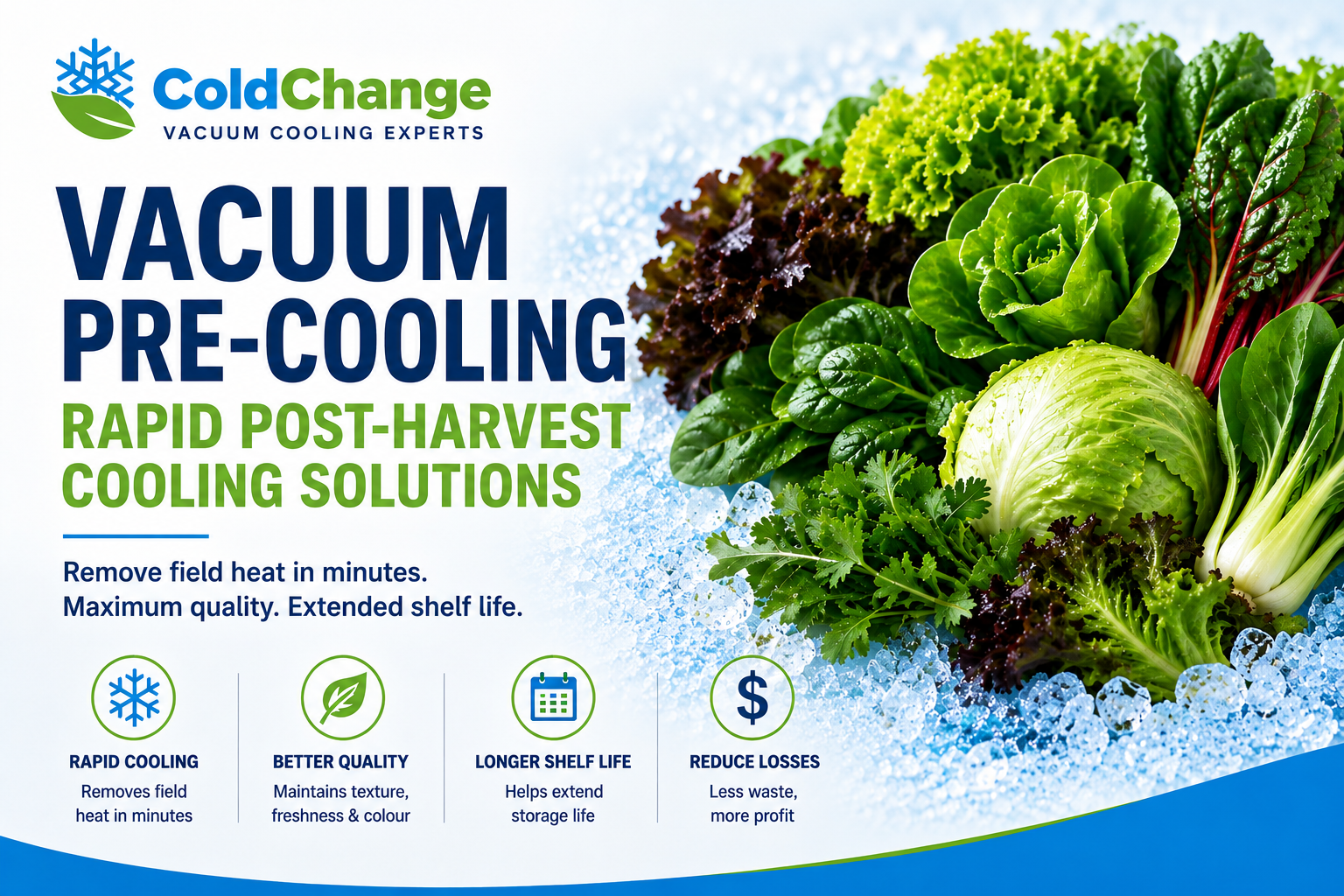
Vacuum pre-cooling provides a fast and effective way to remove field heat from suitable fresh produce immediately after harvest. Cold Change Group supplies industrial cooling systems for growers, farms, packhouses, fresh produce processors and exporters worldwide.
Unlike conventional cold rooms, which rely on refrigerated air gradually removing heat from a product, vacuum coolingworks by reducing atmospheric pressure inside a sealed chamber. This allows a small amount of moisture to evaporate at a low temperature, rapidly removing heat from the produce.
The technology is particularly suitable for products with a high surface-area-to-weight ratio, including lettuce, leafy vegetables, herbs, mushrooms, broccoli, cauliflower, spinach, watercress and other suitable fresh produce.
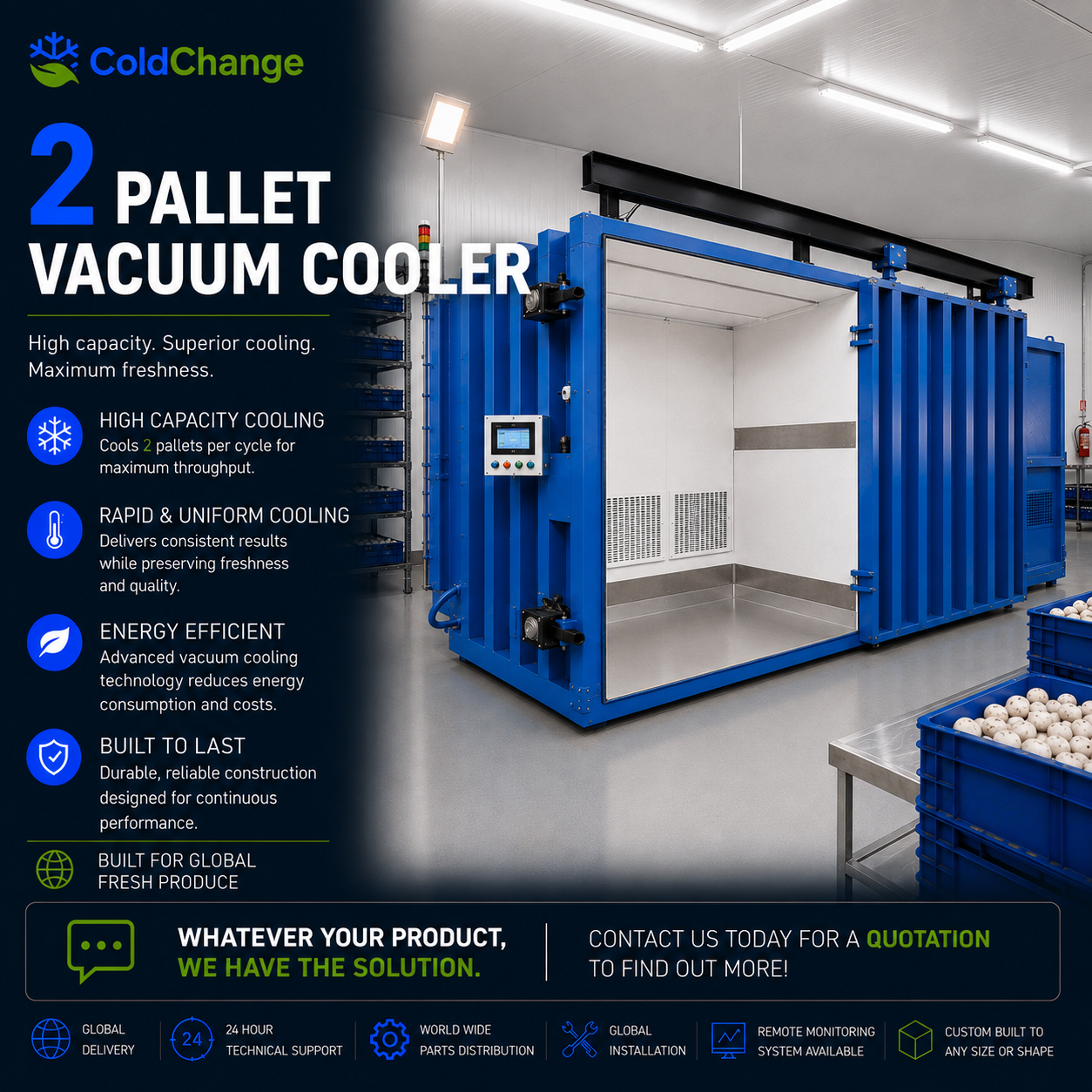
Cold Change Group supplies industrial vacuum coolers ranging from compact single-pallet machines to large commercial systems capable of processing multiple pallet loads per cycle.
What Is Vacuum Pre-Cooling?
Pre-cooling refers to the rapid removal of field heat from fresh produce following harvest and before refrigerated storage, processing or transportation.
Freshly harvested vegetables can retain significant amounts of heat, particularly when harvested during warm conditions. Removing this heat quickly is an important part of effective post-harvest cooling and cold-chain management.
A vacuum precooler places the produce inside a sealed chamber and progressively reduces atmospheric pressure.
As the pressure falls, the boiling point of water also decreases. A small amount of moisture within or on the surface of the product can then evaporate at a much lower temperature.
Evaporation requires energy, and that energy is taken from the produce as heat. The result is a rapid reduction in product temperature.
This process is commonly known as vacuum cooling, vacuum precooling or vacuum pre-cooling.
The Food and Agriculture Organization of the United Nations identifies vacuum cooling as an established method for rapidly pre-cooling suitable fresh produce.
For more information about the technology and available equipment, visit our industrial vacuum cooler guide.
Why Is Pre-Cooling Fresh Produce Important?
Fresh produce continues biological activity after harvesting. Temperature management therefore becomes an important part of maintaining produce quality throughout storage and distribution.
Removing field heat quickly establishes the cold chain sooner and reduces the amount of heat that subsequently needs to be removed by refrigerated storage.
Effective fresh produce precooling can help:
Rapidly remove field heat after harvesting
Reduce produce temperature before cold storage
Establish the cold chain sooner
Improve temperature consistency throughout pallet loads
Reduce the initial cooling load on conventional cold rooms
Prepare produce for refrigerated transportation
Support post-harvest quality management
Improve production throughput where rapid cooling is required
The FAO provides further information about temperature management and cooling during post-harvest handling.
How Does a Vacuum Precooler Work?
An industrial system combines a sealed chamber, high-capacity vacuum pumps, refrigeration equipment, vapour-condensing equipment and automatic controls.
Although individual machine designs vary, the basic process consists of several stages.
1. Loading the Fresh Produce
Produce is loaded into the vacuum chamber, normally in crates, cartons or complete pallet loads.
Depending on production requirements, systems can be designed for anything from a single pallet vacuum cooler through to large commercial multi-pallet installations.
2. Creating the Vacuum
Once the chamber door is securely closed, the vacuum pumps begin removing air.
As atmospheric pressure inside the chamber decreases, the boiling point of water falls.
3. Rapid Evaporative Cooling
At sufficiently low pressure, a small quantity of moisture begins to evaporate from the product.
Evaporation requires energy. This energy is taken from the produce in the form of heat, causing its temperature to decrease rapidly.
4. Removing Water Vapour
The water vapour produced during cooling is captured by the refrigeration and condensing system.
Removing this vapour allows the vacuum system to continue operating efficiently throughout the cooling cycle.
5. Reaching the Required Temperature
The process continues until the required product temperature or programmed cooling endpoint has been achieved.
The chamber then returns to atmospheric pressure and the cooled produce can be unloaded for cold storage, packing, processing or refrigerated transportation.
Vacuum Cooling vs Conventional Cold Rooms
A cold room and a rapid precooling system perform different functions within the cold chain.
Cold rooms are excellent for maintaining produce at its required storage temperature. However, they are not always the fastest method of removing large amounts of field heat immediately after harvesting.
Conventional refrigeration relies primarily on heat transferring from the product into refrigerated air.
Vacuum technology removes heat through controlled evaporation under reduced pressure.
For suitable fresh produce, this can provide much faster temperature reduction throughout a pallet load.
A typical commercial cold chain may therefore look like:
Harvest → Rapid Pre-Cooling → Cold Storage → Refrigerated Transport
The precooler rapidly reduces the product temperature, while the cold room subsequently maintains it.
Learn more about industrial vacuum cooling
Vacuum Cooling vs Forced-Air Cooling
Forced-air cooling uses refrigerated air drawn or pushed through containers and around the fresh produce.
It is widely used for many horticultural products and can provide effective cooling when correctly designed.
Vacuum technology operates differently because cooling does not rely on refrigerated air gradually travelling through every box and around individual products.
For suitable crops, temperature reduction can occur throughout the load as atmospheric pressure decreases.
This makes the technology particularly attractive for high-throughput fresh produce operations requiring fast cooling cycles.
Vacuum Cooling vs Hydrocooling
Hydrocooling removes heat by bringing produce into contact with chilled water.
It can be highly effective for products that tolerate direct water contact.
Vacuum systems instead use controlled evaporation under reduced pressure.
The most appropriate technology depends on the product, packaging, starting temperature, required final temperature, throughput and required cooling time.
What Products Can Be Vacuum Cooled?
Vacuum technology is particularly effective for products with a relatively high surface-area-to-weight ratio.
Cold Change Group supplies equipment for a wide range of fresh produce applications.
Vacuum Cooling Lettuce
Lettuce is one of the best-known applications for commercial vacuum cooling.
Its large surface area makes leafy lettuce particularly suitable for rapid evaporative temperature reduction.
The UC Davis Postharvest Research and Extension Center identifies vacuum cooling and hydro-vacuum cooling among the common initial cooling methods used for crisphead lettuce.
Vacuum Cooling Leafy Vegetables
Leafy vegetables are among the products most commonly associated with this technology.
Suitable applications can include:
Leaf lettuce
Baby leaf
Spinach
Rocket
Watercress
Cabbage
Pak choi
Fresh herbs
Salad leaves
Our vacuum cooling leafy vegetables and fresh produce guide provides further information about the technology across a wider range of leafy crops.
Vacuum Cooling Mushrooms
Rapid temperature reduction is an important consideration during post-harvest mushroom handling.
Commercial vacuum coolers can process large quantities of freshly harvested mushrooms before cold storage, packing and distribution.
Read our complete guide to vacuum cooling mushrooms.
Vacuum Cooling Broccoli
Removing field heat quickly can be important when preparing freshly harvested broccoli for storage and distribution.
Industrial cooling systems can be designed around the required load weight, starting temperature, final temperature and production throughput.
Broccoli is also one of the fresh-produce applications covered within our industrial vacuum cooling systems guide.
Vacuum Cooling Cauliflower
Freshly harvested cauliflower can also require rapid temperature management before cold storage and refrigerated transportation.
Cold Change Group supplies vacuum cooling equipment for fresh produce, including systems suitable for a range of vegetable applications.
Vacuum Cooling Sweetcorn
Fresh sweetcorn benefits from rapid temperature management following harvest.
Cooling the product quickly forms an important part of the post-harvest cold chain.
Our vacuum cooling applications include sweetcorn alongside a wide range of other fresh produce.
Vacuum Cooling Herbs
Fresh herbs typically have a high surface-area-to-weight ratio, making vacuum technology particularly interesting for commercial herb growers and packhouses.
Suitable products can include parsley, coriander, mint and other fresh herbs.
Explore vacuum cooling systems for fresh produce.
Vacuum Cooling Watercress
Watercress and similar leafy products can also be suitable for rapid cooling where fast temperature reduction is required immediately following harvesting.
Vacuum Cooling Cut Flowers
The technology is not limited to food products.
Suitable cut flowers can also be rapidly cooled following harvesting to assist with temperature management before storage and distribution.
How Fast Is Vacuum Pre-Cooling?
One of the major advantages of the process is its ability to achieve rapid temperature reduction.
There is no single cycle time that applies to every product or installation.
Cooling performance depends on:
Product type
Product weight
Starting temperature
Required final temperature
Packaging
Pallet configuration
Vacuum pump capacity
Refrigeration capacity
Chamber dimensions
Required hourly throughput
This is why Cold Change Group designs commercial systems around the actual cooling duty, rather than simply the number of pallets that can fit inside the chamber.
Two customers using the same number of pallets may require significantly different refrigeration and vacuum capacities.
Industrial Vacuum Pre-Cooling Systems
Cold Change Group supplies industrial systems for small, medium and high-volume fresh produce operations.
The complete vacuum cooler range includes machines from compact single-pallet systems through to high-capacity 20-pallet installations.
For example, growers with smaller production requirements can consider the Single Pallet Vacuum Cooler, while higher-throughput operations can use machines such as the 4 Pallet Vacuum Cooler, 10 Pallet Vacuum Cooler or 20 Pallet Vacuum Cooler.
Systems can be engineered around the customer’s product, pallet configuration, load weight, starting temperature, final temperature, required cycle time and hourly throughput.
Choosing the Correct Vacuum Precooler
Selecting the correct machine should not be based solely on the number of pallets that fit inside the chamber.
Several factors determine the correct system specification.
Product Type
Different products behave differently under vacuum. The produce being cooled is therefore one of the first considerations when designing a system.
Product Weight
The total kilograms of produce loaded during each cycle directly affects the required refrigeration capacity.
Starting Temperature
Produce harvested under warm conditions can require substantially more heat removal than produce entering the machine at a lower temperature.
Required Final Temperature
The difference between the starting and final temperature helps determine the total cooling duty.
Required Cycle Time
Businesses requiring high production throughput may require increased vacuum pumping and refrigeration capacity.
Hourly Throughput
Commercial equipment should ultimately be designed around the required kilograms or tonnes of produce per hour, rather than simply chamber size.
Future Production Requirements
Allowing for expected production growth can prevent cooling equipment becoming a production bottleneck in the future.
Cold Change Group can calculate the appropriate vacuum pump capacity, refrigeration duty and chamber configuration from the customer’s production requirements.
Fresh Produce Pre-Cooling for Growers and Packhouses
Commercial fresh produce businesses depend on effective temperature management throughout harvesting, packing, storage and distribution.
A correctly specified rapid cooling system can become the first major refrigeration stage in the cold chain.
Cold Change Group supplies equipment for:
Fresh produce growers
Vegetable farms
Mushroom farms
Salad processors
Herb growers
Packhouses
Fresh produce exporters
Food processors
Distribution centres
Whether installing vacuum technology for the first time or replacing an existing machine, equipment can be engineered around the required production capacity.
Vacuum Pre-Coolers for Sale
Cold Change Group supplies vacuum precoolers and industrial vacuum cooling systems for sale worldwide.
Equipment is available for projects throughout the United Kingdom, Europe, Australia, New Zealand, USA, Canada, South America, Asia, Middle East and Africa.
Systems can be configured around local electrical requirements, operating conditions, pallet configuration, refrigerant selection and required cooling capacity.
Frequently Asked Questions
What Is Vacuum Pre-Cooling?
Vacuum pre-cooling is a rapid cooling process that reduces atmospheric pressure around suitable fresh produce. This allows a small quantity of moisture to evaporate at low temperature, removing heat from the product.
Is Vacuum Precooling the Same as Vacuum Cooling?
The terms are closely related. Vacuum cooling describes the technology, while vacuum precooling commonly refers to using that technology as an initial cooling process following harvest and before refrigerated storage or transportation.
What Is a Vacuum Precooler?
A vacuum precooler is an industrial machine containing a sealed chamber, vacuum pumping equipment, refrigeration system and automatic controls designed to rapidly cool suitable products.
Why Should Fresh Produce Be Pre-Cooled?
Pre-cooling removes field heat and reduces product temperature before produce enters refrigerated storage or transportation.
Can a Vacuum Cooler Replace a Cold Room?
Usually the technologies perform complementary functions. A vacuum cooler rapidly removes heat from suitable produce, while a cold room subsequently maintains the required storage temperature.
Which Vegetables Can Be Vacuum Cooled?
The technology is particularly suitable for many leafy and high-surface-area products. Applications can include lettuce, leafy greens, spinach, herbs, watercress, broccoli, cauliflower and other suitable fresh produce.
What Size Vacuum Precooler Do I Need?
The correct system depends on the product, kilograms per pallet, pallets per cycle, starting temperature, required final temperature, required cooling time and hourly production throughput.
Vacuum Pre-Cooling Systems from Cold Change Group
Cold Change Group designs and supplies industrial vacuum cooling and precooling equipment for fresh produce operations worldwide.
Whether you require a compact machine for a smaller production facility or a high-capacity multi-pallet installation for a major commercial packhouse, equipment can be engineered around your specific production requirements.
Our range extends from single-pallet through to 20-pallet systems, with bespoke configurations available for larger or specialised projects.
To help select the correct system, provide Cold Change Group with:
Product being cooled
Kilograms per pallet
Number of pallets per cycle
Starting product temperature
Required final temperature
Required cooling time
Operating hours per day
From this information, we can determine the appropriate cooling capacity, refrigeration duty and vacuum pump configuration for your operation.
View the complete Cold Change Group industrial vacuum cooler range.