
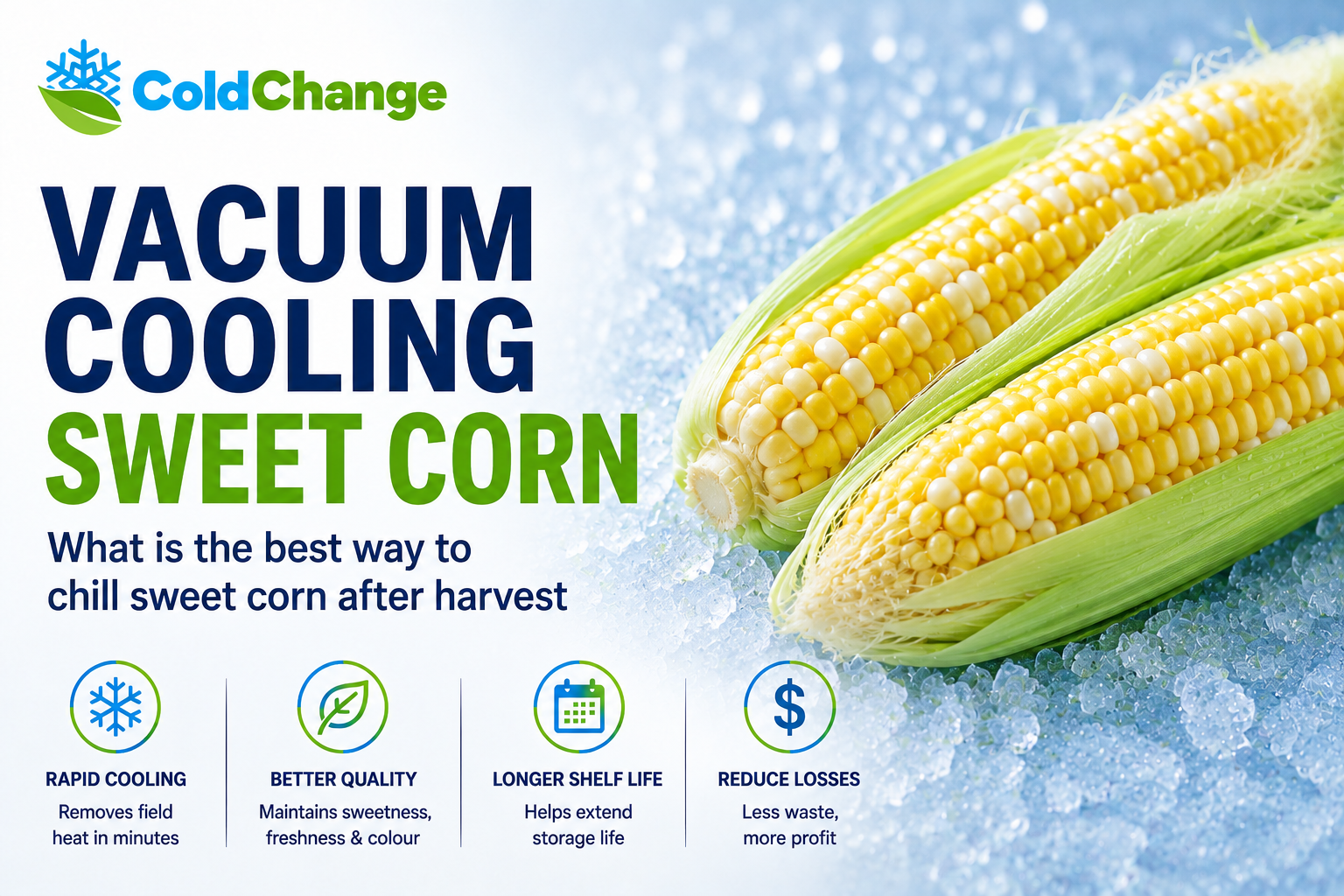
Vacuum Cooling Sweet Corn – Rapid Post-Harvest Cooling for Fresh Sweetcorn
Vacuum cooling sweet corn is a rapid method of removing field heat from freshly harvested sweetcorn before refrigerated storage, packing and distribution.
Sweet corn is particularly sensitive to temperature after harvest. Once picked, deterioration can occur rapidly, making fast post-harvest cooling an important consideration for commercial sweetcorn growers, farms, packhouses and fresh produce processors.
UC Davis states that rapid removal of field heat and continuous refrigeration are essential for maintaining sweet corn quality, with an optimum storage temperature of approximately 0°C–1.5°C (32°F–34°F) and relative humidity of 95–98%.
Cold Change Group supplies industrial vacuum coolers and complete vacuum cooling systems for growers, farms, packhouses and food processors worldwide.
Why Is Rapid Cooling Important for Sweet Corn?
Freshly harvested sweet corn has a high respiration rate and can deteriorate rapidly if field heat is not removed.
Temperature is particularly important because the sugars that give sweetcorn its flavour can be converted after harvest, with deterioration occurring much faster at higher temperatures.
According to Utah State University Extension, post-harvest temperature management is critical to maintaining sweet corn quality, and harvested ears should be chilled as soon as possible.
UC Davis similarly recommends rapid removal of field heat followed by continuous refrigeration.
Rapid vacuum cooling can therefore provide commercial growers with another method of rapidly reducing product temperature after harvest.
What Is the Best Way to Cool Sweetcorn After Harvest?
Several commercial methods can be used for cooling sweet corn after harvest, including:
Vacuum cooling
Hydrocooling
Top icing
Forced-air cooling
Refrigerated cold storage
The best method depends on the sweetcorn variety, packaging, production volume, starting temperature, required final temperature and distribution process.
Sweet corn is traditionally hydrocooled and/or iced in many commercial operations.
However, Oregon State University specifically states that sweet corn can also be adequately precooled using vacuum cooling.
For suitable commercial operations, a vacuum cooler can therefore provide an alternative rapid pre-cooling method before refrigerated storage and distribution.
How Does Vacuum Cooling Sweet Corn Work?
A vacuum cooling system places harvested sweetcorn inside a sealed vacuum chamber.
Powerful vacuum pumps then reduce the atmospheric pressure inside the chamber.
As the pressure decreases, the boiling point of water also decreases. Moisture can therefore evaporate at a much lower temperature.
Evaporation requires energy.
This energy is taken from the sweet corn as heat, causing the temperature of the product to fall rapidly.
This process is known as vacuum cooling or vacuum pre-cooling.
For sweet corn specifically, Oregon State University recommends that the product is wetted before vacuum cooling, followed by top icing where appropriate.
This is important because the cooling process should be designed specifically around the characteristics of sweet corn rather than simply applying the same cooling process used for another vegetable.
How Fast Can Sweet Corn Be Vacuum Cooled?
Cooling performance depends on:
Starting product temperature
Required final temperature
Weight per pallet
Number of pallets
Packaging
Product moisture
Vacuum pump capacity
Refrigeration capacity
Required production throughput
Oregon State University provides a useful commercial example.
Its guidance states that crated sweet corn can be vacuum cooled from approximately 85°F (29°C) to 40°F (4.4°C) in around 30 minutes when the process is correctly carried out.
This demonstrates why industrial vacuum cooling can be particularly interesting for commercial sweetcorn growers requiring rapid removal of field heat.
Benefits of Pre-Cooling Sweet Corn
Rapid pre-cooling can provide several advantages for commercial sweetcorn operations.
Rapid Removal of Field Heat
Sweet corn can be harvested at relatively high temperatures, particularly during warmer weather.
A dedicated vacuum cooler can rapidly remove this initial field heat before refrigerated storage.
Maintaining Sweet Corn Quality
Temperature management is one of the most important factors affecting sweetcorn after harvest.
Rapid cooling followed by appropriate refrigerated storage helps growers establish temperature control as soon as possible.

Protecting Sweetness
One of the biggest reasons for cooling sweet corn quickly is to slow the deterioration that occurs after harvest.
Utah State University notes that standard sugary sweetcorn varieties can lose sweetness particularly rapidly when held at high temperatures.
Rapid pre-cooling and correct refrigerated storage are therefore important parts of maintaining product quality.
Improved Cold Chain Management
Using vacuum pre-cooling before refrigerated storage allows the initial field heat to be removed before the sweetcorn moves further through the supply chain.
High-Volume Commercial Cooling
An industrial vacuum cooler can be designed around the actual production throughput of a commercial sweetcorn farm or packhouse.
This allows machine capacity to be selected according to kilograms or tonnes per hour rather than simply the number of pallets that fit inside the chamber.
Sweet Corn Vacuum Cooling for Commercial Growers
A commercial sweet corn vacuum cooler should be selected around the actual cooling duty.
Important information includes:
Sweetcorn weight per pallet
Pallets per cycle
Starting temperature
Required final temperature
Required cooling time
Cycles per hour
Total tonnes per hour
Packaging configuration
Harvest temperature
Operating hours per day
Available electrical supply
Using this information, Cold Change Group can calculate the appropriate chamber capacity, refrigeration system and vacuum pump configuration.
Sweet Corn Cooling and Sugar Loss
Temperature management is particularly important for sweetcorn because sweetness can deteriorate rapidly after harvesting.
Oklahoma State University reports that at 86°F (30°C), around 60% of sugar may be converted to starch within 24 hours, compared with only around 6% at 32°F (0°C).
The university therefore recommends cooling sweet corn towards 32°F as rapidly as practical after harvest.
This demonstrates why rapid sweet corn cooling is more than simply a storage consideration.
It directly relates to protecting the characteristics that determine the commercial quality of the crop.
Optimum Storage Temperature for Sweet Corn
UC Davis recommends an optimum storage temperature for sweet corn of approximately:
0°C–1.5°C (32°F–34°F)
with an optimum relative humidity of:
95–98%
UC Davis also notes that standard sweet corn has a relatively short storage life even under ideal conditions.
For growers, this means cooling needs to happen rapidly rather than relying on cold storage to gradually reduce the temperature over many hours.
A commercial vacuum cooling system can perform the initial pre-cooling stage before refrigerated storage maintains the required temperature.
Vacuum Cooling vs Cold Room Cooling
A cold room and a vacuum cooler perform different jobs.
Cold rooms are primarily designed to maintain refrigerated product temperatures.
When freshly harvested warm sweetcorn enters a cold room, however, the refrigeration system must gradually remove the field heat from the product.
A vacuum cooler is specifically designed for rapid pre-cooling.
A commercial sweetcorn operation could therefore use a process such as:
Harvest → Wetting → Vacuum Pre-Cooling → Top Icing → Refrigerated Storage → Refrigerated Distribution
The exact process should be selected according to the product, packaging and destination market.
Vacuum Cooling vs Hydrocooling Sweet Corn
Hydrocooling is already widely used for sweet corn.
It works by passing chilled water over or around the harvested product, rapidly transferring heat from the corn into the cooling water.
Cold Change Group also supplies hydro cooling systems for suitable fresh produce applications, including sweetcorn.
Vacuum cooling uses a different process, relying on evaporation under reduced atmospheric pressure to remove heat.
Interestingly, Oregon State University’s commercial guidance states that packaged sweet corn can be cooled more rapidly by vacuum cooling than by hydrocooling for the same temperature reduction under the conditions described in its guidance.
The correct technology should therefore be selected according to the specific sweetcorn operation rather than assuming one cooling method is best for every grower.
Vacuum Cooling vs Forced-Air Cooling
Forced-air refrigeration uses refrigerated air drawn through or around packaged produce.
It can be used for many fresh produce applications but may require significantly longer cooling times for sweetcorn.
Utah State University notes that air cooling is common but may take 24–48 hours for sweet corn ears to become sufficiently chilled, making rapid pre-cooling technologies particularly relevant for commercial operations where time is critical.
A vacuum cooling system is specifically designed for much faster removal of field heat.
Choosing a Vacuum Cooler for Sweet Corn
The correct vacuum cooler should be selected according to production throughput rather than simply chamber dimensions.
Cold Change Group considers:
Product: Sweet corn / sweetcorn
Weight per pallet: How many kilograms of sweetcorn are loaded onto each pallet?
Pallets per cycle: How many pallets need to be cooled simultaneously?
Starting temperature: What temperature is the sweetcorn when harvested?
Required final temperature: What temperature should the product reach?
Cooling time: How quickly must the temperature reduction be achieved?
Hourly throughput: How many tonnes need to be cooled every hour?
Operating hours: How many hours per day will the system operate?
This information allows the industrial vacuum cooling equipment to be designed around the actual production requirement.
Vacuum Cooler Sizes for Sweet Corn
Cold Change Group manufactures vacuum cooling equipment ranging from compact single-pallet machines through to large industrial multi-pallet installations.
Single Pallet Vacuum Cooler
The Single Pallet Vacuum Cooler provides a compact solution for smaller commercial operations.
2 Pallet Vacuum Cooler
The 2 Pallet Vacuum Cooler provides additional capacity for growers requiring a compact multi-pallet system.
4 Pallet Vacuum Cooler
The 4 Pallet Vacuum Cooler provides increased batch capacity for commercial growers and packhouses.
6 Pallet Vacuum Cooler
The 6 Pallet Vacuum Cooler provides additional throughput for larger fresh produce operations.
8 Pallet Vacuum Cooler
The 8 Pallet Vacuum Cooler provides substantial commercial batch capacity.
10 Pallet Vacuum Cooler
The 10 Pallet Vacuum Cooler is designed for high-volume commercial fresh produce cooling.
12 Pallet Vacuum Cooler
The 12 Pallet Vacuum Cooler provides high-volume cooling capacity for larger growers and packhouses.
14 Pallet Vacuum Cooler
The 14 Pallet Vacuum Cooler provides substantial batch capacity for major commercial operations.
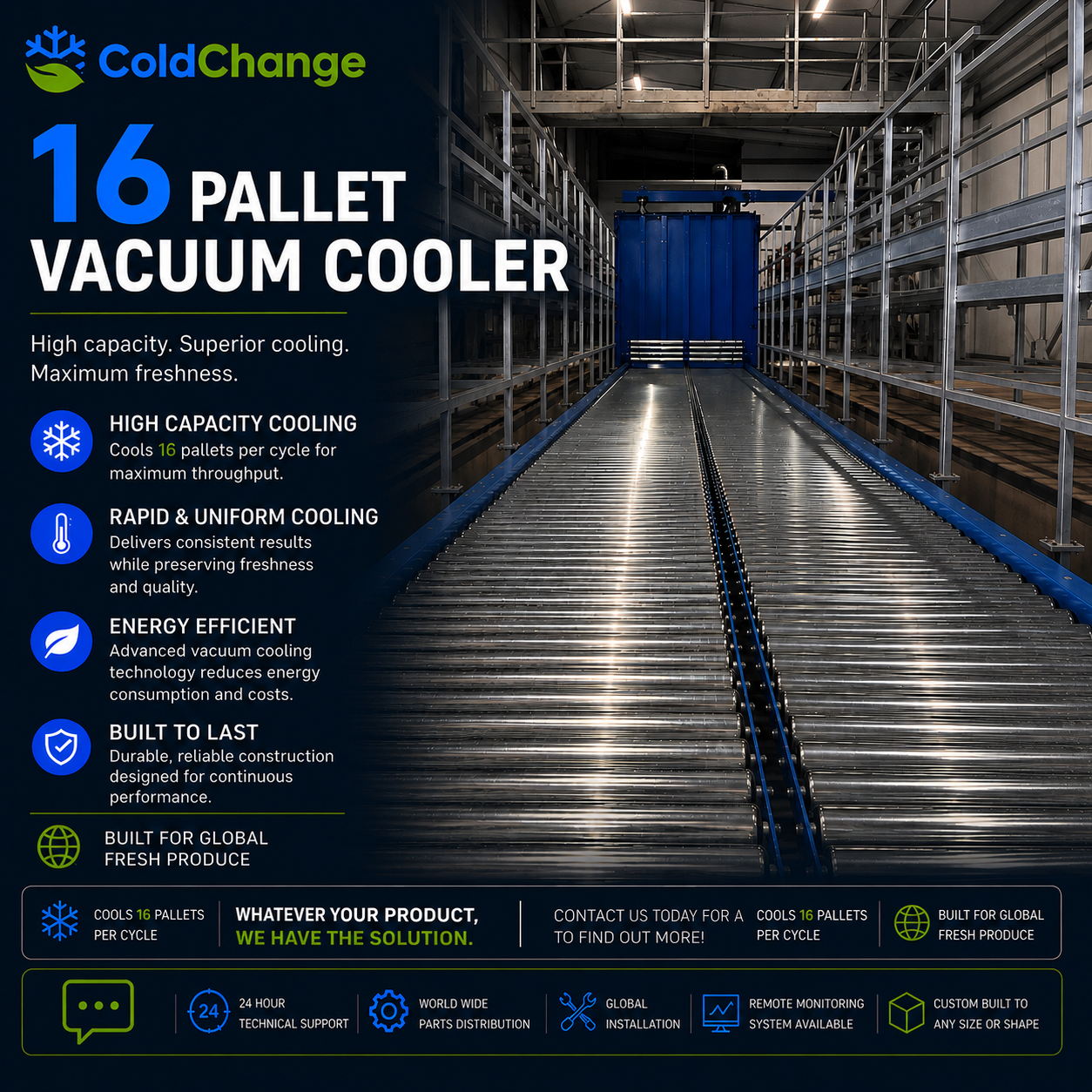
16 Pallet Vacuum Cooler
The 16 Pallet Vacuum Cooler is designed for high-throughput fresh produce cooling.
18 Pallet Vacuum Cooler
The 18 Pallet Vacuum Cooler provides very high batch capacity for large commercial packhouses.
20 Pallet Vacuum Cooler
The 20 Pallet Vacuum Cooler provides industrial-scale cooling capacity for major growers and processors.
The correct machine size should always be calculated according to product weight, temperature reduction, cooling time and required tonnes per hour.
Cooling Sweet Corn for Long-Distance Distribution
Rapid cooling becomes particularly important when sweet corn is being transported to distant markets.
Oklahoma State University recommends that sweet corn intended for distant markets should be precooled to remove field heat and maintained under refrigeration throughout distribution.
This makes post-harvest cooling part of the entire logistics process rather than simply an operation performed at the packhouse.
For exporters and large commercial growers, a vacuum pre-cooling system can therefore form the first stage of a temperature-controlled distribution chain.
Cooling Sweet Corn for Export
Sweetcorn exported internationally may spend significantly longer in the supply chain than locally sold produce.
Maintaining temperature therefore becomes even more important.
A commercial process may include:
Harvest → Pre-Cooling → Packing → Refrigerated Storage → Refrigerated Transport → Distribution → Retail
Rapid removal of field heat at the beginning of this process helps establish the cold chain sooner.
Cold Change Group supplies industrial vacuum coolers internationally for fresh produce growers, farms and packhouses across the UK, Europe, Australia, New Zealand, USA, Canada, South America, Asia, Africa and the Middle East.
Other Products That Can Be Vacuum Cooled
Sweet corn is one of many products that can be considered for industrial vacuum cooling.
Cold Change Group’s current vacuum-cooling range specifically identifies sweetcorn as a vacuum-cooling application, alongside numerous other fresh produce products.
Other applications include:
Celery
Asparagus
Sprouts
Basil
Leeks
Green onions
Turf
This can make an industrial vacuum cooler particularly useful for farms and packhouses producing several different crops throughout the year.
Frequently Asked Questions About Cooling Sweet Corn
Can Sweet Corn Be Vacuum Cooled?
Yes. Oregon State University specifically states that sweet corn can be adequately precooled by vacuum cooling, with the recommendation that the corn is wetted first and top iced after cooling.
Cold Change Group also currently lists sweetcorn among the applications for its industrial vacuum cooling range.
Why Does Sweet Corn Need to Be Cooled Quickly?
Sweet corn deteriorates rapidly after harvest, particularly at high temperatures.
Rapid removal of field heat helps establish the cold chain and slows the deterioration of product quality and sweetness.
What Temperature Should Sweet Corn Be Stored At?
UC Davis recommends approximately 0°C–1.5°C (32°F–34°F) with 95–98% relative humidity.
How Fast Can Sweet Corn Be Vacuum Cooled?
Actual cooling time depends on the starting temperature, final temperature, product weight, packaging and machine specification.
Oregon State University reports an example in which crated sweet corn can be vacuum cooled from approximately 85°F to 40°F in around 30 minutes.
Should Sweet Corn Be Wetted Before Vacuum Cooling?
Yes. Oregon State University’s guidance specifically states that sweet corn should be wetted before vacuum cooling and top iced afterwards.
The exact commercial process should be designed around the grower’s product, packaging and distribution requirements.
Is Vacuum Cooling Better Than Hydrocooling for Sweet Corn?
Both technologies can be used for sweet corn.
Hydrocooling is widely used commercially, while vacuum cooling provides another rapid pre-cooling option.
Oregon State University notes that under the conditions described in its guidance, vacuum cooling packaged corn can achieve the same temperature reduction faster than hydrocooling.
Cold Change Group supplies both vacuum cooling systems and hydro cooling equipment, allowing the technology to be selected around the individual application.
Can One Vacuum Cooler Be Used for Sweet Corn and Other Vegetables?
Potentially, yes.
A suitably specified vacuum cooling system can potentially be used for several compatible crops, including sweetcorn, lettuce, mushrooms, broccoli, cauliflower, leafy vegetables, celery, asparagus and herbs.
What Size Vacuum Cooler Do I Need for Sweet Corn?
The correct machine depends on:
Pallets per cycle
Weight per pallet
Starting temperature
Required final temperature
Required cooling time
Total hourly throughput
Cold Change Group can select the appropriate industrial vacuum cooler around these requirements.
Looking for a Vacuum Cooler for Sweet Corn?
If you are a sweet corn grower, vegetable producer, fresh produce packhouse or food processor looking for a rapid method of removing field heat after harvest, Cold Change Group can design a vacuum cooling system around your production requirements.
From compact single-pallet machines to large industrial installations, our vacuum coolers can be specified according to your product weight, pallet configuration, starting temperature, required final temperature and production throughput.
Explore the Cold Change Group industrial vacuum cooler range to find the right solution for your sweetcorn cooling requirements.
For independent technical information specifically confirming the use of vacuum cooling for sweet corn, see the Oregon State University guidance on post-harvest sweet corn cooling.
Additional post-harvest temperature and storage guidance is available from the UC Davis Postharvest Research and Extension Center.


