

12 Pallet Eco Vacuum Cooler
The 12 Pallet Eco Vacuum Cooler is intended for high-throughput produce and food operations that need substantial batch capacity while placing greater emphasis on part-load efficiency, controlled evacuation and project-specific equipment selection.
Compare this configuration with the standard 12 Pallet Vacuum Cooler using the same product, pallet load, temperature targets and production schedule.
Designed around the real cooling duty
Eco configuration is not based on a single headline energy figure. The vacuum system, refrigeration duty and control strategy are selected around the actual product, pallet loading, starting temperature, required final temperature, packaging and target cycles per hour.
Eco engineering focus
- Variable-speed vacuum pumping so pump output can follow the evacuation profile instead of relying on fixed full-speed operation throughout every stage
- Application-matched refrigeration capacity rather than oversizing without reference to the real product load
- PLC/HMI recipes for repeatable batch control across different products and seasons
- Review of electrical supply, ambient design conditions and expected daily operating hours
- Commissioning around measured product temperature and cycle performance
Typical project considerations
A twelve-pallet system is generally considered where a packhouse needs a meaningful step up in batch throughput without moving immediately to the very largest chamber formats. Final chamber arrangement, door configuration, loading method and plant selection depend on pallet dimensions, site flow and required cycle frequency.
Options for automated handling
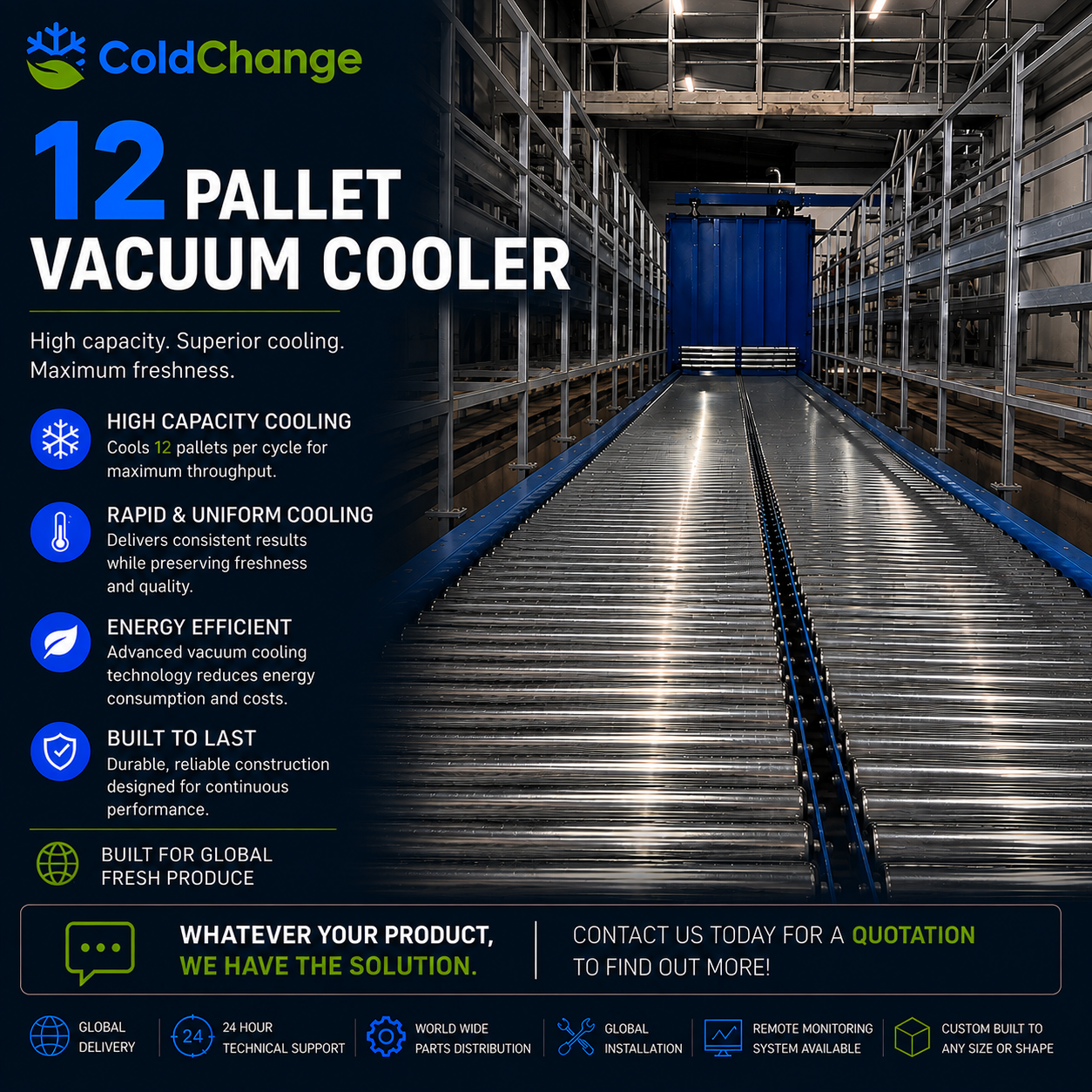
For this capacity class, two-door flow-through arrangements and conveyor integration can be evaluated where the packing line requires continuous or semi-automated pallet movement. Conveyor length, drive arrangement and interface controls are defined as part of the project rather than assumed from a standard layout.
Performance must be application-specific
Final performance is confirmed against the product and process duty. Cold Change will not publish a fixed percentage energy-saving claim for the Eco range without supporting evidence for the exact duty and configuration. The engineering objective is to reduce unnecessary pump and refrigeration consumption while maintaining the required cooling result and cycle repeatability.
The 12 Pallet ECO Vacuum Cooler is a high-capacity configuration for packhouses and food operations that need substantial batch throughput while assessing pump control, refrigeration duty and material flow against the real production schedule. The chamber, vacuum pumps, refrigeration system and controls are selected as one project-specific system rather than from a fixed energy-saving percentage.
Where the 12-pallet ECO configuration fits
This capacity can suit sites that routinely assemble large batches, want to reduce queueing between harvest and cooling, or need a practical step between medium and very large chamber formats. Selection should be based on usable pallets per cycle, batch arrival pattern, required product temperature, cycle frequency and the time available for loading and unloading.
The direct comparison is the standard 12 Pallet Vacuum Cooler. Both should be evaluated using the same product load, starting temperature, target temperature, operating hours and site utilities. The ECO option is most relevant where variable duty, part-load operation or the required control strategy makes variable-speed pumping worth evaluating.
Variable-speed pumping and refrigeration matching
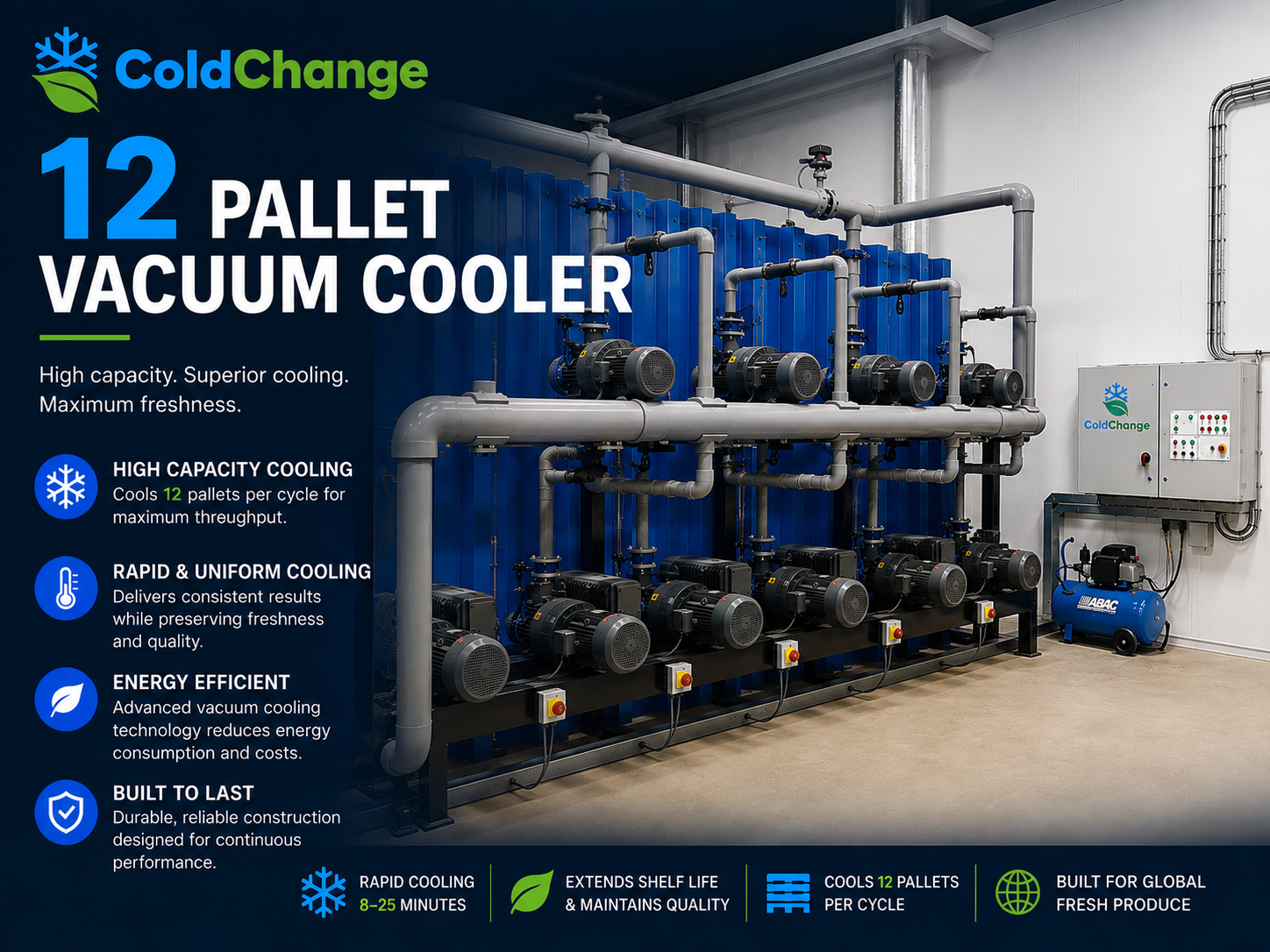
The ECO configuration uses variable-speed vacuum pumping so pump output can be controlled through the evacuation profile instead of assuming fixed full-speed operation at every stage. The result depends on the complete duty: product moisture behaviour, gross batch mass, packaging airflow, chamber leakage, ambient conditions, refrigeration capacity and the number of cycles required per hour or shift.
Refrigeration duty is matched to the intended batch and cycle requirement. Oversizing one part of the system does not guarantee a better cooling result, so the vacuum and refrigeration packages are assessed together. Cold Change does not apply a universal energy-saving or cycle-time claim; those figures require project data and, where needed, product trials.
Batch control and repeatability
PLC and HMI controls can support validated recipes for different crops, incoming temperatures or seasonal conditions. Recipe control helps operators reproduce the agreed process while allowing commissioning adjustments for the real product. Required languages, user access levels, data recording, alarms and wider line interfaces should be identified during specification.
For mixed production, the engineering review should distinguish between a full twelve-pallet batch, partial loads and product changeovers. A machine chosen only around maximum chamber capacity may not reflect the way the site actually operates.
Applications to assess
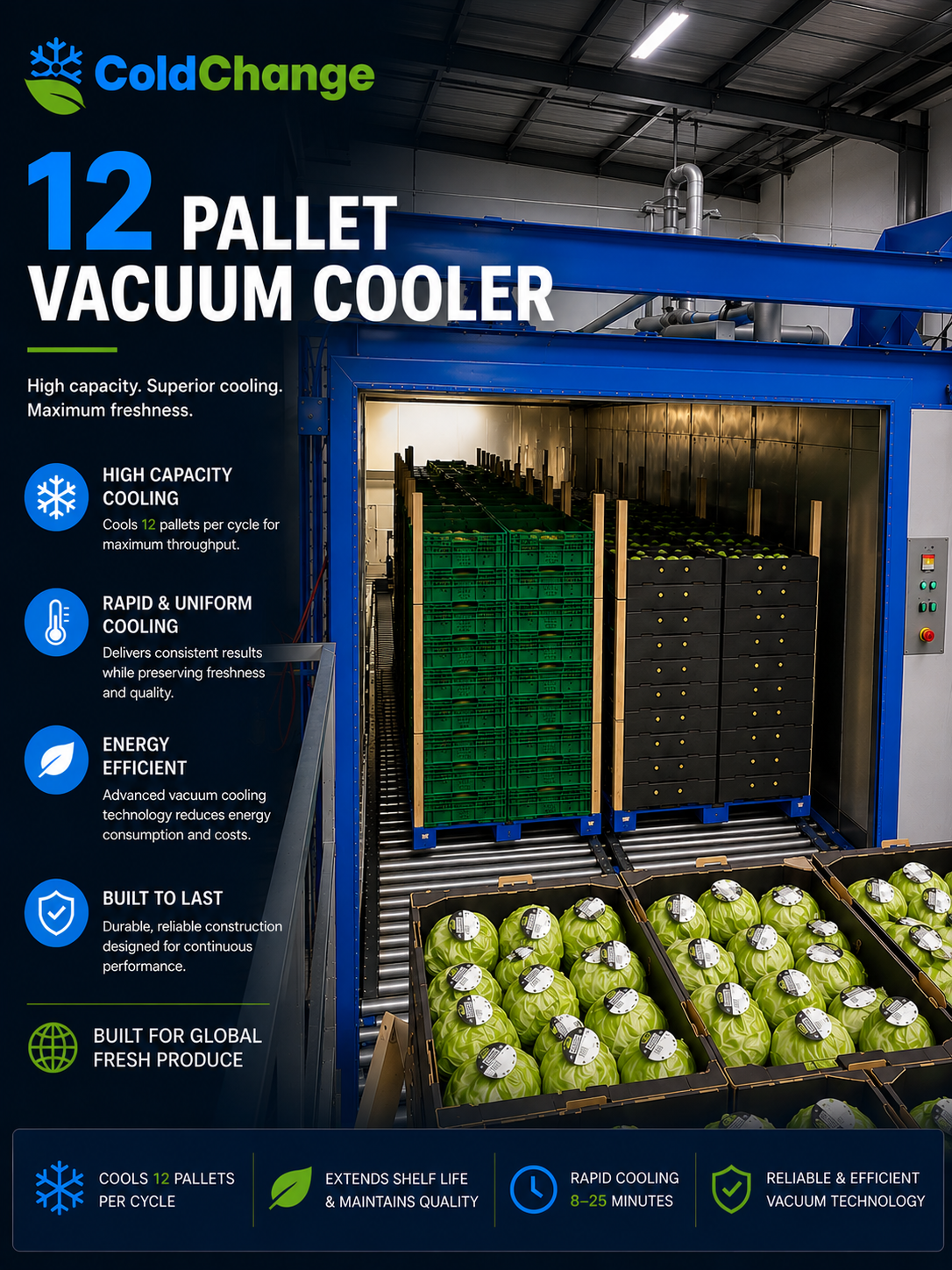
Vacuum cooling can be evaluated for suitable produce and materials that release moisture under reduced pressure. Depending on crop condition, packaging and quality objectives, relevant applications may include mushrooms, lettuce, broccoli, cauliflower, celery, cut flowers and turf. Product suitability must be confirmed against the actual crop, pack style, moisture condition and target result.
Doors, conveyors and packhouse flow
At twelve-pallet scale, loading and unloading can materially affect effective throughput. A single-door arrangement may suit sites where pallets enter and leave from the same area. A two-door flow-through layout can be assessed where separating warm and cooled product supports the building flow. Conveyor integration may also be considered for semi-automated or automated handling.
Conveyor length, pallet type, transfer height, drive arrangement, accumulation logic, guarding and interface controls are project inputs. They are not assumed from chamber capacity alone. Forklift access, door clearance and the space needed to marshal twelve pallets should be checked before the final layout is agreed.
Capacity planning
Nominal pallet count is only one part of selection. Compare the arrival pattern with the total time for loading, evacuation, cooling, pressure recovery and unloading. If batches are commonly smaller, review the 10 Pallet ECO Vacuum Cooler. If twelve pallets would create a production bottleneck during peak periods, compare the 14 Pallet ECO Vacuum Cooler. The best size is the one that fits the normal and peak production pattern without relying on unsupported assumptions.
Project information required
- Product or crop, packaging type and moisture condition
- Pallet footprint, load height, typical and maximum pallet weight
- Normal and peak pallets per hour or shift
- Incoming and target product temperatures
- Required cycle window and permitted product-temperature variation
- Site voltage, frequency, ambient design conditions and utility constraints
- Single-door or flow-through handling requirement
- Forklift, pallet-truck or conveyor loading arrangement
- Control languages, data, alarm and remote-support requirements
Request a project-specific quotation for the 12 Pallet ECO Vacuum Cooler. Final performance, energy use and equipment selection are confirmed from the supplied process and site data.


Valoraciones
No hay valoraciones aún.